
How to Size Solar Recharge for a Home Battery During an Extended Outage
Date: 2026-09-27 Categories: Blog Hits: 186
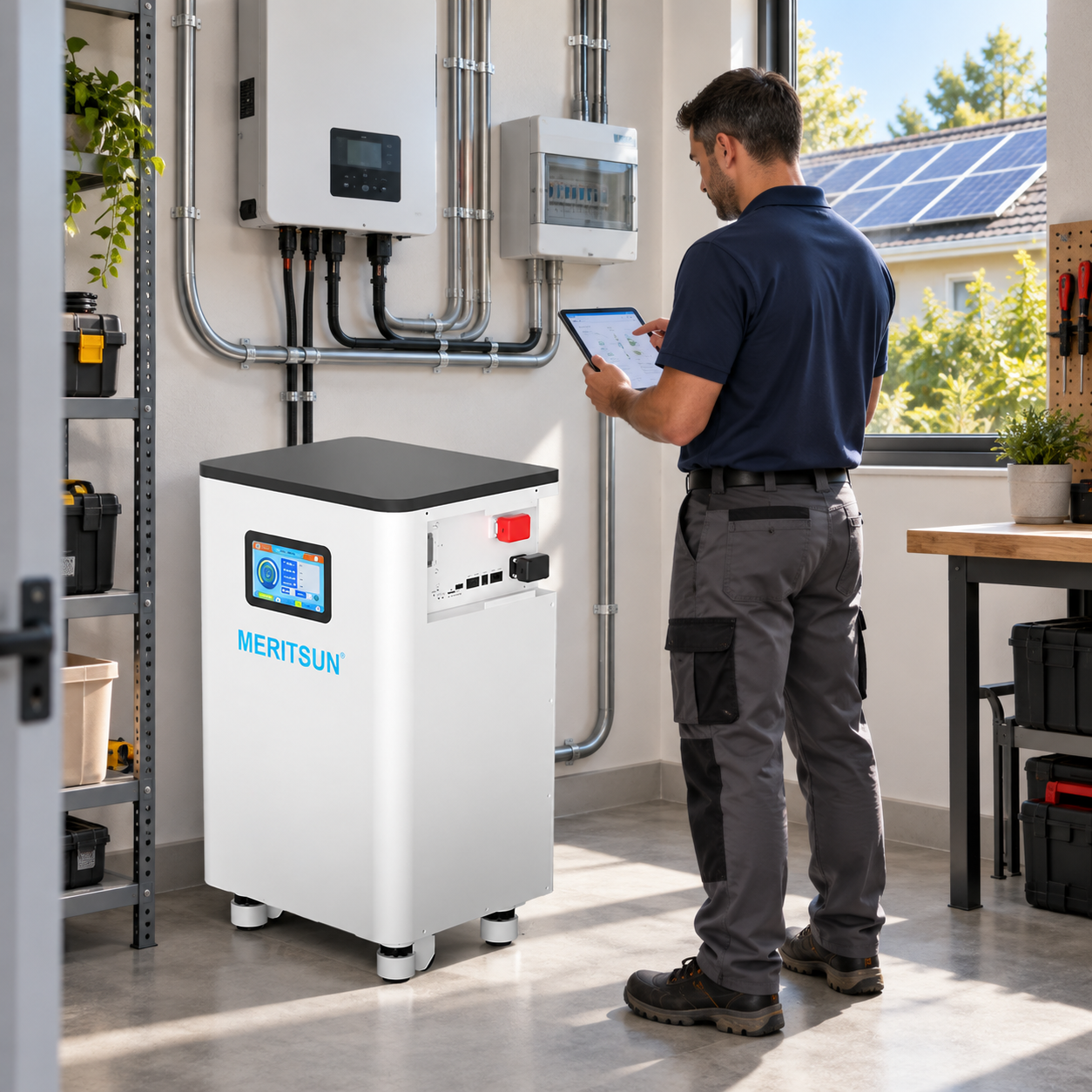
The PV array needed to recharge a home battery cannot be calculated from battery capacity alone. Add the battery energy that must be restored to the home’s daytime load energy, then adjust for the design-season solar resource and system losses. Finally, verify that the inverter, MPPT, battery and backup architecture can actually accept and use that charging power while the grid is down.
A 16 kWh battery may recover in one solar day at one home and fail to recover at another. Starting state of charge, clouds, array orientation, daytime air-conditioning, battery charge limits and island-mode controls can change the result more than the number printed on the battery cabinet.
Battery kWh is only one input
The project needs to answer two different questions:
- Energy question: How many kilowatt-hours must the PV system produce during the recovery window?
- Power question: Can the PV, inverter/charger and battery transfer that energy fast enough while supporting live loads?
The energy calculation establishes the daily requirement. The power review finds bottlenecks that a daily kWh estimate can miss.
| Input | Unit | What it changes |
|---|---|---|
| Battery energy to restore | kWh | Base recharge requirement |
| Daytime load energy | kWh | Solar energy used before the battery is refilled |
| Equivalent full-sun hours | hours/day | Converts daily energy into approximate array size |
| PV/system derating | percentage | Accounts for temperature, shading, wiring, mismatch and other losses |
| PV-to-battery charge limit | kW or A | Caps instantaneous charging power |
| Minimum and target SOC | percentage | Defines how much battery energy must be restored |
The basic solar-recharge calculation
For a preliminary estimate:
Battery energy to restore = nominal battery energy × (target SOC − starting SOC)
Required solar energy = battery energy to restore + daytime load energy + conversion/system losses
A simplified array-size equation is:
Approximate PV array size = required daily energy ÷ design-season sun hours ÷ system performance factor
The performance factor is lower than 1.0. It represents the share of nameplate solar energy expected to reach the required loads and charging path after relevant losses. It should come from a defensible site model—not a universal percentage copied from another project.
Illustrative example: a 16 kWh battery
Assume a project starts at 25% SOC and targets 90% SOC before the next night:
- Nominal battery energy: 16 kWh
- Energy fraction to restore: 90% − 25% = 65%
- Battery energy to restore: 16 × 0.65 = 10.4 kWh
- Daytime loads during the recovery window: 5.0 kWh
- Total before derating: 15.4 kWh
- Design-season equivalent full-sun hours: 4.0
- Preliminary system performance factor: 0.80
Approximate PV array = 15.4 ÷ 4.0 ÷ 0.80 = 4.81 kW
This 4.81 kW result is an energy-balance estimate, not a final system size or a guaranteed one-day recharge. The designer still needs to check hourly weather, array orientation, shading, inverter clipping, island-mode operation, battery current limits and load peaks. Design margin may also be required for seasonal uncertainty and consecutive cloudy days.
Five variables that control recharge time
1. Starting SOC and target SOC
Recharging from 60% to 90% is a different task from recovering from 10% to 100%. The starting and target values should reflect the operating strategy, not an assumed full discharge and full recharge every day.
2. Daytime household loads
During an outage, solar energy normally serves active loads before surplus energy reaches the battery. Cooling, pumps, refrigeration, cooking and home-office equipment can consume a large part of the midday PV window.
3. Design-season solar resource
Annual average production can hide the month that matters most. A storm-season resilience project, a winter heating project and a summer cooling project may require different design periods. Use location-specific monthly or hourly solar data.
4. System losses and operating conditions
Module temperature, soiling, shading, snow, wiring, mismatch, inverter efficiency and availability affect PV energy. Battery conversion and auxiliary consumption add further losses that may not be included in a basic PV estimate.
5. Charge-power limits
Even a large PV array cannot force unlimited power into the battery. The MPPT, hybrid inverter, battery BMS, DC conductors and protection all impose limits. A battery may also reduce charge current because of SOC, temperature or protection logic.
Why nameplate PV output is not available all day
A 6 kW array does not produce 6 kW continuously from sunrise to sunset. Output follows irradiance and is affected by orientation, tilt, temperature, shading and inverter limits. The useful charging window can be much shorter than the daylight period.
NREL’s PVWatts Calculator estimates the energy production of grid-connected PV systems using location, array and loss inputs. It is useful for preliminary solar-resource and production estimates, including downloadable hourly results. It does not by itself prove how a specific hybrid inverter will behave in island mode or how household loads will be prioritized during an outage.
For extended-outage design, combine the PV production profile with:
- an hourly load profile;
- the battery’s SOC window and charge limits;
- the inverter’s off-grid PV operating rules;
- curtailment and export-control behavior;
- generator logic, if used;
- the expected sequence across multiple days.
Check the PV-to-battery charging path
The charging path may be DC-coupled, AC-coupled or integrated in an all-in-one system. Each architecture has different outage behavior.
| Architecture | Key outage question |
|---|---|
| DC-coupled PV and battery | Can the MPPT continue charging in island mode, and what are its voltage/current limits? |
| AC-coupled PV | Can the backup inverter form a stable grid for the PV inverter, and how is excess production controlled? |
| All-in-one hybrid system | What PV input, battery charge and backup-load limits apply simultaneously? |
| Generator-assisted hybrid | Which source has priority, and can generator and PV charging operate together? |
Do not assume that a grid-tied solar array will operate during a utility outage. The exact inverter, transfer and control architecture determines whether PV remains available and how it is curtailed.
A seven-step recharge-sizing workflow
Step 1: Define the recovery objective
State the target clearly: restore the battery to a defined SOC by sunset, support daytime loads, prepare for a second outage night, or maintain indefinite off-grid operation under selected conditions.
Step 2: Calculate battery energy to restore
Use nominal energy, starting SOC, target SOC and any model-specific usable-energy limits. If the battery reports usable rather than nominal energy, avoid counting the same reserve twice.
Step 3: Build the daytime load budget
Estimate energy by circuit and operating schedule. Include loads that may cycle, such as refrigeration and cooling, as well as constant loads such as networking, security and controls.
Step 4: Model design-season PV production
Use a location-specific tool such as NREL PVWatts for preliminary production estimates. Review monthly and hourly data rather than relying only on an annual total.
Step 5: Apply relevant system losses
Document the losses included in the PV model and add battery-side or auxiliary losses separately where appropriate. Avoid one unexplained “efficiency” number for the entire system.
Step 6: Check instantaneous power limits
Verify maximum PV input, MPPT current, inverter charge power, battery charge current, BMS limits and concurrent backup-load demand. The lowest active limit controls the actual recharge rate.
Step 7: Test the multi-day operating sequence
Run at least a clear-day, cloudy-day and consecutive-low-solar scenario. Define when nonessential loads are shed, when a generator starts and what minimum SOC is protected for overnight loads.
What changes on the second cloudy day?
The first outage night is often an energy-capacity problem. The second night becomes a recovery problem.
If the battery reaches morning with a low SOC and PV only covers daytime loads, the system may enter the second night without the planned reserve. A resilient design therefore considers:
- weather uncertainty rather than a single sunny-day profile;
- load reduction during recovery;
- minimum overnight reserve;
- generator availability and fuel logistics, if applicable;
- black-start and restart behavior;
- communications and controls after repeated cycling.
“One day of backup” should be defined by loads, starting SOC and recovery assumptions. It should not be used as an unconditional product promise.
Load priority during solar recovery
A practical recovery sequence may prioritize:
- controls, communications and safety systems;
- refrigeration and essential lighting;
- water supply or medical/operational loads defined by the owner;
- battery recharge to a minimum overnight reserve;
- discretionary cooling, laundry, water heating or EV charging;
- additional battery charging toward the normal target SOC.
The sequence must reflect the actual home and customer agreement. Automatic load control can improve consistency, but its communications, override and failure behavior must be commissioned.
B2B RFQ checklist for recharge-resilient systems
Installers and EPCs should provide:
- project city and country;
- backup objective and design season;
- existing and proposed PV DC capacity;
- module orientation, tilt and known shading;
- PV inverter or hybrid inverter model;
- MPPT voltage/current limits;
- battery model, quantity, nominal energy and SOC window;
- battery maximum charge current and BMS communication method;
- hourly or scheduled daytime and overnight loads;
- 240V or motor-starting loads, where applicable;
- desired recovery time or target SOC by sunset;
- generator model and operating logic, if used;
- grid-connected, hybrid or off-grid architecture;
- installation environment and local approval requirements.
Without these inputs, “How many solar panels do I need?” can only receive a rough estimate.
Frequently asked questions
Can solar recharge a home battery while the grid is down?
Yes, if the inverter and system architecture support PV operation and battery charging in island mode. Many standard grid-tied PV systems shut down during an outage unless they are part of an approved backup architecture.
How long does it take to recharge a 16 kWh battery with solar?
There is no fixed answer. Recharge time depends on starting and target SOC, available PV power, daytime loads, weather, losses and equipment charge limits. Use an hourly project model for a defensible estimate.
Does a larger PV array always charge the battery faster?
Only until another limit is reached. The MPPT, inverter, battery charge-current limit, BMS, temperature or live loads may cap the power available for charging.
What limits battery charging power?
Common limits include PV production, MPPT input, hybrid-inverter charge power, battery current, BMS commands, SOC, temperature, cabling and protective devices. The active limit can change during the day.
Should daytime household loads be included?
Yes. Loads operating during the solar window use energy that might otherwise recharge the battery. They should be included by time of day, not only as a daily average.
How do clouds and seasonal sun hours change the result?
They reduce and redistribute available PV energy. Use the design month and hourly weather data, then test low-solar scenarios if backup depends on next-day recharge.
Can a generator and solar recharge the battery together?
Some hybrid systems support coordinated generator and PV charging; others impose source priorities or power limits. Verify the exact inverter, generator interface, battery limits and control sequence.
What SOC reserve should remain for the next outage night?
The reserve should be calculated from essential overnight loads, uncertainty in next-day solar production, generator availability and the battery’s operating limits. It is a project setting, not a universal percentage.
Key takeaways
- Battery capacity alone does not determine the required PV array or recharge time.
- Include both battery energy to restore and daytime load energy.
- Use design-season hourly solar data, not only annual production.
- Verify island-mode PV operation and every charge-power bottleneck.
- Test a multi-day sequence with cloudy weather, load priorities and reserve recovery.
Request a MERITSUN solar-recharge assessment
MERITSUN develops LiFePO4 battery solutions for residential, off-grid, commercial and industrial energy-storage applications. For a preliminary recharge-path review, send the city/country, PV array size and orientation, inverter/MPPT model, proposed battery capacity, starting and minimum SOC, daytime and overnight load schedules, target recovery time, generator information, project quantity and procurement timeline through the MERITSUN inquiry page.
MERITSUN can review the available battery-side data and interface questions for the proposed configuration. Final PV sizing, electrical design, outage performance and local approval require project-specific engineering and the approved equipment documentation.
Sources and further reading
- National Renewable Energy Laboratory, PVWatts Calculator. https://pvwatts.nrel.gov/
- National Renewable Energy Laboratory, PVWatts Version 5 Manual, NREL/TP-6A20-62641. https://pvwatts.nrel.gov/downloads/pvwattsv5.pdf
- National Renewable Energy Laboratory, System Advisor Model documentation. https://sam.nrel.gov/
- MERITSUN product portfolio. https://www.meritsunpower.com/products