
Is a Solar Battery Worth Adding Before Winter? Start With the Export Data
Date: 2026-11-09 Categories: Blog Hits: 392
A homeowner can have a high winter electric bill and very little solar energy available to store. Before quoting a battery retrofit, compare what the home exports during daylight with what it buys back after sunset. The smaller of those two amounts, after losses and equipment limits, sets a practical ceiling on how much grid electricity stored solar can replace that day.
In October, DYNAVOLT’s UK blog highlighted the seasonal mismatch between rooftop production and household demand. FranklinWH’s October 30 winter-bill guide approached the issue from the homeowner’s side. For the installer at the kitchen table, the useful question is narrower: What would a battery have changed on this customer’s actual bill?
Read the export column, not just the production total
A solar monitoring app might show 12 kWh generated on a winter day. If the house used 8 kWh as it was generated, only 4 kWh left the property. A battery cannot shift the same solar energy that already ran the heat pump or water heater.
Ask for interval import and export data, preferably covering a full year, along with the applicable purchase rate and export credit. If the meter reports only monthly net use, ask for inverter and consumption data before presenting a savings figure. A monthly net total does not tell you whether a sunny afternoon and a high-use evening occurred on the same day.
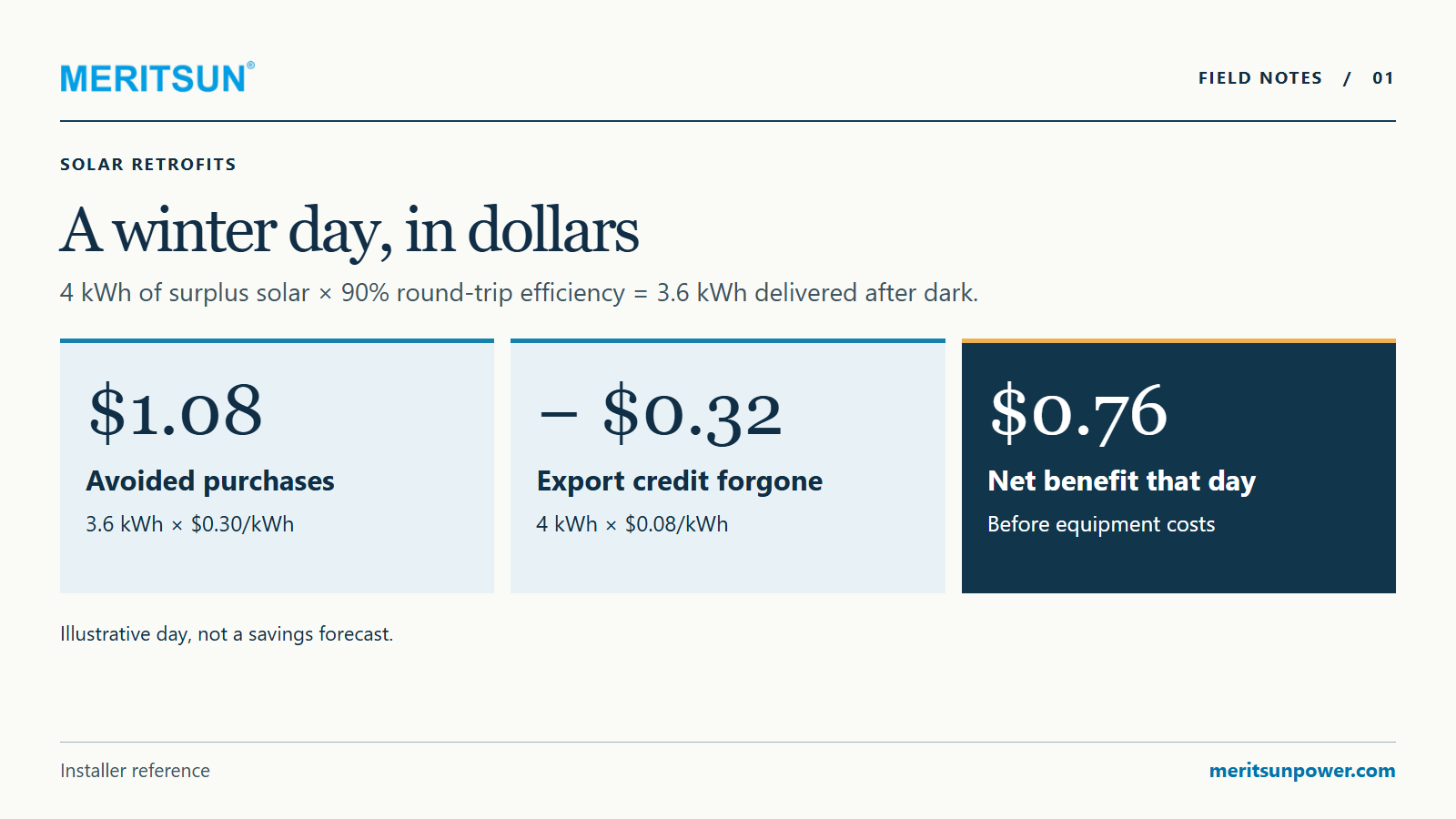
A worked example: the extra capacity that earns nothing that day
Suppose a home exports 4 kWh before sunset and imports 7 kWh that evening. Assume the battery has room to accept the entire surplus, charge and discharge power are sufficient, and AC round-trip efficiency is 90%. At most, 3.6 kWh reaches the evening loads.
| For this illustrative day | Calculation |
|---|---|
| Evening purchases avoided at $0.30/kWh | 3.6 × $0.30 = $1.08 |
| Export credit given up at $0.08/kWh | 4 × $0.08 = $0.32 |
| Difference before equipment cost and other charges | $0.76 |
Both an 8 kWh and a 10 kWh battery could deliver that same result if each had enough available headroom and output. A larger battery may still be worth buying for backup or sunnier months. This one day simply doesn't make the case for it. Don't multiply $0.76 by 365; repeat the calculation against actual seasonal data.
What to put in the retrofit quote
- Start with the no-battery bill. Keep purchase rates, export credits and fixed charges separate.
- Compare two configurations. Run a solar-only charging scenario first. If grid charging is allowed and supported, model it separately using the actual off-peak price.
- Show what backup costs in flexibility. Reserving energy for an outage can leave less available to offset evening purchases. State the reserve assumption next to the savings estimate.
- Check the existing equipment. Record the PV inverter model, proposed battery inverter, metering arrangement and available installation space before ordering.
Installer FAQ
Can I start with annual solar production? Use it for screening, not the final quote. Two homes with identical generation can export very different amounts.
What if the home exports almost nothing in winter? Present backup as a separate objective. Don't count solar-shifting savings where there is no surplus.
What if export credits match retail rates? Recalculate before proposing storage for savings. At equal rates, conversion losses alone can make storing surplus less valuable than exporting it.
Is a utility bill enough to pick the inverter? No. Identify the loads that may run together and their starting requirements separately from the energy estimate.
Which two options should the customer see? Show the smallest configuration that captures most of the modeled surplus and the next size up. State exactly what the extra capacity buys.
Key takeaways
Size for the customer's surplus, not the roof's annual production. Quote backup and bill savings separately so the customer can decide what each is worth.
Planning a retrofit? Send MERITSUN your project details: market, PV inverter model, interval data, import/export rates and the circuits the customer wants backed up. Remove account numbers and service addresses before sharing bills.