
Wall-Mounted vs. Floor-Standing Home Batteries: 9 Checks Installers Should Make
Date: 2026-10-21 Categories: Blog Hits: 240
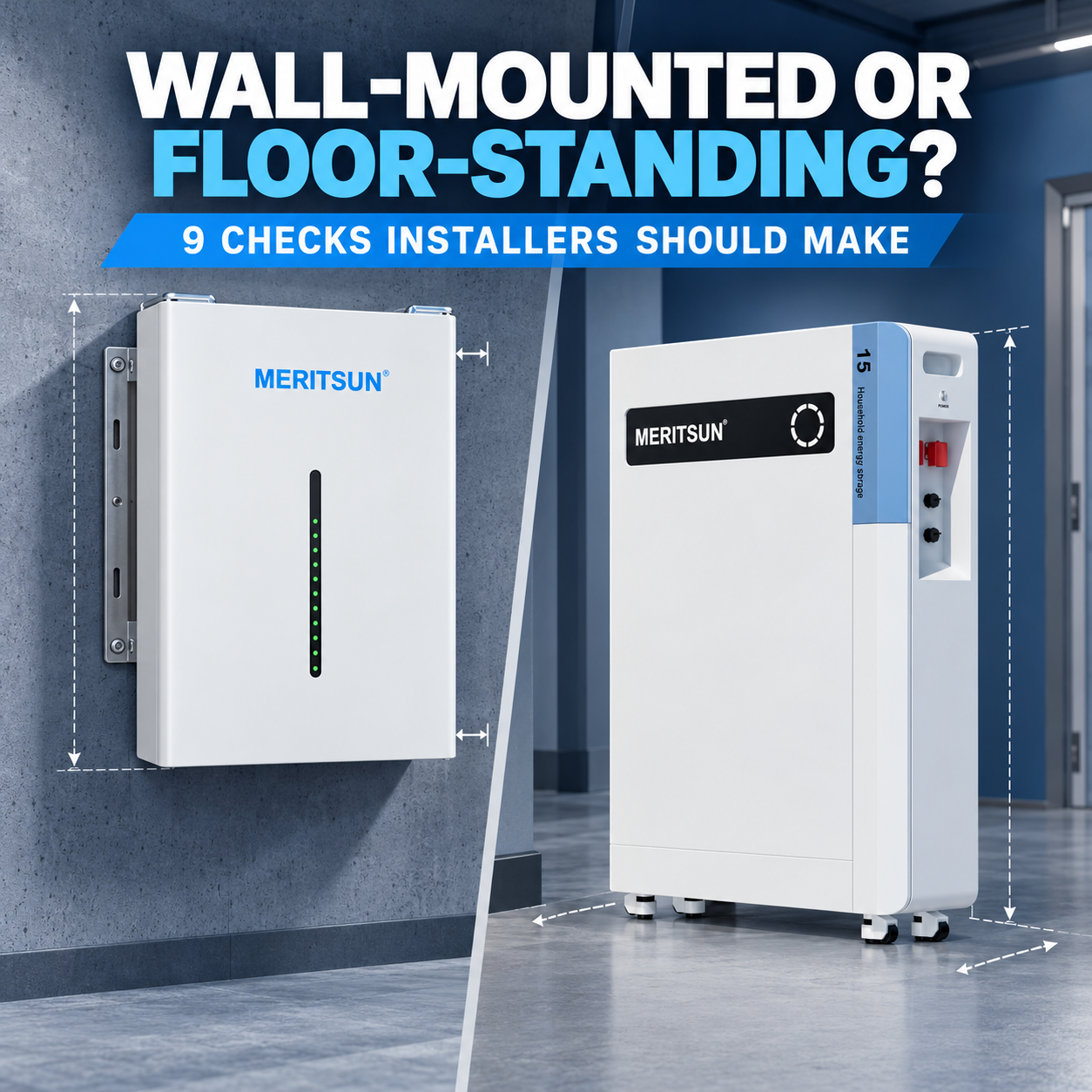
This comparison is written from the installation and project-delivery side: structure, compatibility, service, and handover — not appearance. Final installation and commissioning should be completed by qualified personnel in accordance with the applicable product documentation and local electrical requirements. Relevant MERITSUN examples include wall-mounted battery modules and floor-standing all-in-one systems. Because an all-in-one system also integrates an inverter/charger, installers should compare the electrical architecture separately from the enclosure format.
MERITSUN home energy storage batteries are rated for 8,000 cycles and backed by a 12-year warranty, subject to the applicable product datasheet, operating conditions, and market-specific warranty terms.
Key Terms
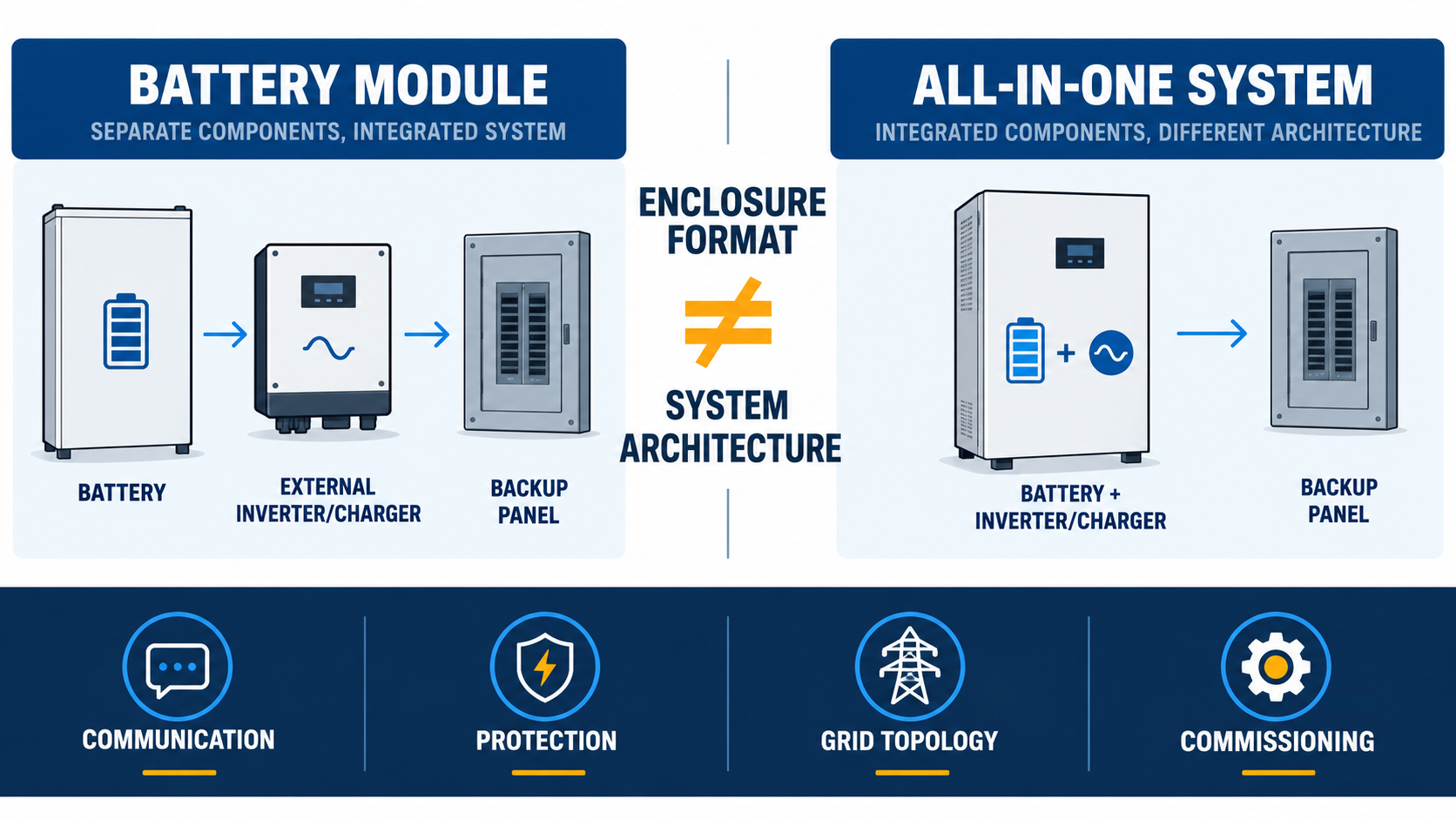
- Battery module — a DC storage unit that requires a compatible inverter, protection devices, and a designed installation. Most wall-mounted and floor-standing LiFePO₄ home batteries, including units on casters, are modules.
- All-in-one (AIO) system — battery and inverter/charger integrated in one enclosure. Integration reduces external wiring; it does not remove the electrical requirements for connecting the system to the premises.
- Supported communication — a documented data link (for example RS485, CAN, or RS232) between battery BMS and inverter, so charge limits, SOC reporting, and protection functions operate as designed.
- Casters — a transport and positioning feature of a floor-standing enclosure. They describe how a unit is moved into place and serviced, not an operating mode for end users.
The 9 Checks
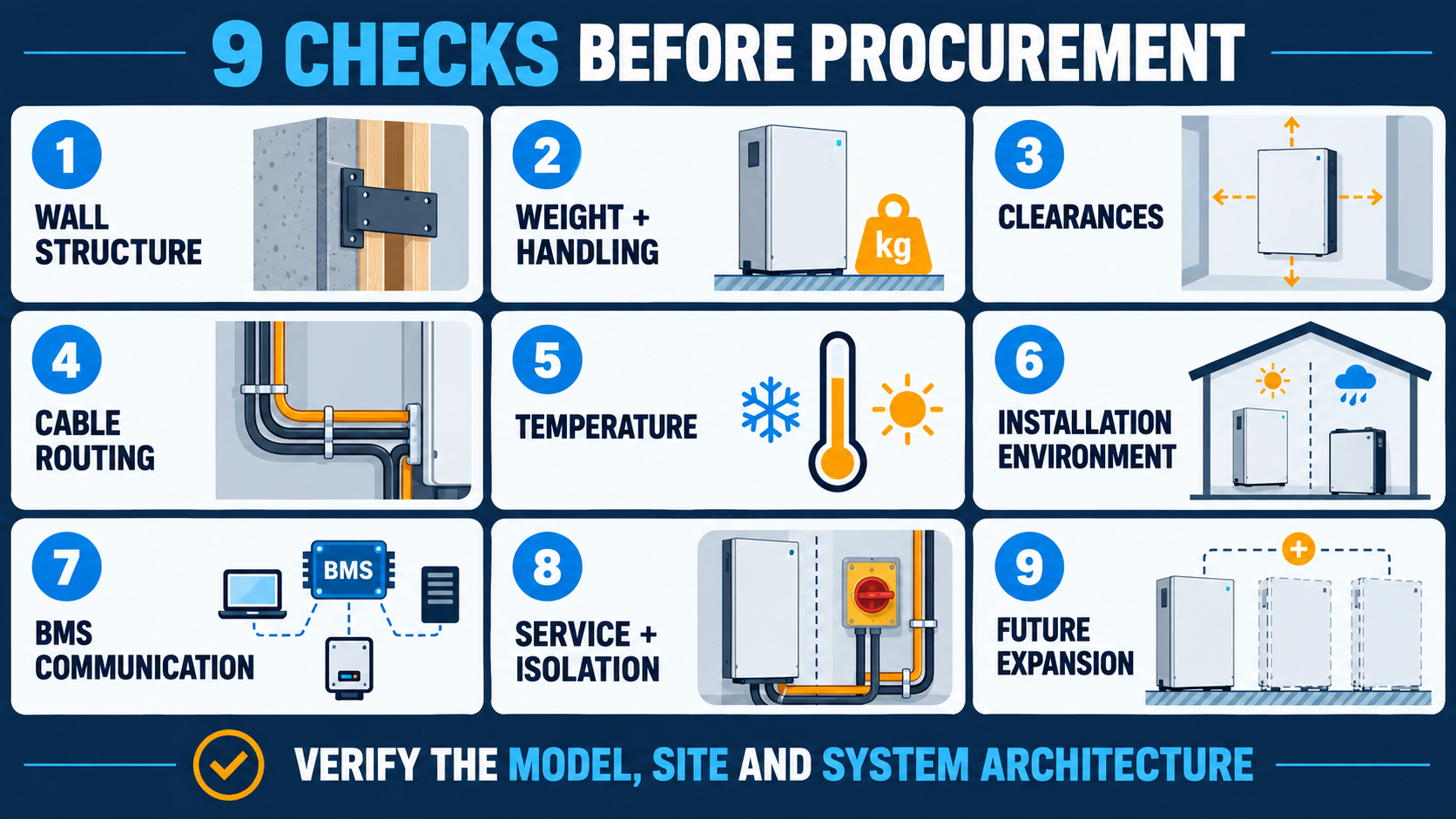
1. Wall structure and load capacity
For a wall-mounted unit, verify the wall construction and its load-bearing capacity against the battery weight and the manufacturer's fixing specification. If the structure cannot be verified, the wall format is not an option for that site, regardless of floor space.
2. Battery weight and handling requirements
Confirm the unit weight and the handling plan for either format: access route, door widths, stairs or lift capacity, lifting equipment, and crew size. A floor-standing unit on casters still has to be transported, leveled, and positioned safely.
3. Required installation clearances
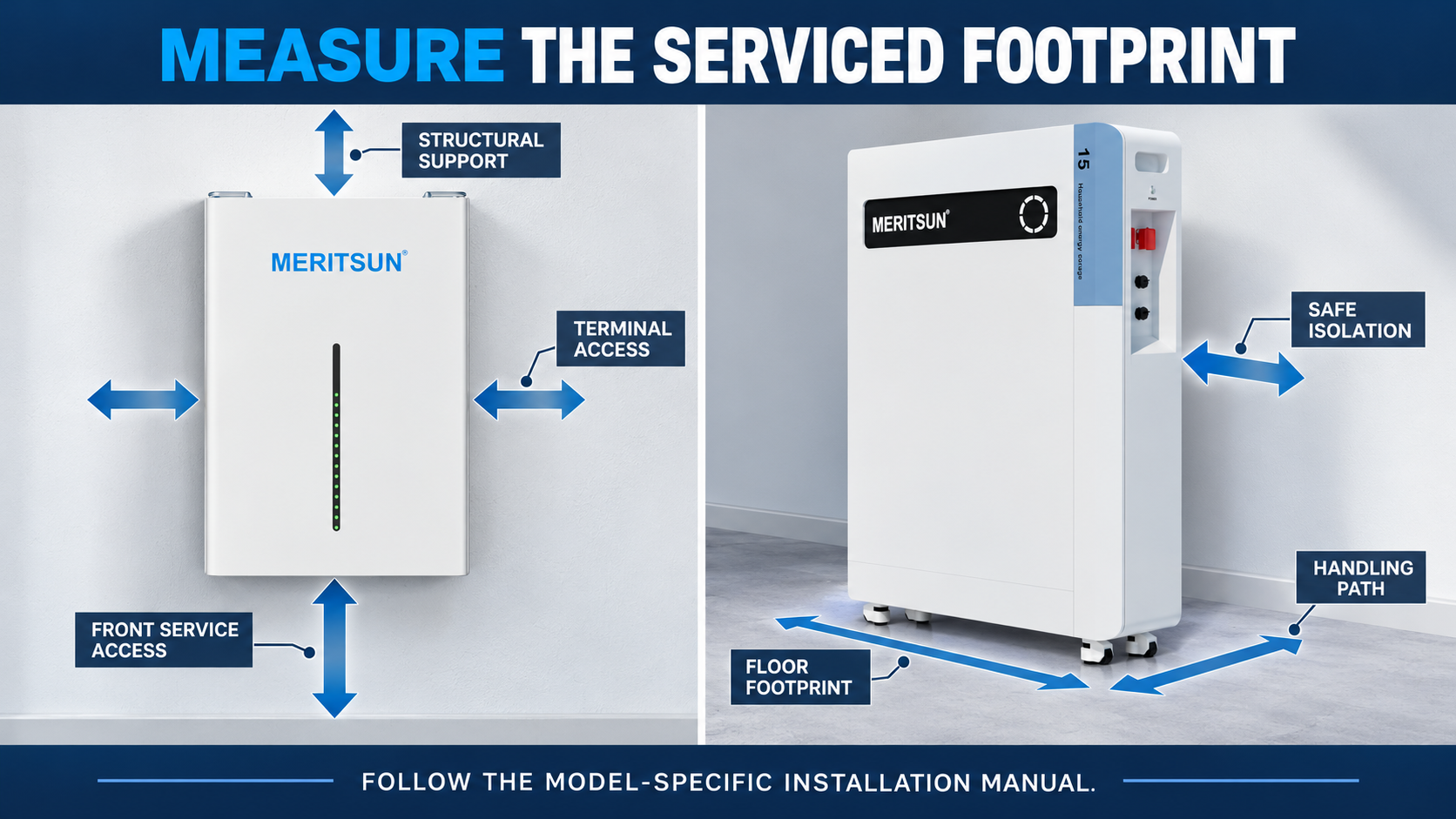
Apply the clearances in the installation manual: front service access, space around terminals and disconnect devices, and any specified gaps to walls and ceilings. Measure the serviced footprint, not the product footprint.
4. Cable length and routing
Confirm DC cable gauge, maximum run length, terminal specification, and routing between battery and inverter, plus the AC run to the distribution board. Longer runs increase voltage drop and losses; cable routing can rule out a location that otherwise looks suitable.
5. Ventilation and ambient temperature
Check the installation location against the product's operating temperature range and any ventilation requirements in the datasheet. Enclosed, sun-exposed, or heat-trapping locations that fall outside the specified range require a different location or a different product.
6. Indoor or protected-outdoor environment
Match the unit's protection (IP) rating and environmental limits to the actual location — indoor, covered outdoor, or exposed. Moisture, dust, and condensation exposure must stay within what the product documentation allows.
7. Inverter and BMS communication
Verify the inverter model against the battery's compatibility documentation and confirm the communication protocol and settings before installation day. A battery without supported closed-loop communication may be unsuitable unless the battery and inverter documentation explicitly permits open-loop operation and defines the required voltage, current, charge, discharge, and protection settings.
8. Service and emergency access
Confirm that the installed position leaves room for inspection, maintenance, and safe isolation of the system, and that disconnect devices remain reachable. A unit that cannot be serviced or isolated safely is a delivery risk, whatever its format.
9. Future capacity expansion
Establish the expansion path before the first unit is installed: whether parallel units are supported for the model, the maximum configuration, the additional wall or floor space required, and the communication wiring between units. Retrofitting expansion into a finished installation is more expensive than planning for it.
Common Mistakes
- Treating a floor-standing unit on casters as a consumer appliance that needs no installation design.
- Specifying wall mounting before the wall structure has been verified.
- Measuring the product footprint instead of the serviced footprint, then blocking service access with the final placement.
- Discovering on installation day that the inverter model has no documented communication support for the battery.
- Planning capacity expansion without confirming that the model supports parallel operation.
FAQ
Does a floor-standing battery on casters still require professional installation? In most projects, yes. Connection to the premises' electrical system, protection, grounding, and commissioning are installer work performed to the product documentation and local requirements. Casters address positioning and service only.
What documents should be checked before selecting a format for a project? The product datasheet, installation manual (weight, fixings, clearances, environment), inverter compatibility documentation, and the warranty terms for the target market (see How to Compare Home Battery Warranties: Installer and Distributor Guide).
Can a battery operate without communication to the inverter? Only where the battery and inverter documentation explicitly permits open-loop operation and defines the required voltage, current, charge, discharge, and protection settings. Otherwise, specify a battery with supported communication for the selected inverter.
Which format suits higher-capacity residential systems? Floor-standing designs generally reach higher single-unit capacities and can simplify service access at higher weights. The deciding factors remain the 9 checks above, applied to the specific model and site.
How much clearance should be left around a home battery? The value in the model's installation manual. Clearances are product specifications, not installer preference, and they cover service access as well as any ventilation requirements.
Can the format decision be changed after installation? Changing the format after installation may require new mounting hardware, revised cable routes, relocation work, and recommissioning. The format should therefore be confirmed before procurement.
Key Takeaways
- Format is a structural and installation decision, not a styling choice.
- Wall-mounted installation depends on verified structural support, while floor-standing installation depends on adequate space, safe handling, and service access.
- Inverter and BMS communication must be documented for the selected pairing, or an approved open-loop mode must exist.
- Clearances, cabling, and environment are product specifications — check them against the site before ordering.
- Final system design and commissioning should be verified by qualified professionals.
Request a Preliminary Configuration Review
Before selecting a wall-mounted or floor-standing battery, share the installation location, wall condition, available floor space, inverter model, cable distance, environmental conditions, and future expansion plan with MERITSUN for a preliminary configuration review.