
How Long Will a 10 kWh Battery Run a House? A Practical Runtime Guide
Date: 2026-10-21 Categories: Blog Hits: 290
This guide gives installers and project buyers the calculation method, the assumptions behind it, and a planning table. It does not promise a fixed number of hours for any product: runtime is an output of the formula, not a product feature.
MERITSUN home energy storage batteries are rated for 8,000 cycles and backed by a 12-year warranty, subject to the applicable product datasheet, operating conditions, and market-specific warranty terms.
Key Terms: The Four Inputs of the Runtime Formula
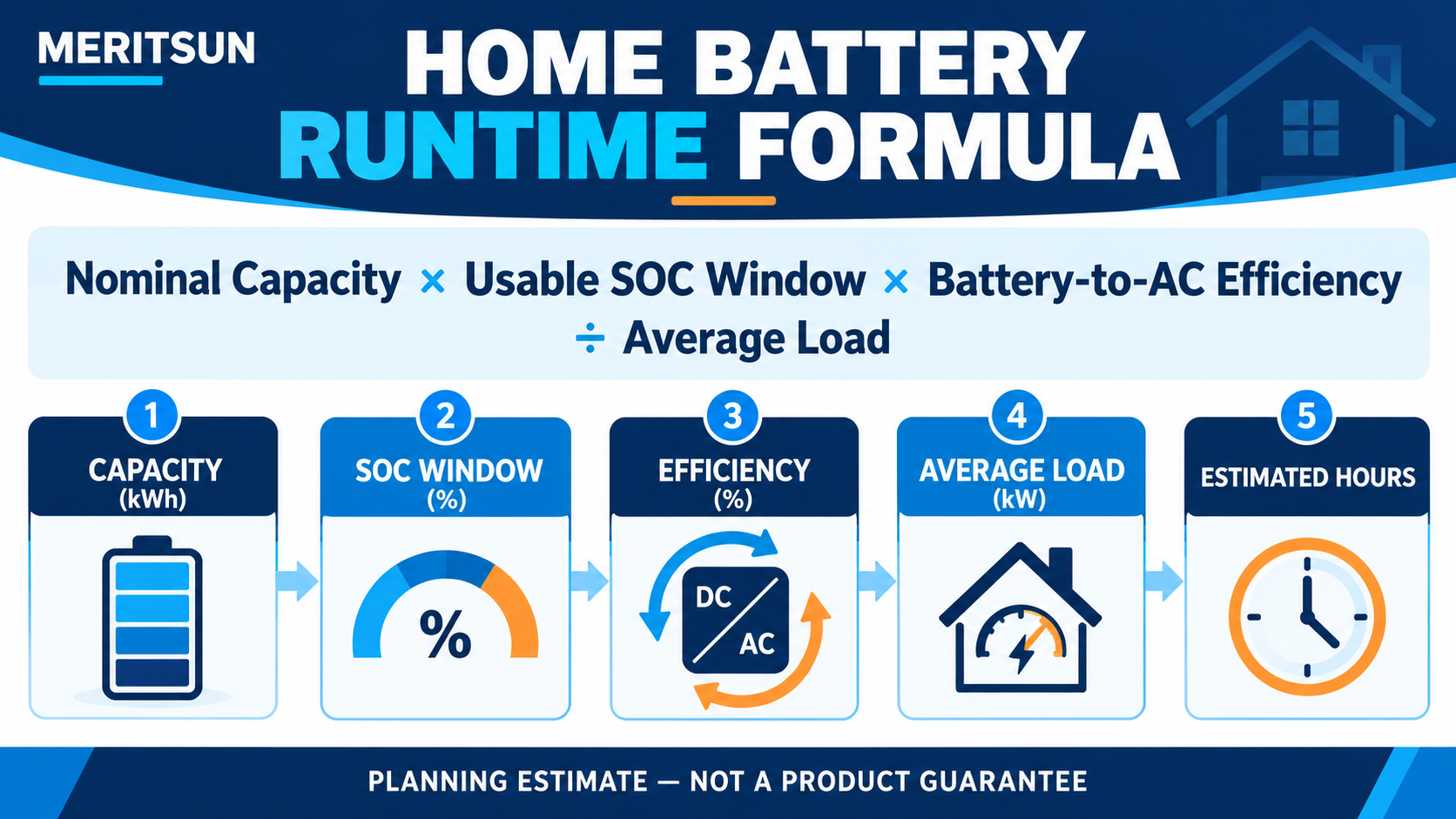
Estimated runtime = Nominal battery capacity × Usable SOC window × Battery-to-AC efficiency ÷ Average backed-up load
- Nominal battery capacity (kWh) — the nameplate energy rating of the battery. Not all of it is available to loads.
- Usable SOC window — the state-of-charge range the system is configured to use (for example, cycling between 10% and 100% SOC is a 90% window). The window is set by the BMS and project design; a reserve held for the next outage reduces it further.
- Battery-to-AC efficiency — the share of stored DC energy delivered as AC power after inverter conversion and system losses. Use the system datasheet value where available.
- Average backed-up load (kW) — the mean power drawn by the circuits connected to backup during the period. It is not the sum of appliance nameplate ratings, and it is not the home's total consumption.
For a fuller treatment of this distinction, see the MERITSUN guide Nominal vs. Usable Home Battery Capacity. Note: if a manufacturer publishes a rated usable capacity for a specific model, that figure already accounts for the SOC window — use it directly instead of applying a window factor to the nominal capacity.
Illustrative Example
Illustrative example — not a guaranteed runtime.
For a 10 kWh battery with a 90% usable SOC window and an assumed 90% battery-to-AC efficiency, the estimated usable AC energy is approximately 8.1 kWh. At an average backed-up load of 1 kW, the estimated runtime would be about 8.1 hours. Actual performance will vary with temperature, battery condition, inverter settings, load cycling, and system design.
Planning Table (Same Assumptions Throughout)
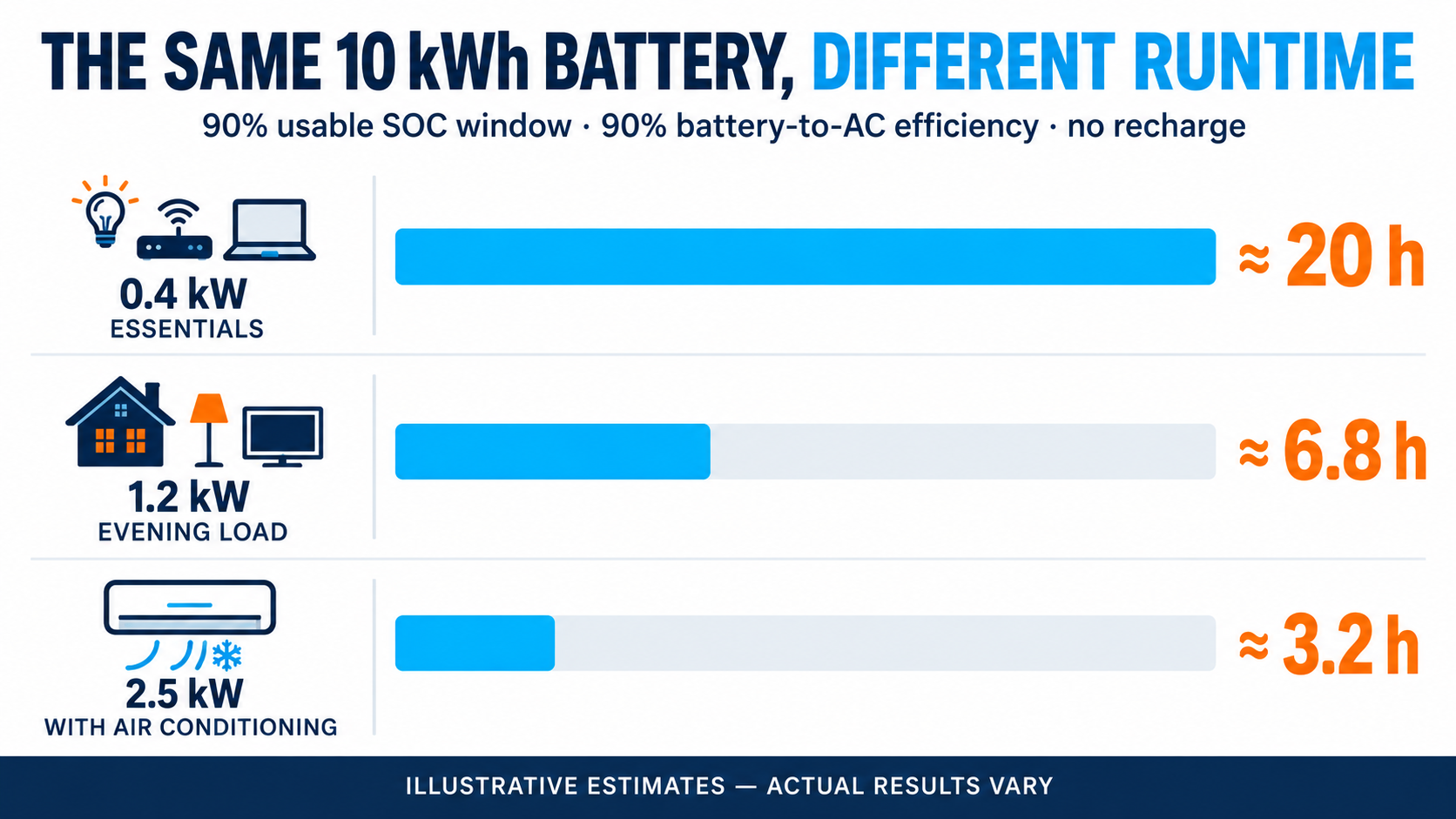
Calculated with a 90% usable SOC window and 90% battery-to-AC efficiency (combined factor 0.81), constant average loads, no recharge during the period, and no allowance for inverter standby draw. These are planning estimates for comparing sizes, not product guarantees.
| Nominal capacity | Estimated usable AC energy | Essentials ≈ 0.4 kW | Evening load ≈ 1.2 kW | With air conditioning ≈ 2.5 kW |
|---|---|---|---|---|
| 8 kWh | ≈ 6.5 kWh | ≈ 16 hours | ≈ 5.4 hours | ≈ 2.6 hours |
| 10 kWh | ≈ 8.1 kWh | ≈ 20 hours | ≈ 6.8 hours | ≈ 3.2 hours |
| 15.36 kWh | ≈ 12.4 kWh | ≈ 31 hours | ≈ 10.4 hours | ≈ 5.0 hours |
Read the column that matches the project's load profile. The same battery is an overnight battery in one column and a short-bridge battery in another; the difference is the load, not the battery.
Air Conditioning: A Power Check Before a Runtime Check
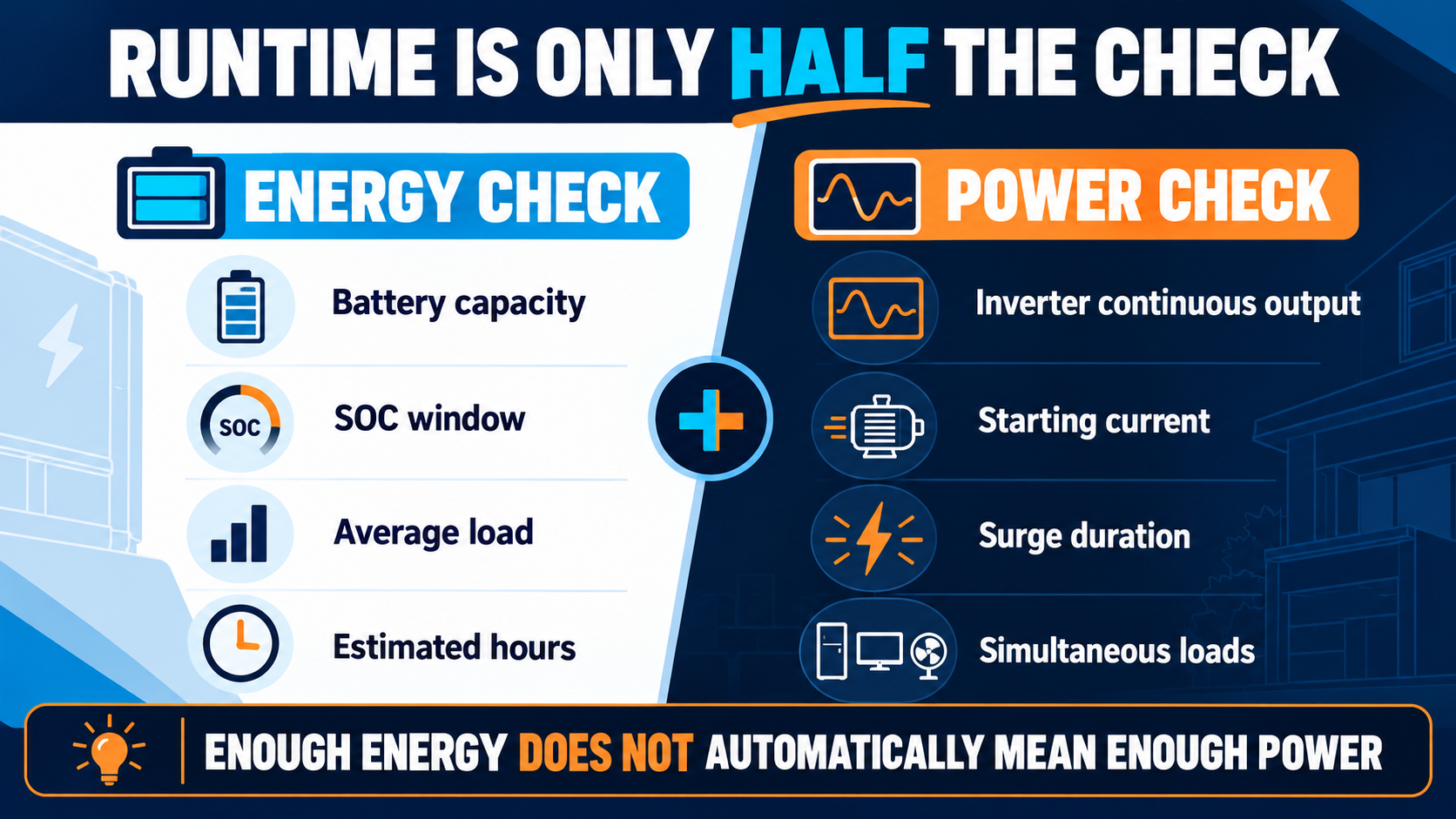
Runtime figures for air conditioning assume the AC can run at all — a separate question decided by power ratings, not capacity. Starting demand may exceed running power. Use the air-conditioner manufacturer's maximum-input and starting-current data, together with the inverter's continuous and surge ratings. If the combined simultaneous load exceeds the inverter's continuous rating, the runtime figure is irrelevant because the system cannot carry the load.
Refrigerators and Cycling Loads
Refrigerators and freezers cycle on and off, so their average energy consumption may be lower than their nameplate power. Runtime calculations should use measured or documented energy consumption whenever possible. Single-appliance runtime figures (usable energy divided by one appliance's draw) are simplified calculations for orientation only; they exclude standby draw, shared loads, and temperature effects.
Multi-Day Outages
Across multiple days, runtime becomes an energy-balance question. Daily coverage depends on solar generation (which varies with weather and season), daytime consumption, charge power limits, and the battery's state of charge at the start of each outage period. A system that keeps up in one set of conditions can fall behind in another, so multi-day designs should be modeled with local solar data and the project load profile rather than extrapolated from a single-night figure. For the recharge side of the calculation, see How Much Solar Is Needed to Recharge a Home Battery After an Outage?
Common Mistakes
- Dividing nominal capacity by load and presenting the result as the runtime, with no SOC window or efficiency applied.
- Summing appliance nameplate ratings to estimate the average backed-up load.
- Quoting a runtime without stating the load and the assumptions behind it.
- Checking battery capacity for an AC project without checking the inverter's continuous and surge ratings.
- Extrapolating a single-night estimate into a multi-day autonomy claim.
FAQ
What data produces a useful runtime estimate for a project? Inverter model, battery quantity, minimum reserve SOC, the essential-load list, air-conditioner specifications, average daily consumption, and the target backup duration. Measured load data improves the estimate more than any other input.
Why do suppliers quote different runtimes for the same nominal capacity? Because the hidden assumptions differ — SOC window, efficiency, and the load used. Figures are comparable only when the assumptions and the load are stated.
How does a reserve SOC change the result? Energy held in reserve is not available during the current outage period. A project holding a 20% reserve should calculate with a correspondingly smaller usable window.
Can runtime be extended without a larger battery? Reducing the average backed-up load extends runtime on the same battery, under the same formula: fewer circuits on backup, staged appliance use, and shedding high-power loads during the outage.
Does temperature affect runtime? Yes. Operating temperature influences battery performance and appliance behavior (for example, refrigeration load in hot conditions). Datasheet operating ranges and project conditions should be part of the estimate.
Is a runtime table a product specification? No. It is a planning tool built on stated assumptions. Product specifications are the values in the model's datasheet; project runtime is calculated from those values and the project's load data.
Key Takeaways
- Runtime should be calculated from usable energy and average backed-up load — never from nominal capacity alone.
- State the SOC window, efficiency, and load behind every runtime figure.
- High-power and motor-driven loads require separate output and starting-demand checks against the inverter.
- Product selection should be based on project data rather than household size alone.
- Final system design should be verified by qualified professionals.
Request a Project Runtime Estimate
For a more useful runtime estimate, send MERITSUN your inverter model, battery quantity, minimum reserve SOC, essential-load list, air-conditioner specifications, average daily consumption, and target backup duration.