
How to Plan a 30.72 kWh U.S. Home Backup System Around the Load Panel
Date: 2026-10-18 Categories: Blog Hits: 341
Design Snapshot
| Item | Design example |
|---|---|
| Market | U.S. residential 120/240 V split-phase applications |
| Battery configuration | 2 × 15.36 kWh MERITSUN LiFePO4 batteries |
| Nominal stored energy | 30.72 kWh |
| Backup architecture | Dedicated backup-load center shown as an example |
| Inverter | Split-phase hybrid inverter; final model requires project validation |
| PV array | To be confirmed from site information |
| Installation location | Residential garage shown as a design example |
| Evidence boundary | No runtime, customer load, SOC setting or commissioning result is claimed |
Why the Load Panel Comes Before the Runtime Claim
Homeowners often begin with one question: “How long will the battery run my house?” An installer cannot answer that question accurately until the backup boundary is defined.
A dedicated backup-load panel may include refrigeration, lighting, communications, selected receptacles and essential controls. Adding HVAC, well pumps, electric water heating, cooking equipment or EV charging can change both the required inverter power and the expected runtime.
The load panel turns a general request for “home backup” into a measurable circuit list.
Critical-Loads Backup or Whole-Home Backup?
Critical-loads design
A critical-loads panel limits backup operation to selected circuits. This can reduce simultaneous demand, make runtime easier to predict and prevent discretionary appliances from consuming the emergency reserve.
Whole-home design
Whole-home backup may be possible in some projects, but it requires more than sufficient battery energy. The inverter, transfer equipment, service rating, surge demand and load-management strategy must all support the operating plan.
The phrase “whole-home backup” should not be used until the design team has reviewed the service and load schedule.
Understand 120/240 V Split-Phase Loads
Many U.S. homes use 120/240 V split-phase service. Some loads operate at 120 V from either L1 or L2 to neutral, while larger appliances may use 240 V across both legs.
The site survey should identify:
- Continuous load on L1 and L2
- Large 240 V appliances
- Motor and compressor starting demand
- Circuits that must remain available during an outage
- Loads that can be shed or scheduled
- Any existing generator or transfer equipment
A balanced design helps prevent one leg or one output limit from constraining the system before the stored energy is exhausted.
Battery Energy Is Not Inverter Power
Two 15.36 kWh batteries provide 30.72 kWh of nominal energy. That number does not state how many kilowatts the system can deliver at once.
The inverter must be evaluated for:
- Continuous output power
- Short-duration surge capability
- 120/240 V split-phase output
- Battery-side voltage and current limits
- PV charging capacity
- Transfer behavior during grid loss
- Communication compatibility with the battery BMS
The battery bank, inverter and backup-load panel must be designed as one system.
A Practical Runtime Method
Use this planning formula:
Estimated runtime = usable battery energy × conversion efficiency ÷ average backed-up load
For example, if the operating strategy provides 24 kWh of usable energy after reserve and the backed-up circuits average 3 kW, the simple estimate is about eight hours before accounting for changing loads, temperature and other site-specific effects.
This is an illustration, not a MERITSUN performance claim. Final runtime must be validated with actual load data and commissioned settings.
Do Not Ignore Starting Demand
Average household load can look manageable while a compressor, pump or motor creates a much higher starting demand. Installers should document both running and starting power for:
- Central air conditioning and heat pumps
- Well and booster pumps
- Refrigerators and freezers
- Garage-door operators
- Workshop equipment
- Other motor-driven appliances
Where necessary, soft starters, circuit priority or automatic load management should be evaluated by the project engineer.
Set the SOC Reserve Around the Customer’s Objective
A battery used primarily for solar self-consumption may cycle differently from a battery reserved for outages. The design team should agree on:
- Minimum operating SOC
- Emergency reserve target
- Grid-charging permissions
- Solar-recharge priority
- High-load restrictions during an outage
- Operating instructions for extended outages
These settings belong in the commissioning and handover record.
Garage Installation Considerations
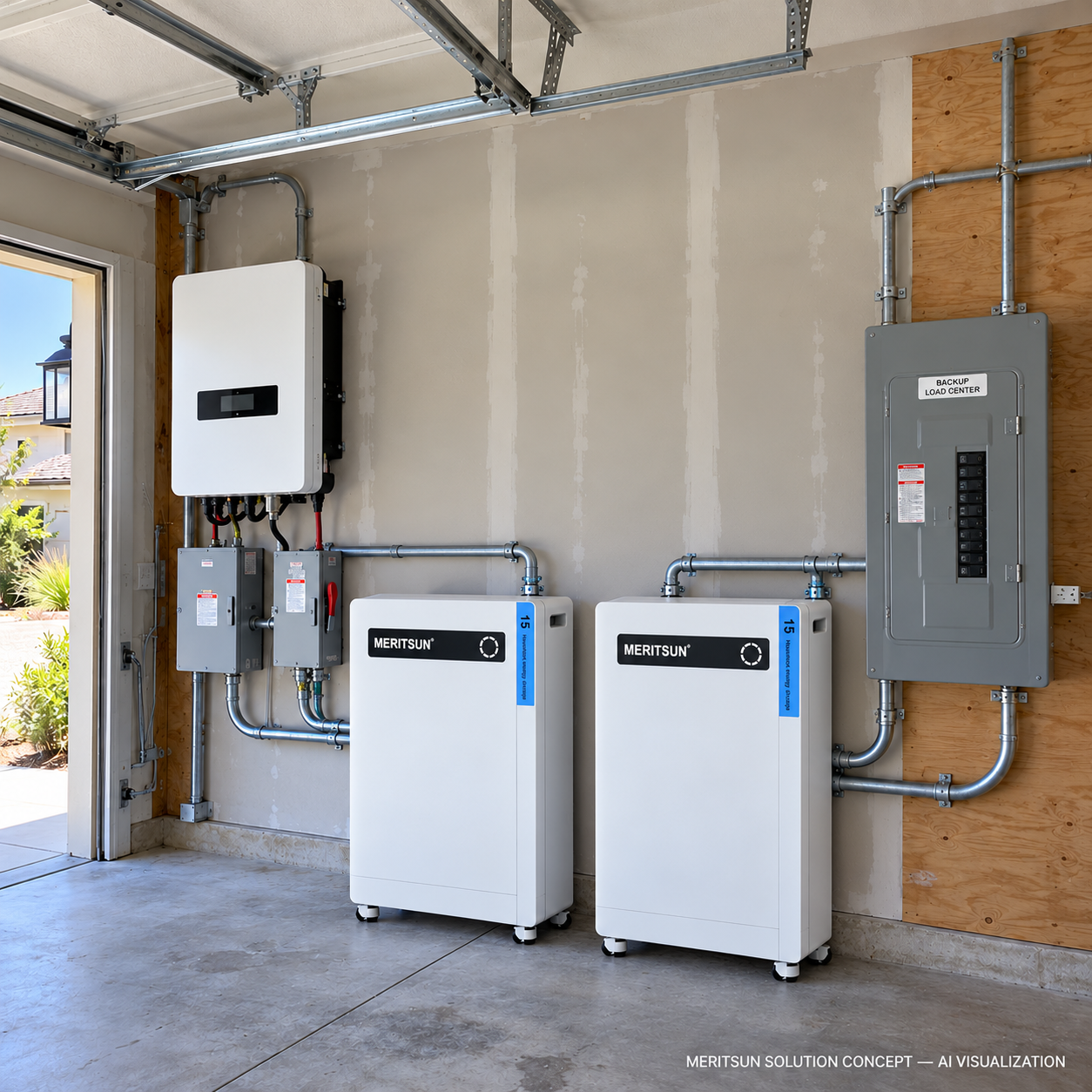
The concept image places two batteries beside the inverter and backup-load center in a garage. A real site review must verify:
- Manufacturer clearances and mounting instructions
- Protection from vehicle impact and physical damage
- Ambient temperature and direct sunlight
- Water exposure and drainage
- Disconnect access and equipment labeling
- Conduit routing and cable protection
- Local permitting, electrical and fire-safety requirements
The authority having jurisdiction and the selected equipment documentation determine the final installation requirements.
Commissioning and Handover Checklist
Before customer handover, the installer should document:
- Service voltage and L1/L2 measurements
- Battery and inverter model information
- Firmware and communication status
- Charge, discharge and SOC limits
- Circuits included in the backup-load panel
- Operation of major 120 V and 240 V backup loads
- Transfer behavior during a controlled grid-loss test
- PV charging and monitoring operation
- Alarm, shutdown and restart procedures
- Customer instructions and emergency contacts
Only the results recorded during this process should be presented as project outcomes.
What Should an Installer Submit for Configuration Review?
Provide the following information when requesting system support:
- State or project location
- Utility service and main-panel rating
- Existing or proposed inverter model
- PV array size
- Daily energy consumption
- L1/L2 circuit and load schedule
- 240 V appliances and motor loads
- Required backup circuits
- Target backup duration
- Garage, basement or outdoor installation environment
- Number of systems and procurement timeline
Frequently Asked Questions
Is 30.72 kWh enough for whole-home backup?
It depends on the average load, peak demand, inverter power, backup boundary, SOC reserve and available solar. The nominal energy figure alone cannot answer the question.
Why use a dedicated backup-load panel?
It defines which circuits remain energized during an outage and prevents nonessential loads from using the stored reserve. It can also make system sizing and customer expectations clearer.
Can a 30.72 kWh system run central air conditioning?
Possibly, but the installer must verify continuous power, compressor starting demand, other simultaneous loads and the desired runtime. Battery capacity alone is not sufficient.
Does the battery connect directly to the load panel?
The complete architecture normally includes an approved inverter, protection, disconnects and transfer equipment. Connections must follow the selected manufacturers’ documentation and local requirements.
How should L1 and L2 loads be evaluated?
The installer should record the circuits and demand on each leg, then verify that the inverter and backup architecture can support the proposed distribution without exceeding output limits.
Is the image an actual U.S. customer installation?
No. It is a MERITSUN solution concept used to explain the installation-planning process. It does not represent a named customer or measured project result.
What information is needed for a project quotation?
At minimum: service type, inverter, PV capacity, load schedule, backup circuits, target runtime, installation location, required quantity and delivery schedule.
Key Takeaways
- Two 15.36 kWh batteries provide 30.72 kWh of nominal stored energy.
- The backup-load panel defines what the system is expected to support.
- Energy capacity, inverter power and motor-starting capability are separate design variables.
- L1/L2 balance and 240 V loads must be documented in a split-phase project.
- Runtime and commissioning results must come from actual site data.
Project CTA
Send MERITSUN the project location, service type, inverter model, PV capacity, backed-up circuits, major motor loads, required runtime, installation environment and quantity for a preliminary configuration discussion.
Discuss Your Project with MERITSUN