
8 kWh vs. 10 kWh vs. 15.36 kWh Home Batteries: A Load-Shedding Sizing Guide
Date: 2026-10-21 Categories: Blog Hits: 314
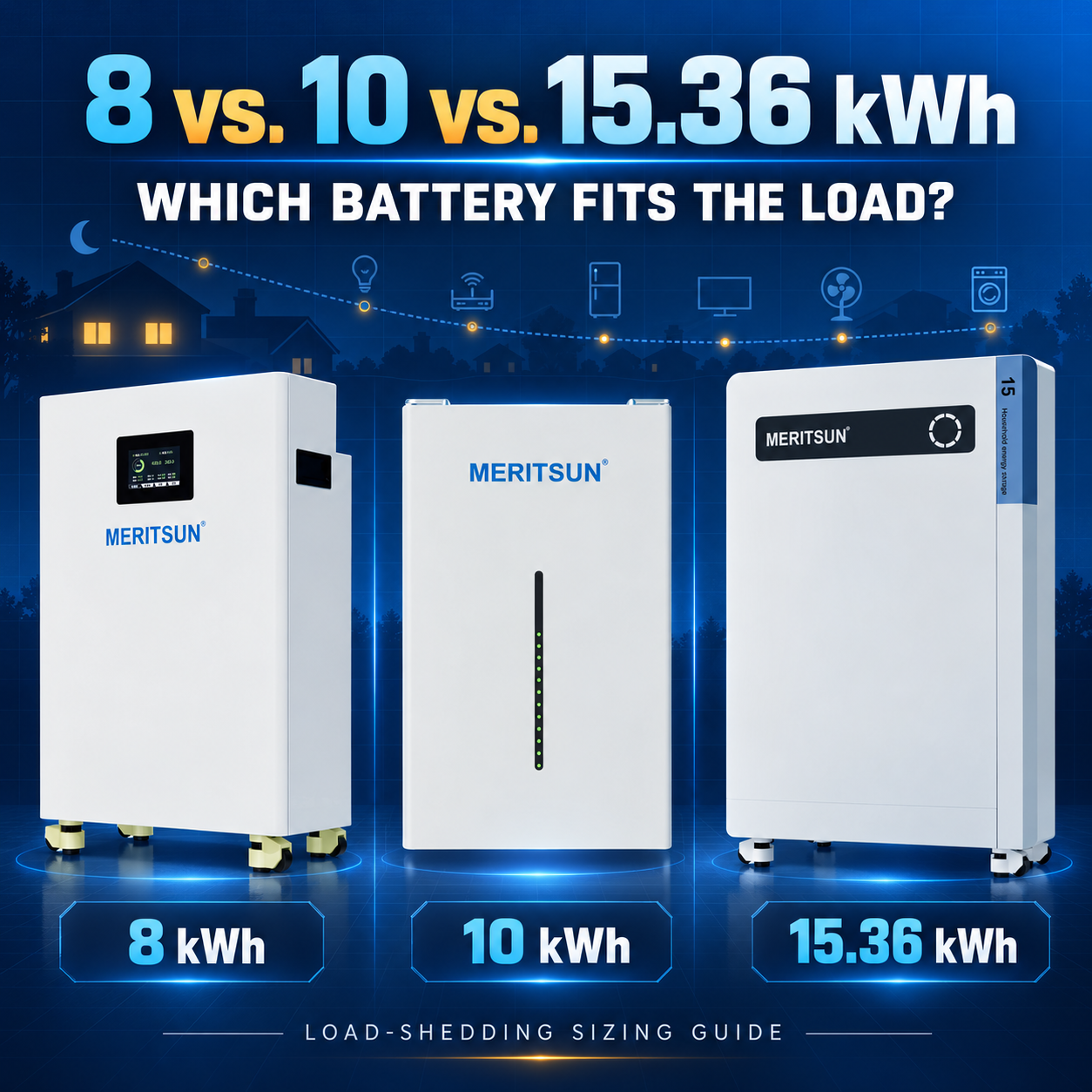
This guide is written for installers, EPCs, system integrators, and distributors sizing single-battery LiFePO₄ residential backup systems in load-shedding markets. It does not size by house size, and it does not treat any scenario below as a field-verified result. For system-level sizing of multi-battery configurations (10 kWh / 20 kWh / 30 kWh), see the MERITSUN Home Battery Sizing Guide for Solar Installers; this article covers the narrower question of choosing one battery for a load-shedding home.
MERITSUN home energy storage batteries are rated for 8,000 cycles and backed by a 12-year warranty, subject to the applicable product datasheet, operating conditions, and market-specific warranty terms.
Key Terms
- Backed-up load — the circuits the battery is expected to supply during an outage, measured in kW (running power) and kWh (energy over time).
- Usable battery energy — the portion of nominal battery capacity available within the configured SOC window. Usable AC energy is lower after inverter conversion, standby consumption, and other system losses are applied.
- Reserve (minimum SOC) — the charge held back for the next outage window or for battery protection. Energy held in reserve is not available for the current window.
- Load-shedding window — the scheduled outage period the system must bridge, including how often it repeats per day.
- Inverter continuous output — the AC power the inverter can deliver continuously, in kW. It is a separate limit from battery capacity.
The Selection Logic: Capacity and Output Are Different Questions
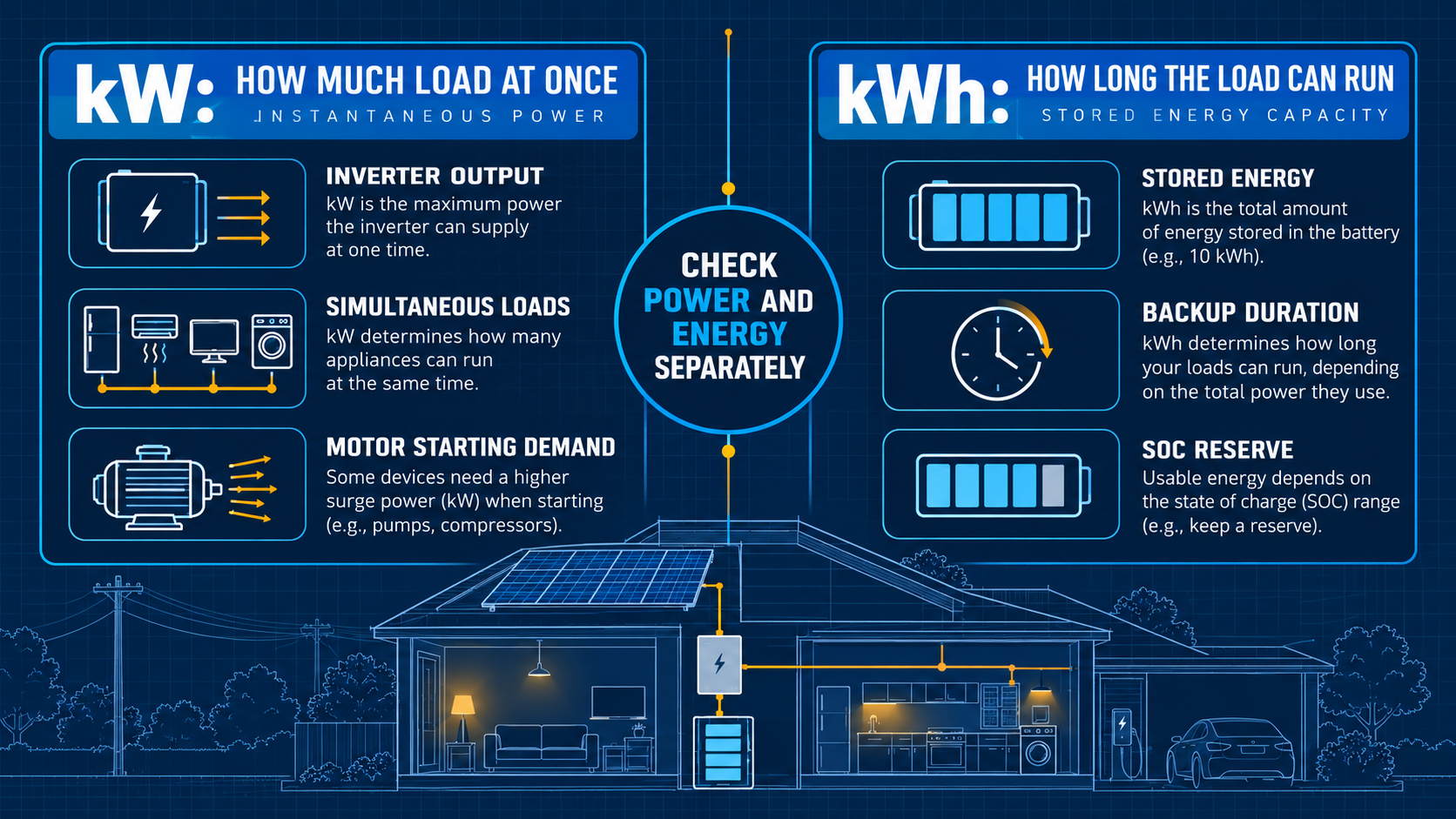
- kWh determines how much energy can be stored. It sets the total backup energy available across an outage window.
- kW determines how much load can run at the same time. A large battery behind a small inverter still cannot carry a large simultaneous load.
- The inverter's continuous output may become the limit before the battery capacity does. Check both numbers on every project; the binding constraint is the smaller one.
- Motor loads need a separate starting check. Air conditioners, pumps, and compressors draw starting current above their running power. Verify the appliance manufacturer's starting data against the inverter's continuous and surge ratings.
- Battery size cannot be selected from floor area. Two homes of the same size can have substantially different backed-up loads. Size from the load list, the outage window, and the reserve — not from square meters.
Comparison: 8 kWh vs. 10 kWh vs. 15.36 kWh
| 8 kWh | 10 kWh | 15.36 kWh | |
|---|---|---|---|
| Format (MERITSUN range) | Floor-standing, casters, color touch screen | Wall-mounted, LED SOC bar, RS485 / CAN / RS232 | Floor-standing, casters, high-capacity class |
| Illustrative backup scenario | Shorter scheduled outage windows; essential loads only; recharge between windows available | Longer or twice-daily windows; essentials with margin; partial reserve retained | Longer windows combined with intermittent higher-power loads, subject to inverter limits |
| Sizing risk if underspecified | Reserve eroded when windows extend or loads are added | High-power loads added later can turn it into a daily deep-cycling system | Floor space and budget committed beyond the project's actual duty |
The scenarios in this table are planning illustrations, not measured runtimes. For runtime calculations once a load is fixed, use the method in How Long Will a 10 kWh Battery Run a House? A Practical Runtime Guide.
Recharge Between Windows
In load-shedding duty, discharge is only half the design. The available solar and grid-charging capacity should be sufficient to restore the energy used during the outage while maintaining the required backup reserve before the next expected interruption. If the recharge path cannot do this — short grid-return windows, limited array size, high daytime consumption — the correct response is a revised configuration or a revised reserve target, confirmed in the project design. Recharge capacity cannot be judged from battery size alone; for the full calculation, see How Much Solar Is Needed to Recharge a Home Battery After an Outage?
Installer Checklist: Data Required Before Sizing
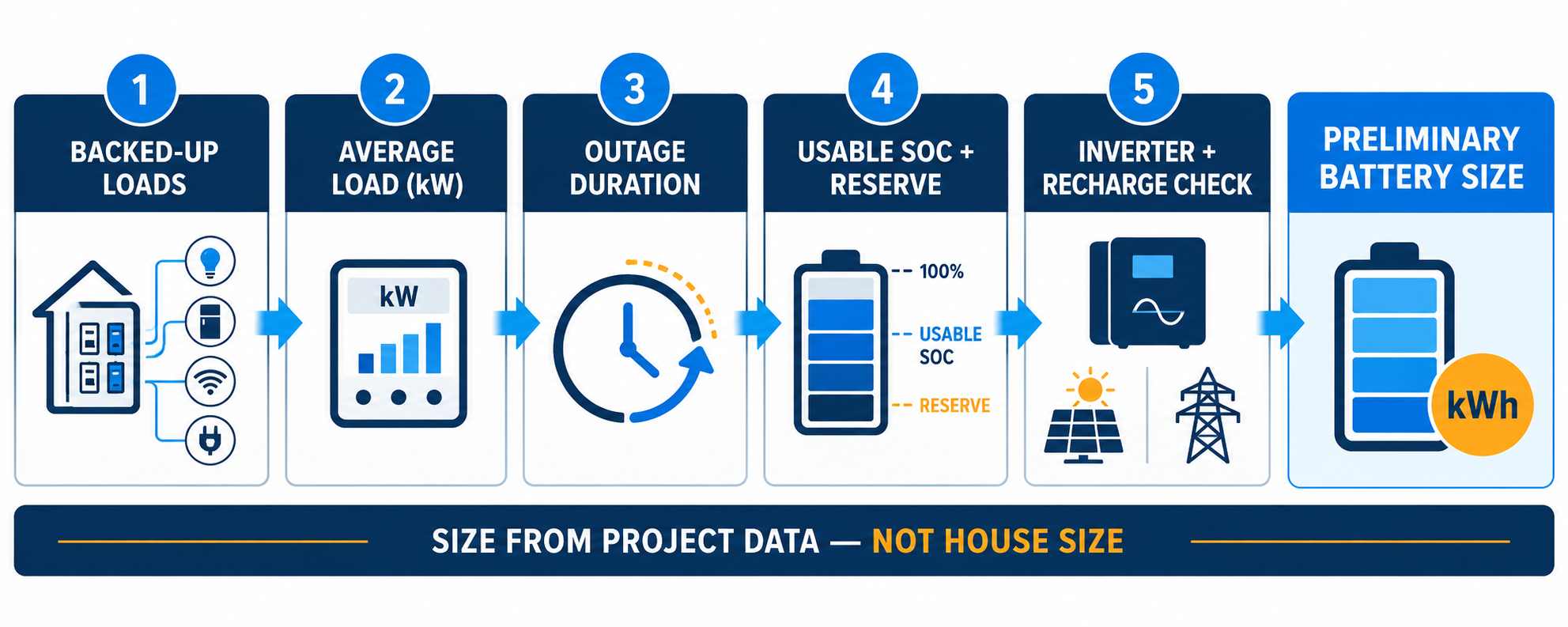
- Country and target market
- Grid voltage and phase (and frequency)
- Inverter model, continuous output, and surge rating
- Solar array capacity (kWp), if solar charging is part of the design
- Essential load list (running watts)
- High-power appliance list (running watts and starting data)
- Target backup time and outage-window pattern
- Required reserve (minimum SOC)
- Installation location: indoor or protected outdoor
- Project quantity and purchase timeline
Illustrative Example
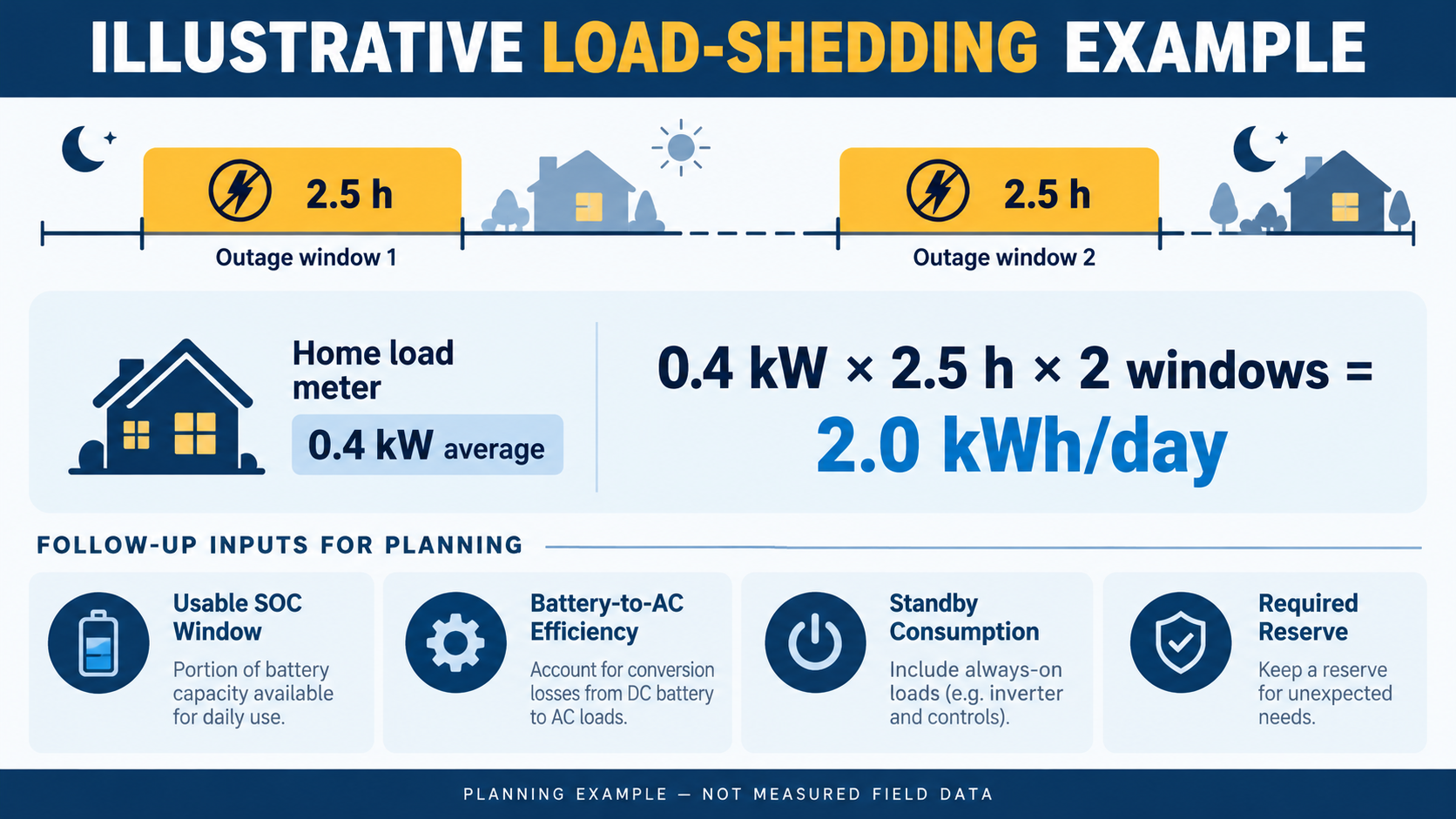
Illustrative example — planning values only, not a measured result.
A project specifies two scheduled outage windows of 2.5 hours per day. The backed-up list (refrigerator, LED lighting, WiFi, TV, fans) averages 0.4 kW during a window. Energy per window: 0.4 kW × 2.5 h = 1.0 kWh. The two outage windows require approximately 2.0 kWh of delivered backup energy per day before reserve and system losses are considered. The installer must then apply the permitted SOC window, battery-to-AC efficiency, standby consumption, and required reserve before approving an 8 kWh, 10 kWh, or 15.36 kWh configuration. Adding a 1 kW pump or extending the window changes the inputs and requires the calculation to be re-run — which is the point of sizing from parameters.
Common Mistakes
- Sizing from floor area or from total household consumption, including loads the battery never supplies.
- Comparing nominal kWh between brands without checking the usable SOC window behind each figure.
- Checking battery capacity but not the inverter's continuous and surge output.
- Treating motor loads as their running watts only, without starting data.
- Assuming the battery returns to a full charge between windows without verifying the recharge path.
FAQ
What project data does MERITSUN need to recommend a size? Country, grid voltage and phase, inverter model, solar capacity, essential loads, high-power appliances, and target backup time. With those, the choice between 8, 10, and 15.36 kWh is a calculation rather than an estimate.
Can these batteries be paralleled if one unit is not enough? Parallel configuration depends on the specific model. Confirm the supported parallel quantity and wiring requirements in the product datasheet before designing a multi-unit system.
How does the reserve (minimum SOC) affect sizing? Directly. A project that must hold 20% in reserve has 20% less usable energy for the current window, so the nominal capacity must be larger for the same duty.
Does a higher daily consumption automatically mean the 15.36 kWh model? No. What matters is the consumption of the backed-up circuits during the outage windows. High total consumption driven by non-backed-up loads does not change the battery size.
Which documents should a distributor request before quoting? The product datasheet, installation manual, inverter compatibility documentation, and the warranty terms for the target market.
Can the battery be sized before the inverter is selected? Only provisionally. Inverter continuous and surge output can become the binding constraint, so final sizing should be confirmed against the selected inverter model.
Key Takeaways
- Battery capacity (kWh) and inverter output (kW) solve different design requirements.
- Size from backed-up load, outage window, and reserve — not from household size.
- High-power and motor-driven loads require separate output and starting-demand checks.
- The recharge path between windows is part of the sizing decision.
- Final system design should be verified by qualified professionals.
Request a Preliminary Configuration Review
Planning a residential backup project? Send MERITSUN your country, grid voltage and phase, inverter model, solar capacity, essential loads, high-power appliances, and target backup time. Our team can help review the preliminary battery configuration for your project.