
Can an Existing Generator Recharge a Home Battery During an Outage?
Date: 2026-11-09 Categories: Blog Hits: 349
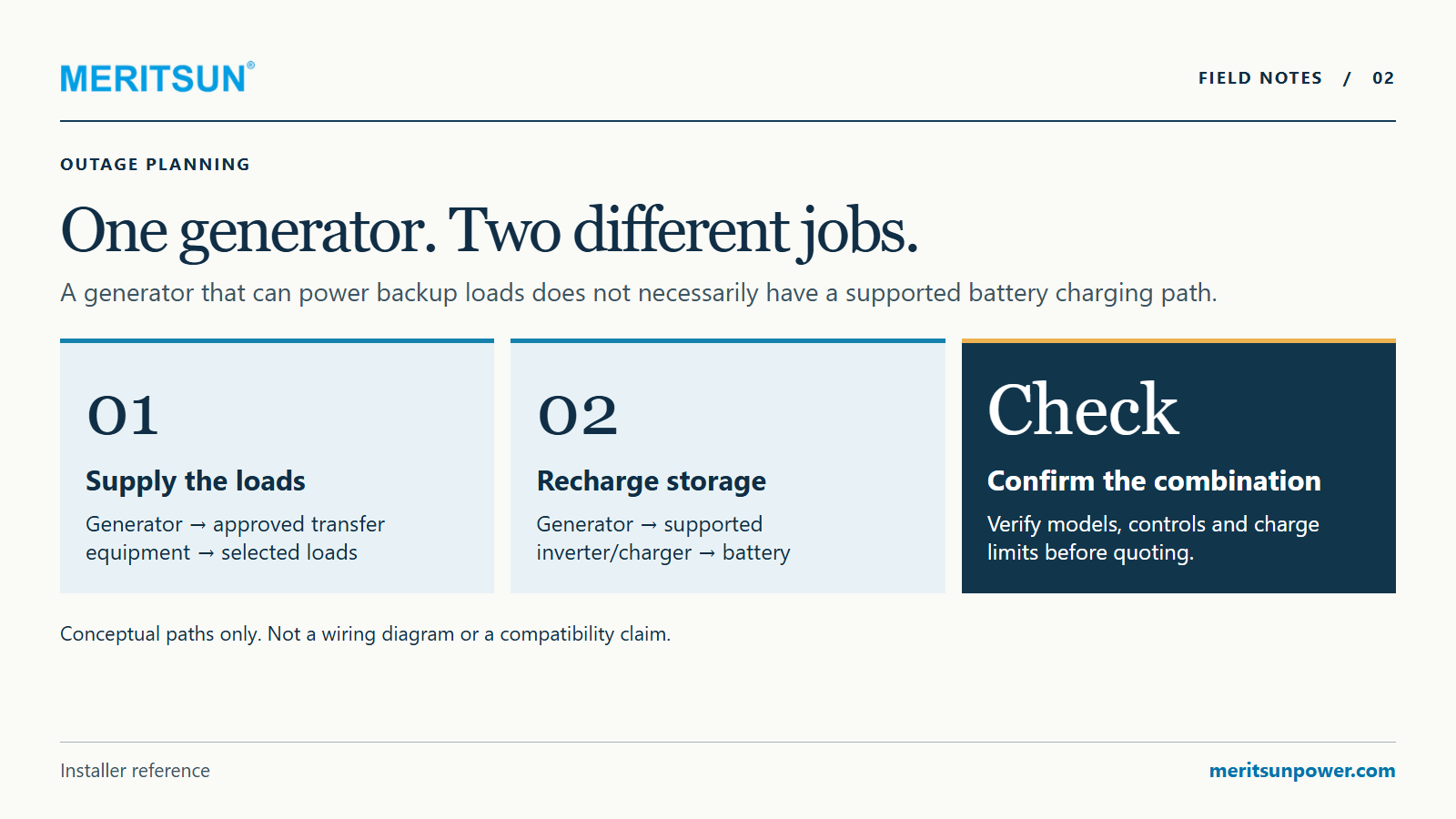
Sometimes. The generator needs a charging path that the battery-system manufacturer supports for that exact equipment combination. A generator that can power the home's backup panel does not necessarily have a way to recharge the battery.
That distinction shows up in Base Power’s generator integration guide, updated November 2, 2026. Base describes separate options for supplying a home and for recharging a battery, with different provisions by system model. Those details apply to Base equipment. The question worth carrying into any storage proposal is: When the grid is down, where can the generator's power actually go?
Three promises that sound alike in a sales meeting
| What the homeowner asks for | What the installer needs to verify |
|---|---|
| “I want to use my generator after the battery runs down.” | An approved way to supply the selected circuits from the generator. This alone does not establish a charging path. |
| “I want the generator to refill the battery.” | A supported charger or inverter/charger input, the permitted generator specifications and the maximum accepted charge power. |
| “I want both without anyone being home.” | Documented automatic start/stop support, control ownership, restart behavior and the agreed response if the generator fails to start. |
Put the customer's choice in the written scope. “Generator compatible” is too vague for the crew doing the installation or the homeowner expecting the lights to stay on.
Why a larger generator may not shorten recharge time
Consider an illustrative system that can accept up to 3 kW of AC charging input. The generator can supply 5 kW continuously under the assumed site conditions. If the approved design serves 3 kW of household load from that same source first, only 2 kW remains for charging.
At an assumed 90% AC-to-battery efficiency, that leaves about 1.8 kW reaching the battery. Adding 5.4 kWh would take about three hours at that steady rate. If the house load falls to zero, the charger's 3 kW input limit still applies. Startup loads, charge taper and changing conditions can extend the time; these numbers are not a MERITSUN product specification.
Before the purchase order
- Photograph the generator nameplate and record its continuous rating, not just the advertised peak rating.
- Obtain the exact inverter/charger and battery model numbers, firmware requirements and the manufacturer's supported operating modes.
- Have the qualified designer identify the approved transfer equipment, isolation method and backed-up circuits on the project one-line diagram. Do not infer a connection from a matching plug.
- Agree on a handover test: record separately whether critical circuits were supplied, whether battery charge increased and whether normal operation resumed. Mark any untested function as unverified.
Installer FAQ
Does an automatic transfer switch prove the battery can recharge? No. Source transfer and battery charging are separate functions.
Can I substitute a standby generator for a portable model? Not on the strength of a wattage match. Ask for written support for the proposed generator type and controls.
What rating belongs in the energy estimate? Use the sustained charging power available after competing loads and conversion losses, not starting watts.
Will generator charging work if communications go offline? Check which controls are local and which need a network connection. Record the documented fallback behavior.
Who should demonstrate the setup? The qualified installation team should follow the equipment manuals and applicable requirements. The homeowner needs operating instructions, not directions for changing wiring.
Key takeaways
Powering loads, recharging storage and starting automatically are three different deliverables. Name each one in the quote and give it its own acceptance test.
Quoting a home with an existing generator? Ask MERITSUN for a configuration review. Include the market, generator and inverter models, priority loads and which of the three functions the owner expects. Confirm the supported combination before committing to it.