
Nominal vs. Usable Home Battery Capacity: What Installers Should Calculate Before Quoting Runtime
Date: 2026-09-09 Categories: Blog Hits: 139
Direct answer
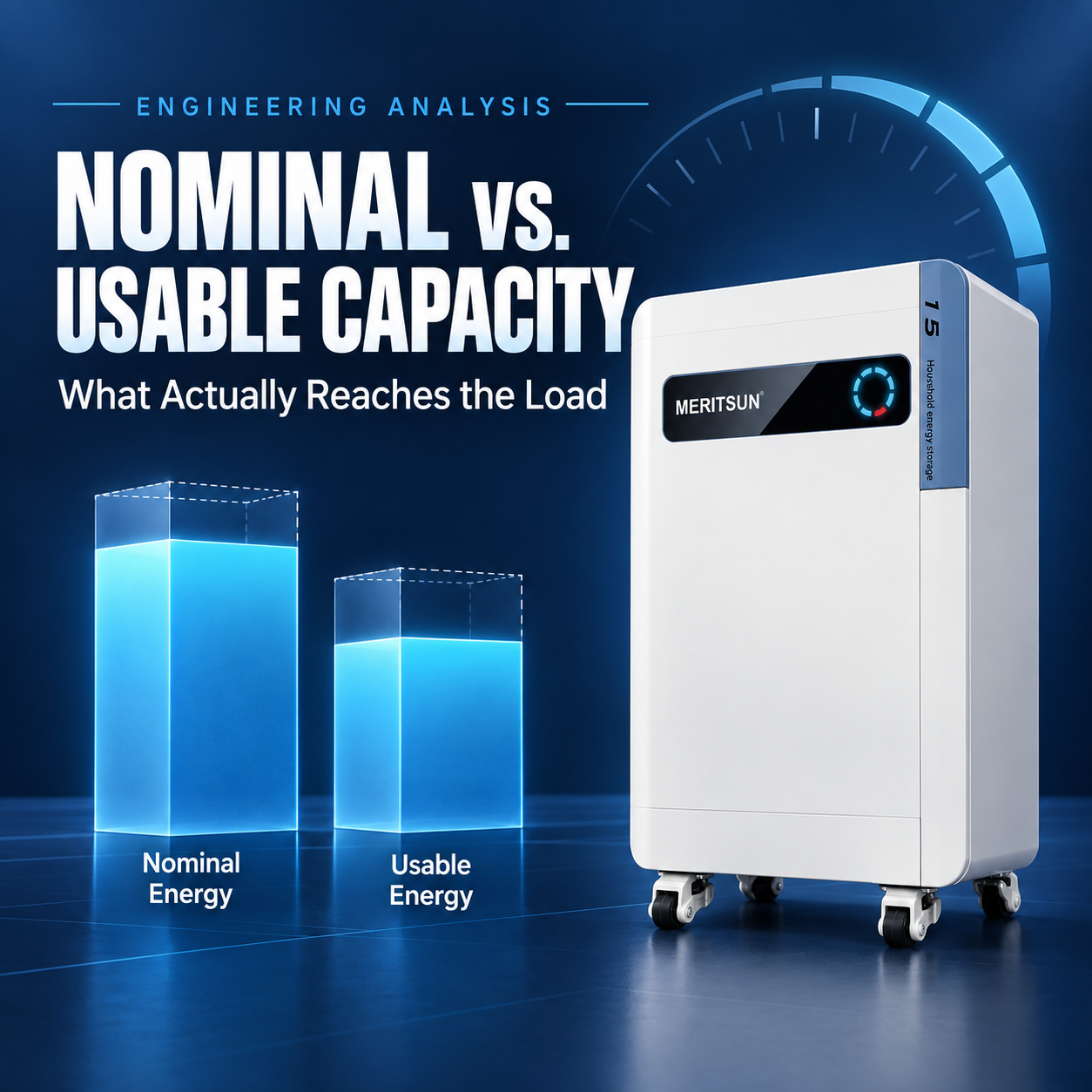
A battery's nameplate capacity is not the amount of AC energy a home will necessarily receive during an outage. Available backup energy depends on the battery's state of charge when the outage begins, the configured lower SOC limit, the permitted operating window, conversion losses, temperature, system limits and the actual load profile.
For a defensible runtime estimate, calculate available energy first and then divide it by the expected average load. After that, perform a separate power check to confirm that the inverter can carry continuous demand and motor-starting events.
What is nominal battery capacity?
Nominal capacity is the energy value assigned to the battery under specified conditions. It is usually shown in kilowatt-hours. It is useful for comparing the physical size of battery systems, but it is not a runtime guarantee.
The term answers one question:
How much energy is represented by the battery's rated configuration?
It does not answer:
how much energy is stored when an outage begins;
how far the system is allowed to discharge;
how much AC energy reaches the load;
whether the inverter can start an air conditioner, well pump or other motor;
whether solar will recharge the battery during the outage.
What is usable capacity?
Usable capacity is the portion of stored energy available within the permitted operating window. That window may be defined by the product, the battery-management system, the inverter settings or the project operating strategy.
The phrase needs context. A datasheet may state usable energy under specified conditions, while a project may reserve an additional percentage for outages or battery protection. Installers should therefore document both the manufacturer's energy definition and the site's actual SOC settings.
What is backup reserve?
Backup reserve is the energy intentionally held for an outage instead of being used for daily self-consumption or time-of-use operation. A higher reserve improves the probability that energy will be available when the grid fails, but leaves less capacity for daily bill management.
This is an operating decision, not free extra capacity. Tesla's public description of Backup Reserve makes the same tradeoff visible: increasing reserve preserves more outage energy, while a 100% reserve prevents normal use of the remaining capacity for self-powered or savings modes. That example is product-specific, but the underlying planning principle applies broadly: reserve policy changes the energy available for each operating objective. See Tesla's Backup Reserve explanation.
The calculation installers should show
For a first-pass estimate:
Available AC energy = nominal battery capacity × (starting SOC − minimum SOC) × discharge-path efficiency × environmental/aging adjustment
Then:
Estimated runtime = available AC energy ÷ expected average load
Do not use peak load as the divisor unless the home will actually run at that level continuously. Do not use average load to approve the inverter, either. Energy and power require separate checks.
Worked example: four 5.12 kWh modules
The MERITSUN MST-ESS 5000 is listed as a 51.2 V, 5.12 kWh module, with a published stack range of 5–40 kWh. Four modules therefore represent 20.48 kWh of nominal energy. Product details should be rechecked on the current MST-ESS 5000 product page before a project is quoted.
Assume the following design inputs:
nominal capacity: 20.48 kWh;
SOC when the outage begins: 90%;
minimum permitted SOC during backup: 15%;
assumed discharge-path efficiency: 92%;
no additional temperature or aging adjustment in this simplified example.
The calculation is:
20.48 × (0.90 − 0.15) × 0.92 = 14.13 kWh available to the AC load
At an average load of 1.8 kW:
14.13 ÷ 1.8 = 7.85 hours
At an average load of 3.0 kW:
14.13 ÷ 3.0 = 4.71 hours
This is an engineering illustration, not measured MERITSUN field performance. Actual results depend on the approved product configuration, inverter efficiency, temperature, battery condition, wiring, controls and changing household loads.
Why HVAC makes runtime harder to predict
An air conditioner rarely draws exactly the same power for the entire outage. Compressor starts create short power peaks, while the duty cycle changes with outdoor temperature, thermostat setting, insulation, humidity and the number of occupied rooms.
An installer should record at least three HVAC values:
running power;
starting or locked-rotor demand, or the measured start profile when available;
expected duty cycle during the design outage.
If a 2.4 kW air conditioner runs 50% of the time, its hourly energy contribution averages roughly 1.2 kWh before accounting for changing conditions. But the inverter must still be able to support the running load and the starting event. Tesla's public backup guidance also notes that backup duration depends on the number of batteries, appliances and household usage, and distinguishes whole-home from partial-home backup. See What Can Powerwall Back Up.
Energy check and power check are different
| Design question | Unit | What it determines |
|---|---|---|
| How much energy is stored? | kWh | Potential operating duration |
| What is the average outage load? | kW | Rate at which stored energy is consumed |
| What is the maximum simultaneous load? | kW | Required continuous inverter output |
| What motors start during backup? | kW/kVA and time | Required surge capability and control strategy |
| What SOC must remain reserved? | % | Energy unavailable for normal daily dispatch |
A project can have enough kWh and still shut down on excessive power. It can also have enough inverter power but too little energy to meet the target duration.
A five-step runtime workflow
Step 1: Define the backup scope
List every circuit included during an outage. Separate essential loads, comfort loads and deferrable high-power loads.
Step 2: Build an hourly load profile
Use interval data where available. If it is not available, record equipment power, daily operating hours, duty cycle and coincidence assumptions.
Step 3: Set the operating window
Document expected starting SOC, minimum SOC and whether the system is also used for self-consumption, time-of-use savings or a VPP program.
Step 4: Apply conversion and site adjustments
Use values supported by the selected equipment documentation. Do not copy an efficiency value from a different inverter or system configuration.
Step 5: Check continuous and starting power
Confirm the inverter, battery current limits, protection devices, conductors and transfer equipment against the load schedule and local requirements.
Procurement checklist
Before accepting a runtime claim, ask for:
nominal energy and the conditions under which it is rated;
stated usable energy or permitted depth of discharge;
minimum SOC and reserve-setting behavior;
continuous and surge output for the exact inverter configuration;
battery charge and discharge limits;
system efficiency basis—battery only, inverter only or full AC round trip;
low- and high-temperature derating information;
parallel or expansion limits;
compatible inverter and communication protocol;
warranty conditions that may limit operating window or throughput;
the assumed load profile behind the runtime estimate.
Frequently asked questions
Is a 20 kWh battery equal to 20 kWh of backup energy?
Not automatically. The home receives only the energy available between the starting SOC and minimum SOC, after applicable system losses and operating limits.
Should runtime be calculated from nominal or usable capacity?
Use the definition documented for the exact product. If starting from nominal capacity, apply the permitted SOC window and supported system adjustments. If starting from stated usable energy, make sure you do not subtract the same limitation twice.
Does a 20% reserve mean 20% is permanently unavailable?
Not necessarily. Reserve behavior is product- and mode-specific. Some systems release reserved energy during an outage; others also maintain a protective floor. Verify the exact control logic.
Why does actual runtime change from one outage to another?
Starting SOC, temperature, solar production, HVAC duty cycle, occupant behavior and simultaneous loads can all change.
Can a larger battery solve an inverter-overload problem?
Only if the approved expansion also increases available power and the full system supports that configuration. More kWh by itself does not guarantee more kW.
Should EV charging be included in whole-home backup sizing?
Only if the customer explicitly requires it. EV charging can consume energy quickly and may need a controlled charging limit or exclusion during an outage.
What information is needed for a credible runtime estimate?
At minimum: starting and minimum SOC, nominal or usable energy, expected average load, peak load, motor-starting demand, system efficiency basis and solar availability.
Is the worked example a guaranteed MERITSUN runtime?
No. It demonstrates the calculation method. A project-specific estimate requires the exact battery, inverter, settings, environment and measured or documented load profile.
Key takeaways
Nameplate kWh is the beginning of the calculation, not the answer.
SOC reserve changes how stored energy is allocated between daily operation and outage readiness.
Runtime depends on average load; inverter approval depends on continuous and starting power.
Every published runtime should show its assumptions.
A final design must be completed by qualified professionals using the exact equipment documentation and local requirements.
Project CTA
For a preliminary residential ESS review, send MERITSUN the project country, grid voltage and phase, daily energy use, interval load data if available, PV capacity, inverter model, major motor/HVAC loads, starting and minimum SOC targets, and required backup duration. We can then identify the battery-energy range and the technical questions that must be resolved before a final configuration is quoted.