
How to Size a 50–200 kWh Outdoor Battery Cabinet for a Grid-Constrained Commercial Site
Date: 2026-09-04 Categories: Blog Hits: 282
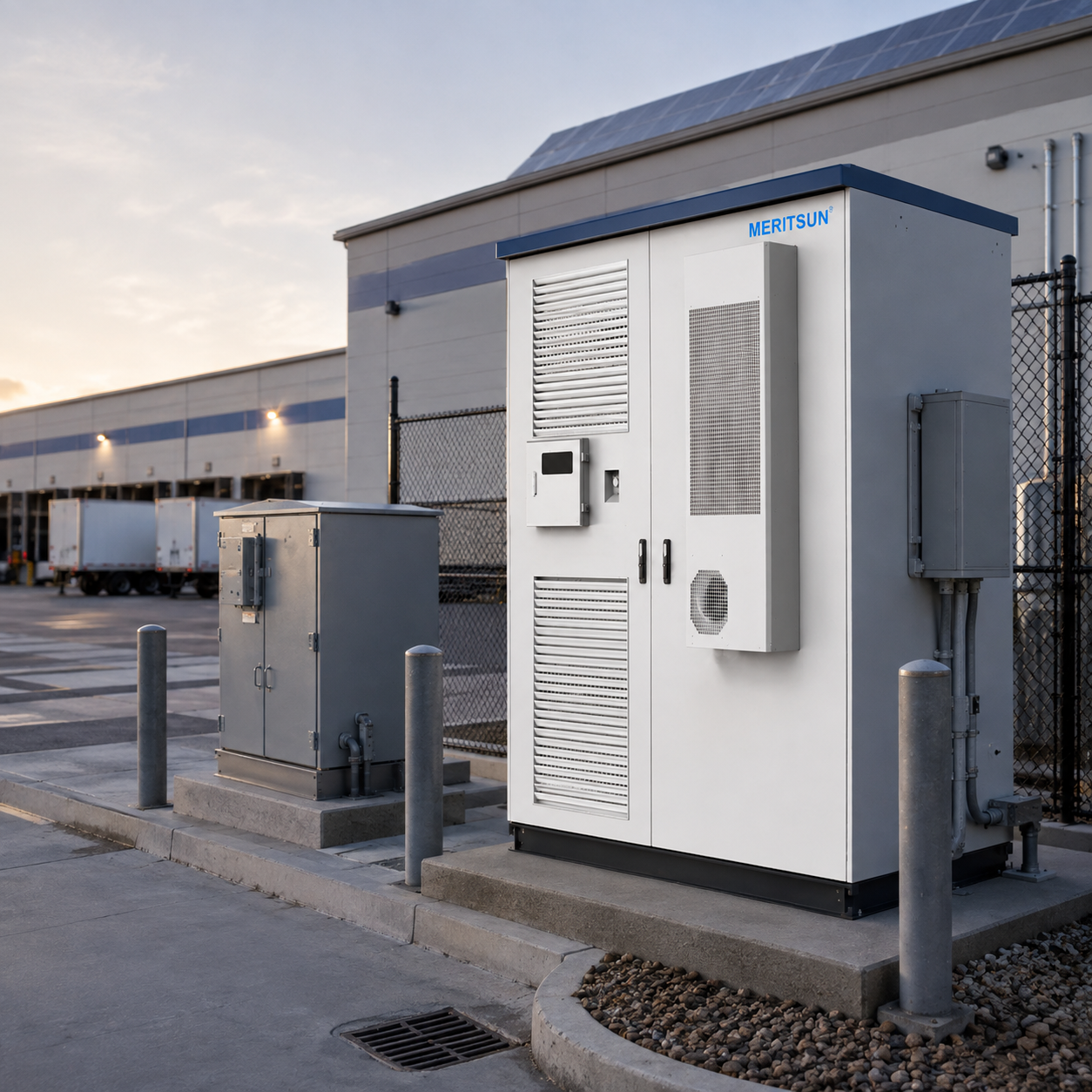
This article and visual illustrate commercial battery sizing and commissioning logic. They do not depict a MERITSUN customer installation.
Direct answer
Commercial battery storage should be sized from the site's power shortfall and required duration, not from an arbitrary kWh target. The engineer must establish the constrained grid capacity, coincident load, controllable demand, PCS rating, battery operating window, and dispatch schedule before selecting the number of cabinets.
This article uses a Schneider Electric customer project in Belgium as a public industry benchmark and maps the engineering questions to MERITSUN's MBox200 platform. It does not state or imply that the Schneider project used MERITSUN batteries.
The public benchmark: grid capacity was the problem
Schneider Electric reports that Elektro Internationaal requested a 630 kVA grid connection for a new facility but received only 355 kW. Published site loads included:
Building consumption: 80 kW.
Required EV charging: 360 kW.
HVAC: 80 kW.
Electric heater: an additional 100 kW.
Reported grid-capacity shortfall: approximately 265 kW.
The solution used two behind-the-meter microgrids, one AC and one DC. Schneider reports 200 kWp of solar split equally between the systems, with 100 kW/300 kWh of battery storage for each AC and DC system.
Source: Schneider Electric — Elektro Internationaal Customer Story
What the 100 kW/300 kWh ratio tells an EPC
A 100 kW/300 kWh battery has a nominal three-hour energy-to-power ratio. That does not mean it will always discharge at 100 kW for exactly three hours. The usable duration depends on reserve SOC, allowable depth of discharge, conversion losses, thermal conditions, auxiliary loads, and the controller's dispatch objective.
At an illustrative 20% reserve:
Nominal energy: 300 kWh.
Energy above reserve: 240 kWh.
Theoretical duration at 100 kW: 2.4 hours before losses.
Theoretical duration at 60 kW: 4.0 hours before losses.
The 20% value is a transparent design assumption, not a published setting from the Belgian project.
Mapping the requirement to MBox200
MERITSUN publishes the following MBox200 battery-cabinet range:
250–800 V operating range.
50–200 kWh per cabinet configuration.
140 A rated charge and discharge current.
200 A maximum charge and discharge current.
IP54 enclosure.
HVAC thermal management.
Integrated fire-fighting system.
CAN, RS485, and Modbus TCP/IP communications.
Up to five cabinets in parallel.
Source: MERITSUN Commercial & Industrial Energy Storage Systems
A 300 kWh requirement might be configured as two 150 kWh cabinets, but that is only a preliminary energy match. The final cabinet configuration must be validated against the selected DC bus voltage, PCS input range, maximum current, redundancy objective, protection architecture, and manufacturer-approved series/parallel arrangement.
Battery sizing and PCS sizing are separate decisions
| Design question | Battery cabinet | PCS and controls |
|---|---|---|
| How long can the site receive support? | Determined primarily by usable kWh | Affected by efficiency and dispatch limits |
| How much instantaneous support is available? | Must provide the required DC current | Determined primarily by PCS kW/kVA rating |
| Can EV charging be limited? | Stores energy for the event | EMS controls charger setpoints and priorities |
| Can the system island? | Supplies DC energy | Requires grid-forming capability, transfer equipment, protection, and approved controls |
| Can the system participate in demand response? | Must retain available energy and cycle capability | Requires EMS/VPP integration, telemetry, metering, and utility approval |
This separation prevents a common proposal error: presenting a 300 kWh battery as if it automatically solves a 265 kW shortfall. A 100 kW PCS can offset only about 100 kW at that moment, regardless of how much energy remains in the cabinets.
Recommended dispatch hierarchy
For a site with building loads, HVAC, electric heating, and EV charging, a practical hierarchy is:
Protect safety, controls, communications, and essential building services.
Cap EV charging to maintain the grid-import limit.
Discharge the battery when measured demand approaches the contracted limit.
Delay electric heating or other flexible loads during coincident peaks.
Preserve a defined SOC reserve for outages or late-day peaks.
Recharge from solar or the grid only within the site's import and tariff constraints.
The dispatch schedule should be simulated against interval data before equipment is ordered.
Commissioning and acceptance tests
A bankable C&I handover should include more than a screenshot showing that the battery is online.
Verify cabinet identification, polarity, insulation resistance, torque records, and protective-earth continuity.
Confirm BMS-to-PCS and BMS-to-EMS communications.
Validate voltage, current, SOC, temperature, and alarm mapping in the monitoring platform.
Conduct controlled charging and discharging at multiple power levels.
Confirm the grid-import limit using a known load step.
Test EV-charger or flexible-load curtailment.
Verify reserve SOC behavior and recovery charging.
Test loss of communications and fail-safe behavior.
Test islanding only if the approved PCS, switchgear, protection scheme, and local rules permit it.
Record the initial performance baseline for future warranty and service analysis.
EPC procurement checklist
Twelve months of 15-minute or finer interval data.
Utility service capacity and export limitations.
Single-line diagram and available fault current.
Critical, noncritical, and controllable load schedules.
Maximum demand and duration of each peak event.
PCS kW/kVA, grid-forming requirement, and DC input window.
Required nominal and usable battery energy.
SOC reserve and dispatch priority.
Fire, spacing, ventilation, permitting, and emergency-response requirements.
EMS protocol, point list, cybersecurity, and remote-support responsibilities.
Factory acceptance and site acceptance test criteria.
Frequently asked questions
Is a 200 kWh cabinet a two-hour battery?
Only when paired with approximately 100 kW of discharge power and when the usable operating window supports that duration. Nameplate energy alone does not establish runtime.
How many MBox200 cabinets can be installed in parallel?
The MERITSUN page states a maximum of five cabinets. The approved capacity, voltage, wiring, current sharing, and communication design still need project-specific confirmation.
Can an MBox200 cabinet operate without a PCS?
It is a battery cabinet. A complete AC-connected system requires compatible conversion equipment, controls, switchgear, metering, protection, and commissioning.
What SOC reserve should a commercial site use?
The reserve should be tied to the site's outage risk, next expected peak, solar forecast, tariff objective, and minimum critical-load requirement. It should not be copied blindly from a residential system.
Can a battery solve a utility-capacity shortfall?
It can reduce the site's instantaneous grid import when the PCS has sufficient power and the battery has sufficient energy. Flexible-load controls may still be necessary.
What makes a C&I project ready for acceptance?
The system must demonstrate communications, metering accuracy, controlled charge/discharge, import-limit response, protection behavior, alarm handling, and recovery after faults or outages.
Key takeaways
Start with the site's kW shortfall and event duration.
Size battery kWh and PCS kW separately.
Treat SOC reserve as an operating requirement, not a marketing number.
MBox200 supports 50–200 kWh cabinet configurations and up to five cabinets in parallel, subject to final engineering approval.
EMS logic and commissioning evidence determine whether the installed hardware can deliver the intended business result.
CTA
For a preliminary MERITSUN C&I assessment, send the installation country, single-line diagram, service voltage, interval load data, PV capacity, utility import/export limits, critical loads, proposed PCS, peak-demand objective, backup duration, communications requirements, and local permitting standard.