
How to Size a Modular Stackable Home Battery for Whole-Home Backup
Date: 2026-09-03 Categories: Blog Hits: 407
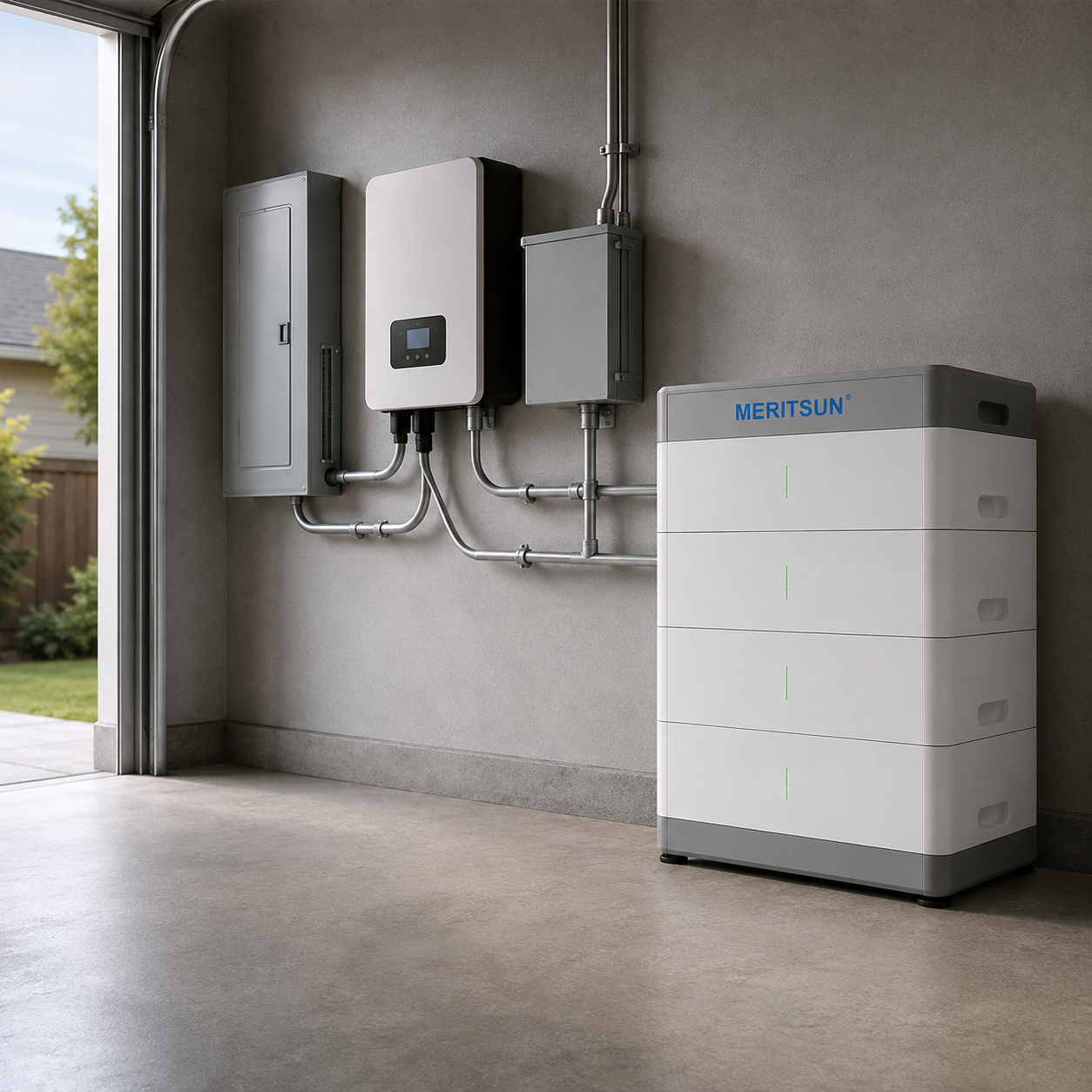
This article and visual illustrate sizing and commissioning logic. They do not depict a MERITSUN customer installation.
Direct answer
A 40 kWh-class battery can provide meaningful whole-home backup, but the capacity number does not prove that a home can run every load at the same time. The installer must separately verify usable energy, inverter output, motor-starting demand, reserve state of charge, circuit priorities, and the expected solar contribution during an outage.
This article uses a publicly documented FranklinWH installation in Northern California as an industry benchmark, then shows how the same design questions apply to a MERITSUN MST-ESS 5000 reference configuration. It does not claim that the FranklinWH project used MERITSUN equipment.
What the public benchmark actually shows
FranklinWH describes a Northern California home equipped with three 13.6 kWh aPower units, providing 40.8 kWh of storage, and one aGate controller. The backed-up loads included the home's HVAC system, pool heater, medical equipment, and main electrical panel. The project also used a 20% battery threshold: below that level, the controller prioritized dedicated circuits rather than continuing to support every managed load.
That detail matters more than the headline capacity. The project treated backup as a controlled operating state, not as permission to run every appliance indefinitely.
Source: FranklinWH — Home Power Optimizes Energy Use From Every Source
Translating that design logic to the MST-ESS 5000
The MERITSUN MST-ESS 5000 is a 51.2 V, 5.12 kWh floor-mounted battery module. MERITSUN's product page states that modules can be configured in 5 kWh increments, with up to 40 kWh per stack. The published maximum discharge current is 200 A, and the enclosure is rated IP55.
Eight 5.12 kWh modules equal 40.96 kWh of nominal energy. That is close to the 40.8 kWh benchmark, but it does not make the two systems technically interchangeable. The inverter architecture, usable depth of discharge, current limits, communications, controls, certifications, and backup switching equipment must be evaluated independently.
Source: MERITSUN MST-ESS 5000 product page
Nominal capacity, reserved capacity, and runtime
For a reference design with 40.96 kWh nominal capacity and a 20% backup floor:
Energy above the reserve: 40.96 × 80% = 32.77 kWh.
At a steady 2 kW load: approximately 16.4 hours before conversion losses.
At a steady 4 kW load: approximately 8.2 hours before conversion losses.
At a steady 8 kW load: approximately 4.1 hours before conversion losses.
These are arithmetic examples, not guaranteed runtimes. Actual runtime will be lower after inverter losses, auxiliary consumption, temperature effects, battery protection limits, and changing household demand are included.
Tesla's published Backup Reserve guidance illustrates the operating tradeoff. A higher reserve protects more outage energy, while a lower reserve makes more capacity available for self-consumption or time-of-use savings. Tesla also reports that customers participating in its ConnectedSolutions VPP have used an average 20% reserve. Those figures are useful industry benchmarks; they are not preset MERITSUN values.
Sources: Tesla Backup Reserve and Tesla ConnectedSolutions VPP results
Why kW still controls the design
The battery's kWh rating determines how much energy is stored. The inverter's kW rating determines how much load can be supported at one time.
A home may average only 2–4 kW during an outage while still producing short peaks when an air conditioner, well pump, pool pump, or heat pump starts. The design therefore needs four load values:
Normal continuous demand.
Maximum expected simultaneous demand.
Motor-starting or compressor surge demand.
Loads that can be delayed, shed, or locked out during backup operation.
Adding battery modules increases energy capacity. It does not automatically increase inverter output or motor-starting capability.
Recommended load-management structure
| Load group | Typical loads | Control approach |
|---|---|---|
| Tier 1: must remain on | Medical equipment, refrigerator, communications, security, selected lighting | Preserve through the full backup window |
| Tier 2: comfort | One HVAC zone, selected receptacles, home office | Operate within a defined power and SOC window |
| Tier 3: discretionary | Pool heater, EV charging, electric water heating, secondary HVAC | Shed or schedule when grid power is unavailable |
The FranklinWH benchmark shows this logic in practice: once the battery reached the stated 20% threshold, the system shifted attention to dedicated circuits.
Commissioning steps installers should document
Enphase's published functional-validation procedure provides a useful industry model. It calls for activating a known load, confirming that the monitoring interface registers the increase, disabling PV input, confirming battery discharge, then removing the load and verifying that the measured load and battery discharge return to zero.
A MERITSUN project should have its own manufacturer-approved procedure, but the handover record should cover the same functions:
Confirm every battery module is detected and communicating.
Record module voltage, SOC, temperature, alarms, and firmware status.
Apply a known load and verify meter direction and magnitude.
Disable PV and confirm battery discharge under controlled conditions.
Simulate loss of grid and verify transfer behavior.
Test the largest approved motor load.
Verify load shedding at the configured SOC threshold.
Restore the grid and confirm charging priority and alarm clearance.
Source: Enphase Storage System Commissioning Functional Validation
Installer procurement checklist
Twelve months of utility bills or interval load data.
Main-service voltage, phase configuration, and panel rating.
HVAC compressor ratings and starting characteristics.
Existing PV inverter model and system capacity.
Required backup duration and acceptable load shedding.
Minimum reserve SOC for normal operation and storm preparation.
Required inverter continuous and surge output.
Battery-to-inverter communication compatibility.
Applicable electrical, fire, permitting, and interconnection requirements.
Commissioning report and homeowner operating instructions.
Frequently asked questions
Is 40 kWh enough for whole-home backup?
It can be enough for a substantial backup window, but only after the home's load profile and inverter power are checked. A 40 kWh battery cannot sustain a 12 kW load through an eight-hour outage.
Does adding more battery increase backup power?
It increases stored energy. It increases power only when the battery, inverter, busbars, protection equipment, and control system are all designed for the additional current and output.
What reserve SOC should an installer use?
There is no universal percentage. The setting should reflect outage exposure, solar availability, critical-load energy, tariff objectives, battery limits, and the homeowner's risk tolerance.
Can the battery support central air conditioning?
Possibly, but the inverter must support both running demand and compressor starting demand. Soft starters or managed load controls may be required.
Is 40.96 kWh all usable?
No assumption should be made from nominal capacity alone. Confirm the manufacturer-approved operating window, low-SOC protection, reserve setting, inverter efficiency, and environmental derating.
What proves that commissioning was successful?
A credible handover record includes communications status, meter validation, controlled charge and discharge tests, grid-loss transfer, restoration, alarm review, and operation of the largest approved load.
Key takeaways
Capacity determines duration; inverter power and surge capability determine which loads can operate.
A reserve threshold changes how much energy is available for daily savings versus outages.
Eight MST-ESS 5000 modules provide 40.96 kWh nominal capacity, but the complete system still requires compatible inverter, protection, communications, and transfer equipment.
A commissioning record is part of the product delivered to the customer.
CTA
For a preliminary MERITSUN system assessment, send the installation country, service voltage and phase, daily energy consumption, PV capacity, inverter model, HVAC nameplate data, major motor loads, required backup time, and proposed reserve SOC. MERITSUN can then evaluate battery quantity and system compatibility for the project.