
LiFePO4 Home Battery Charging Below Freezing: What Installers Must Verify
Date: 2026-09-27 Categories: Blog Hits: 187
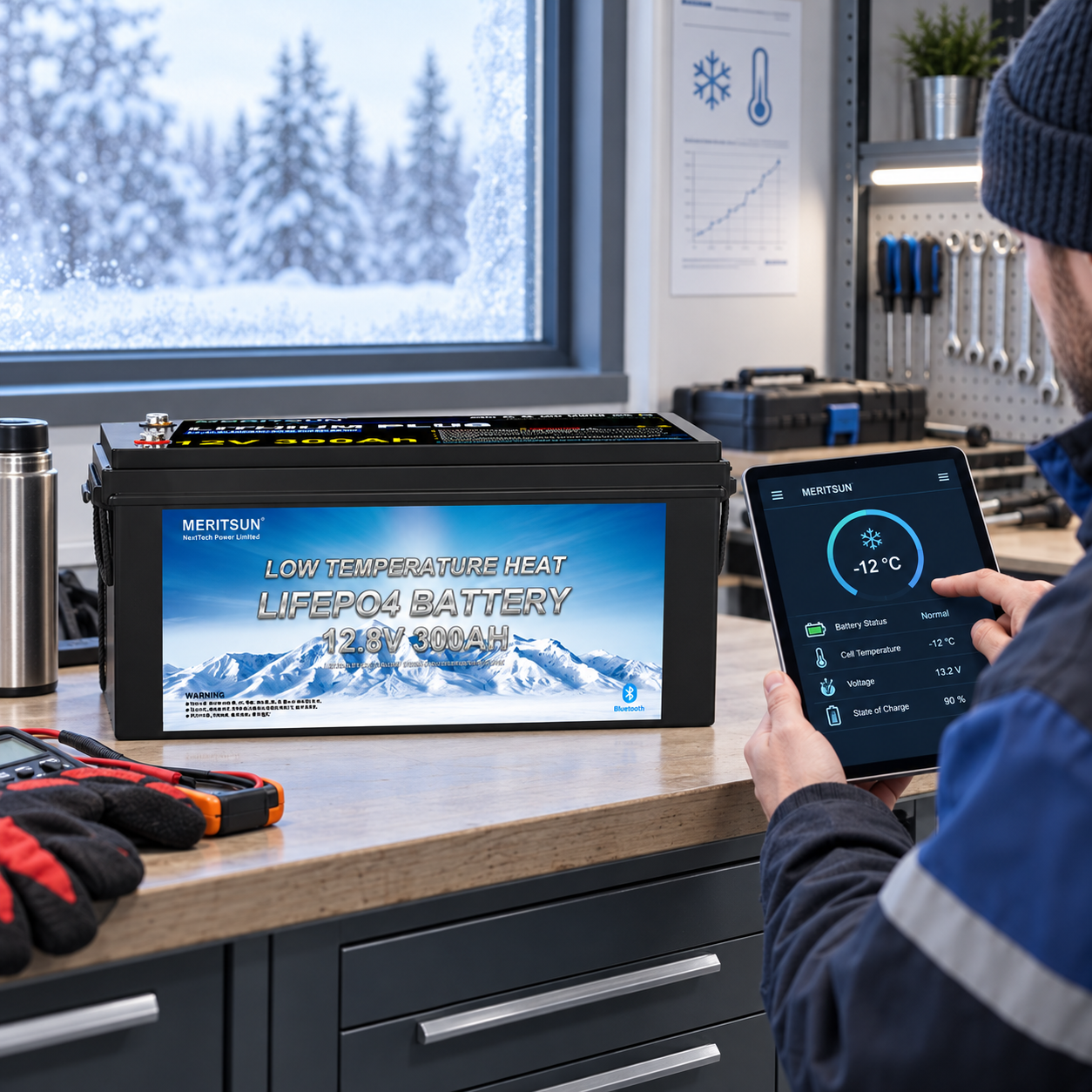
A LiFePO4 home battery should be charged only within the temperature range and operating logic approved for that exact battery model. In freezing conditions, the installer must verify cell temperature—not just outdoor air temperature—along with the BMS charge cutoff, any approved current derating and the behavior of an integrated heater. A “low-temperature” label by itself is not enough to approve a winter installation.
Low-temperature charging is a system question. The cells, BMS, heater, inverter or charger, enclosure and installation location must work as one controlled sequence. If any part of that sequence is assumed rather than documented, the system can be unavailable when solar production returns after a cold night.
Why cold-weather charging needs a separate design review
LiFePO4 batteries can often discharge at temperatures where charging is restricted, but the exact limits vary by cell design and battery system. That distinction matters during winter outages: a battery may support loads overnight, reach a low state of charge and then reject morning PV charging because the cells remain below the permitted charge temperature.
Low-temperature charging can promote lithium plating on the graphite anode. Published LiFePO4 research has linked subzero charging conditions to accelerated degradation and lithium deposition, with temperature, charge rate and voltage all affecting the result. That research explains the mechanism; it does not replace the limits in the battery manufacturer’s current manual.
For an installer, the safe rule is straightforward: never create a universal charging threshold from chemistry alone. Use the approved operating envelope for the exact battery, firmware and system configuration being installed.
Ambient temperature, enclosure temperature and cell temperature are not the same
Three temperature values may be present on a winter project:
| Temperature | What it describes | Why it matters |
|---|---|---|
| Ambient temperature | Air around the battery location | Helps define site exposure and heating demand |
| Enclosure temperature | Air or surface temperature inside the cabinet | Can differ from ambient because of sun, insulation, ventilation and internal heat |
| Cell temperature | Temperature measured at or near battery cells | Usually the value the BMS uses for charge and discharge protection |
A battery installed in an unconditioned garage may be warmer than the outdoor air during the day and colder than expected after several idle nights. A wall exposed to winter sun may also create uneven conditions across the enclosure. One temperature reading at the room entrance does not prove the cells are ready to charge.
The commissioning plan should therefore identify which sensor controls the BMS decision, where it is located, how its value is displayed and what happens if the sensor fails or reports an implausible value.
What a self-heating battery should document
A self-heating battery is not simply a standard battery with a heater added nearby. The heating function must be coordinated with charging so the cells are not charged outside their approved range.
Before specifying a heated LiFePO4 battery, request documentation for:
- the temperature that starts and stops heating;
- whether external charging power is routed to the heater before the cells;
- the minimum input power or current needed to run the heater;
- whether heating is available from PV, grid and generator sources;
- the expected warm-up behavior under the project’s minimum design temperature;
- how the BMS reports heating, charge lockout and sensor faults;
- the permitted charging current after heating begins or ends;
- heater protection, power consumption and firmware requirements.
Different products use different sequences. Some may block cell charging until a threshold is reached. Others may allow a reduced current within a defined band. The installer should not assume either behavior without model-specific evidence.
Seven checks before quoting a winter home battery installation
1. Define the design temperature
Use the project location and installation environment, not a national average. Record the expected minimum ambient temperature, the length of cold periods and whether the site is occupied and heated throughout winter.
2. Confirm the exact battery operating envelope
Request the current datasheet and installation manual for the exact model. Separate charge, discharge and storage temperatures, and check whether any values require derating, heating or a particular enclosure configuration.
3. Verify the inverter and charger response
The inverter or charger must respect the battery’s limits. In a closed-loop system, confirm the approved communication protocol and how charge-current or charge-enable commands are handled. In an open-loop system, document who owns the protection function and how the charger is prevented from forcing current into a cold battery.
4. Check the installation location
Compare indoor utility space, garage, conditioned enclosure and outdoor installation options. Review ventilation, moisture, direct sun, snow accumulation, service access, impact protection, clearances and local code requirements. An IP rating does not establish an acceptable charging temperature.
5. Calculate the heating-energy path
If the battery requires preheating, identify the energy source available before the cells can accept charge. A fully depleted battery, limited winter PV and a heater that depends on incoming power can create a recovery constraint that will not appear in the nominal kWh rating.
6. Model the morning recovery period
Estimate overnight load energy, morning household loads, expected winter PV and the power needed for heating. The important question is not only “Can the battery operate at this temperature?” It is “Can the system warm, recharge and support the required loads in the available solar window?”
7. Define the handover instructions
The owner and service team should know what a temperature lockout looks like, which alarms require action and when the system will resume charging automatically. Include the approved temperature limits and recovery procedure in the handover record.
Cold-weather commissioning checklist
Commissioning should verify behavior, not merely show that the battery turns on in a warm room.
Record the following:
- Battery model, serial number, firmware and inverter model.
- Installation location and measured ambient, enclosure and cell temperatures.
- BMS temperature readings and sensor status.
- Charge-enable or charge-limit behavior near the approved threshold.
- Heater status, input source and power flow, if heating is provided.
- Inverter response when the battery blocks or limits charging.
- Alarm and event records for temperature protection.
- Recovery behavior after the cells return to the approved range.
- Remote-monitoring visibility and service escalation procedure.
- Final settings exported or photographed for the project file.
Do not create a cold test outside the manufacturer’s procedure. If site conditions cannot safely reproduce the design temperature, document which functions were tested, which records were reviewed and which conditions remain subject to seasonal verification.
Indoor placement, insulation and active heating: how the options differ
| Approach | Potential advantage | Design questions |
|---|---|---|
| Conditioned indoor location | More stable operating temperature | Is the location permitted, accessible and consistent with the listing and local code? |
| Unconditioned garage | Easier residential access in some projects | How cold does the space become, and is impact protection required? |
| Insulated enclosure | Slows temperature change | Does it create summer heat or condensation problems? |
| Integrated battery heating | Can support approved cold-weather recovery | What powers the heater, and how is charging interlocked? |
| External enclosure heating | May support multiple components | Is it approved, controlled, protected and included in standby-energy calculations? |
The best option depends on climate, code, product approval, service access and the owner’s operating target. Insulation does not generate heat, and heating does not make an enclosure universally suitable for outdoor use.
B2B procurement checklist for cold-climate battery projects
Installers and distributors should request more than a temperature line on a sales sheet:
- exact model datasheet and installation manual;
- charge, discharge and storage temperature ranges;
- derating curve or charge-current logic, where applicable;
- BMS alarm and protection descriptions;
- heater sequence and power requirements, if equipped;
- compatible inverter models and communication protocol;
- enclosure rating and approved installation locations;
- commissioning procedure and service documentation;
- transport, storage and long-idle instructions;
- applicable certifications and market-specific project documents.
This package reduces quote-stage ambiguity and gives the installer a defensible basis for placement, wiring, settings and handover.
Frequently asked questions
Can a LiFePO4 battery discharge below freezing?
Many LiFePO4 systems allow discharge at temperatures below their minimum charging temperature. The exact discharge limit and available power are model-specific, and cold conditions may reduce performance. Check the approved manual rather than applying a chemistry-wide rule.
Can a LiFePO4 battery charge below freezing?
Only if the exact battery system explicitly permits it under defined current, temperature or heating conditions. Otherwise, the BMS should block charging until the cells return to the approved range.
Does a heated battery heat continuously?
Not necessarily. Heating may start only when charging power is available and cell temperature is below a defined threshold. The trigger, power source and stop condition must be confirmed for the specific product.
Can the inverter override a battery temperature cutoff?
It should not bypass battery protection. The system design must define how the BMS and inverter exchange charge limits or charge-enable status. Any open-loop configuration requires special attention to charger settings and independent protection.
Where should battery temperature be measured?
The BMS generally relies on sensors installed within the battery assembly. Site ambient readings are useful but do not substitute for cell or internal sensor data. Confirm sensor placement and monitoring in the product documentation.
Does IP65 mean a battery can charge in freezing weather?
No. IP65 describes protection against specified dust and water exposure. It does not establish charge-temperature limits, heating performance, solar exposure, condensation control or local installation approval.
What cold-weather information belongs in the handover package?
Include the approved temperature limits, heater and charge-lockout behavior, final settings, alarm meanings, monitoring access, recovery procedure and service contact. Add commissioning records showing the conditions and functions actually verified.
Key takeaways
- Cold-weather charging is controlled by the exact battery system, not by the words “LiFePO4” or “low temperature” alone.
- Cell temperature and BMS logic matter more than a single outdoor temperature reading.
- A heating function needs documented triggers, power flow, interlocks and recovery behavior.
- Winter sizing must include overnight loads, heating energy and the available recharge window.
- The final quote should be based on current model documentation and project conditions.
Plan a cold-climate MERITSUN battery project
MERITSUN develops LiFePO4 battery solutions for residential, off-grid, commercial and industrial energy-storage applications. For a model-specific cold-climate review, send the project country and city, minimum design temperature, installation location, required battery capacity, inverter model, PV capacity, primary loads and target backup duration through the MERITSUN inquiry page.
The technical team can review the available product documentation and interface requirements for the proposed configuration. Final product selection, electrical design and installation approval remain subject to the exact equipment, licensed project professionals and applicable local requirements.
Sources and further reading
- Fan, J. et al., “Low temperature aging mechanism identification and lithium deposition in a large format lithium iron phosphate battery for different charge profiles,” Journal of Power Sources, 2015. https://doi.org/10.1016/j.jpowsour.2015.03.178
- Li, Y. et al., “Effect of irreversible lithium plating at low temperature on the performance degradation of LiFePO4 lithium-ion batteries,” Energy Storage Science and Technology, 2024. https://doi.org/10.19799/j.cnki.2095-4239.2024.0285
- MERITSUN product portfolio. https://www.meritsunpower.com/products