
Greenhouse Battery Backup Planning: Controls, Pumps, Fans and Lighting
Date: 2026-09-17 Categories: Blog Hits: 135
Direct answer
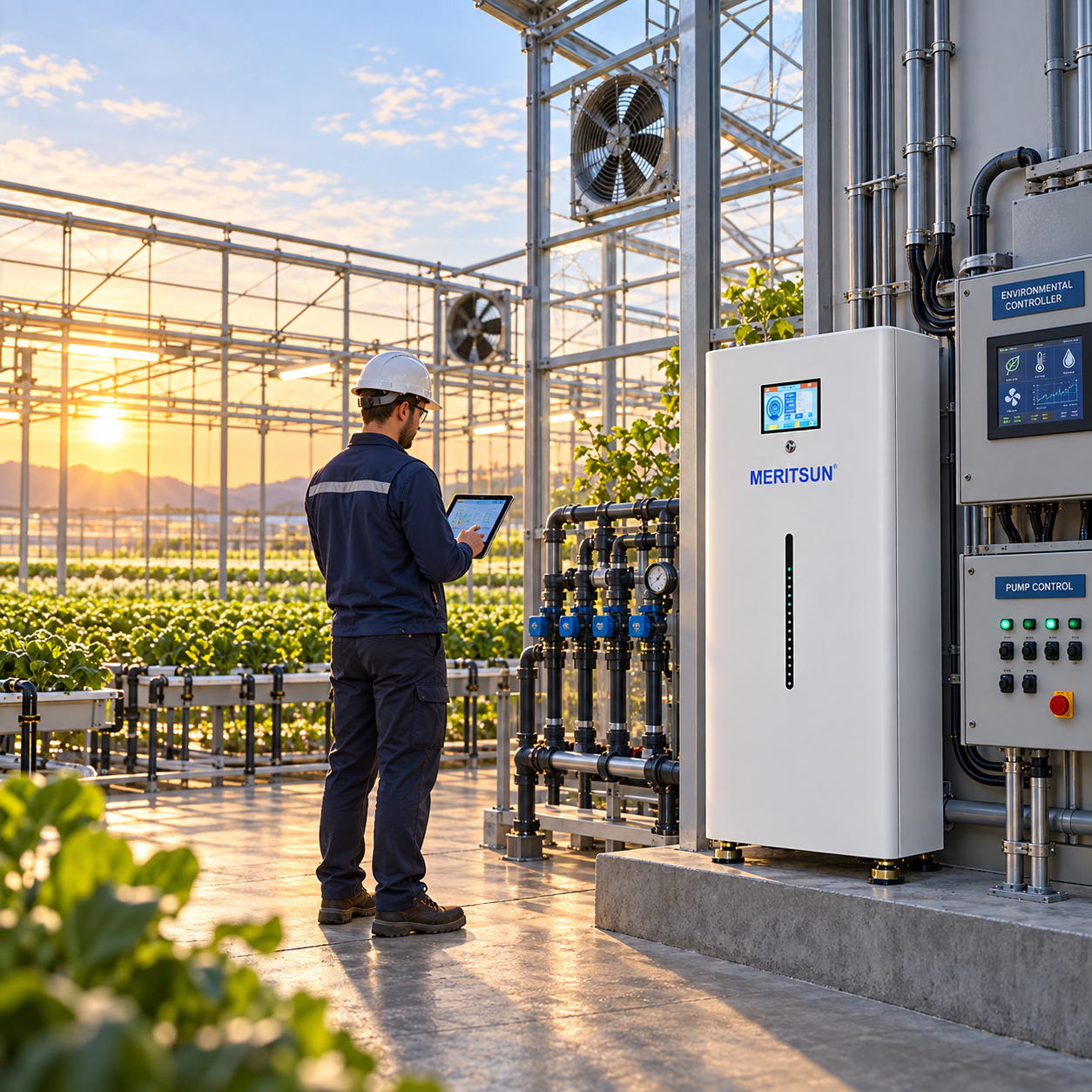
A greenhouse battery backup system should be sized from a time-based load schedule, not from floor area or battery capacity alone. Start with controls, alarms and communications, then add the irrigation, ventilation, heating/cooling and lighting functions that must operate during the design outage.
Calculate required kWh from power, duty cycle and duration. Separately verify inverter continuous output, motor-starting demand, transfer behavior and the consequences of each load being unavailable.
What is greenhouse battery backup?
Greenhouse battery backup is an energy storage system configured to support selected greenhouse functions during grid outages or other defined operating events. The system may work with solar PV, the grid, a generator or a hybrid power architecture.
It is not automatically whole-facility backup. For many projects, the best design protects environmental controls and crop-critical processes while scheduling or shedding high-energy loads.
USDA reporting identifies irrigation, heating, air circulation, ventilation fans and supplemental lighting as important electricity uses in greenhouse production. That mix explains why a single “average kW” value is rarely enough for design.
Divide the greenhouse into load tiers
| Tier | Typical loads | Design objective |
|---|---|---|
| Tier 1 — Controls and visibility | Environmental controller, sensors, alarms, networking, communications, selected security | Maintain decision-making, alarms and control logic |
| Tier 2 — Crop protection | Essential irrigation, circulation fans, vents, selected pumps, freeze/overheat protection | Prevent time-sensitive crop damage |
| Tier 3 — Production support | Supplemental lighting, noncritical pumps, packing or charging loads | Continue selected production when energy is available |
| Tier 4 — Deferrable loads | Loads that can be delayed without immediate crop or safety impact | Shed or schedule during an outage |
The tier assignments must come from the grower's crop, season, climate, process and risk tolerance. A ventilation fan may be Tier 1 on a hot afternoon and Tier 3 on a mild night.
Build a 24-hour outage load schedule
Record when each load operates, not just its rated power.
| Load | Running kW | Start kW/kVA | Duty cycle | Time window | Priority |
|---|---|---|---|---|---|
| Controls/alarms/network | ___ | ___ | ___% | 24 h | 1 |
| Circulation fans | ___ | ___ | ___% | ___ | 1–2 |
| Exhaust fans/vents | ___ | ___ | ___% | ___ | 1–2 |
| Irrigation pump/valves | ___ | ___ | ___% | ___ | 1–2 |
| Heating/cooling equipment | ___ | ___ | ___% | ___ | 1–2 |
| Supplemental lighting | ___ | ___ | ___% | ___ | 2–3 |
| Packing/charging/other | ___ | ___ | ___% | ___ | 3–4 |
Use interval-meter data where available. For motor loads, record the start sequence and whether two or more devices can start at the same time.
Calculate battery energy
For each operating period:
Energy (kWh) = load power (kW) × time (hours) × duty cycle
Then apply the usable SOC window and supported system-efficiency assumptions. Include a design margin based on measurement quality, temperature, aging and operational uncertainty; do not hide that margin inside an unexplained sales figure.
Illustrative 16 kWh calculation
Assume a 16 kWh nominal battery system with:
starting SOC: 95%;
minimum SOC: 15%;
assumed discharge-path efficiency: 92%;
no additional temperature or aging adjustment in this simplified example.
Available AC energy is approximately:
16 × (0.95 − 0.15) × 0.92 = 11.78 kWh
At a measured average protected load of 2.0 kW:
11.78 ÷ 2.0 = 5.89 hours
At 3.5 kW:
11.78 ÷ 3.5 = 3.37 hours
This is an engineering illustration, not a MERITSUN field result. Real performance depends on the exact battery, inverter, settings, environment, wiring, crop-control sequence and changing loads.
Why average load is not enough
Motor starting
Pumps, fans, compressors and motorized vents can create short power peaks. The inverter/PCS, battery current limits, protection and conductors must support the permitted sequence.
Duty-cycle changes
Temperature, sunlight, humidity and crop stage can change fan, irrigation and cooling runtime. Design against the relevant worst operating period, not a mild-day average.
Simultaneous events
An irrigation pump starting while ventilation and cooling are already running can create a very different power requirement from the daily energy average. Sequencing and load controls can reduce coincident peaks.
Transfer performance must be tested
Do not describe a greenhouse system as 0 ms or “uninterrupted” unless the exact inverter/PCS, transfer equipment, controls and tested load support that statement.
Controllers, variable-frequency drives, relays and network devices may respond differently to a short voltage interruption. During commissioning, test grid loss and return with representative operating loads and verify that controls retain settings, sensors remain online, motors restart safely and alarms reach the operator.
Six-step EPC design workflow
Step 1: Define the risk window
Identify the season, weather condition and outage duration that drive crop risk. The same site may need different summer and winter operating plans.
Step 2: Classify loads by consequence
Document what happens if each load stops for 5 minutes, 1 hour, 4 hours or overnight. This turns “backup everything” into an actionable priority plan.
Step 3: Measure the load profile
Collect running power, startup behavior, duty cycle and time-of-day schedule. Confirm which motors may start together.
Step 4: Size power and energy
Calculate kWh for the required duration, then verify continuous kW, surge capability, battery current limits and phase requirements.
Step 5: Plan recharge and extended outages
Model solar production for the design season and define generator interaction if used. Consider what happens on a second cloudy day or before the battery has returned to its target SOC.
Step 6: Commission crop-critical sequences
Test alarms, controls, ventilation, irrigation and the approved restart sequence. Record SOC, loads, operating state and any restrictions.
Load shedding versus battery expansion
| Strategy | Best when | Tradeoff |
|---|---|---|
| Automatic load shedding | Some loads can be deferred during outages | Requires control design and owner acceptance |
| Staged motor starts | Peak demand is driven by simultaneous starts | May change process timing |
| Higher battery energy | Runtime is the main gap | Does not automatically increase inverter power |
| Higher inverter/PCS power | Peak or continuous power is the main gap | Does not automatically increase runtime |
| PV or generator integration | Multi-hour or multi-day resilience is required | Output/fuel and control assumptions must be modeled |
B2B procurement checklist
Before requesting a greenhouse ESS quotation, provide:
project country, grid voltage, phase and frequency;
greenhouse type, crop and operating season;
site single-line diagram;
interval load data where available;
controller, alarm and communications loads;
pump, fan, compressor and motorized-vent ratings;
startup current or measured start profile;
lighting power and schedule;
heating/cooling architecture;
essential-load tiers and permitted shedding;
target outage duration and SOC reserve;
PV capacity, orientation and expected seasonal production;
generator size and interface, if applicable;
proposed inverter/PCS and communication protocol;
installation environment, cable distances and expansion plan;
local approval and certification requirements.
Frequently asked questions
How many kWh does a greenhouse need for backup?
It depends on the protected loads, duty cycles, season and runtime target. A 16 kWh battery may be adequate for one carefully prioritized load set and inadequate for another greenhouse with large ventilation, heating or lighting demand.
Which greenhouse loads should be backed up first?
Controls, alarms and communications are often the starting point, followed by the irrigation, ventilation or temperature-control functions that protect the crop during the specific risk window.
Can a battery run greenhouse heating?
It can support approved electrical loads within the system's power and energy limits, but electric-resistance heating can consume stored energy quickly. Measure the actual heating demand and evaluate load reduction, alternative heat or hybrid backup.
Can solar recharge the system during an outage?
Only if the approved inverter architecture supports it and sufficient solar energy is available. Model seasonal weather and load timing rather than assuming nameplate PV output.
Why test controllers during transfer?
A controller may reboot, lose communications or require manual acknowledgement even when the interruption is brief. The full control chain must be tested.
Can more batteries solve a pump-start problem?
Only if the approved expansion also increases the available power/current and the inverter supports the start profile. More kWh alone may not solve an overload.
Should supplemental lighting remain on during backup?
That is an operational decision. Lighting may be reduced, scheduled or shed to preserve energy for crop-protection loads, depending on crop and outage duration.
What should be recorded at handover?
Record the protected-load schedule, SOC limits, tested grid-loss/return behavior, motor-start sequence, alarm delivery, monitoring access, firmware, protection settings and owner procedures.
Key takeaways
Size greenhouse backup from a time-based load schedule.
Prioritize control and crop-protection functions before deferrable production loads.
Check motor starting and simultaneous demand separately from kWh.
Never claim 0 ms transfer without exact system evidence and load testing.
A strong handover proves the operating sequence and documents limitations.
Project CTA
For a preliminary MERITSUN greenhouse ESS review, send the project country, grid details, load profile, equipment schedule, pump/fan/compressor start data, crop and seasonal risk window, target backup duration, PV system, inverter/PCS preference, SOC reserve and proposed installation location. MERITSUN can then work with the EPC to define a battery-energy range, power requirement and commissioning questions before final quotation.