
IP65 Outdoor Home Battery Installation: What Installers Must Verify Beyond the Rating
Date: 2026-09-15 Categories: Blog Hits: 133
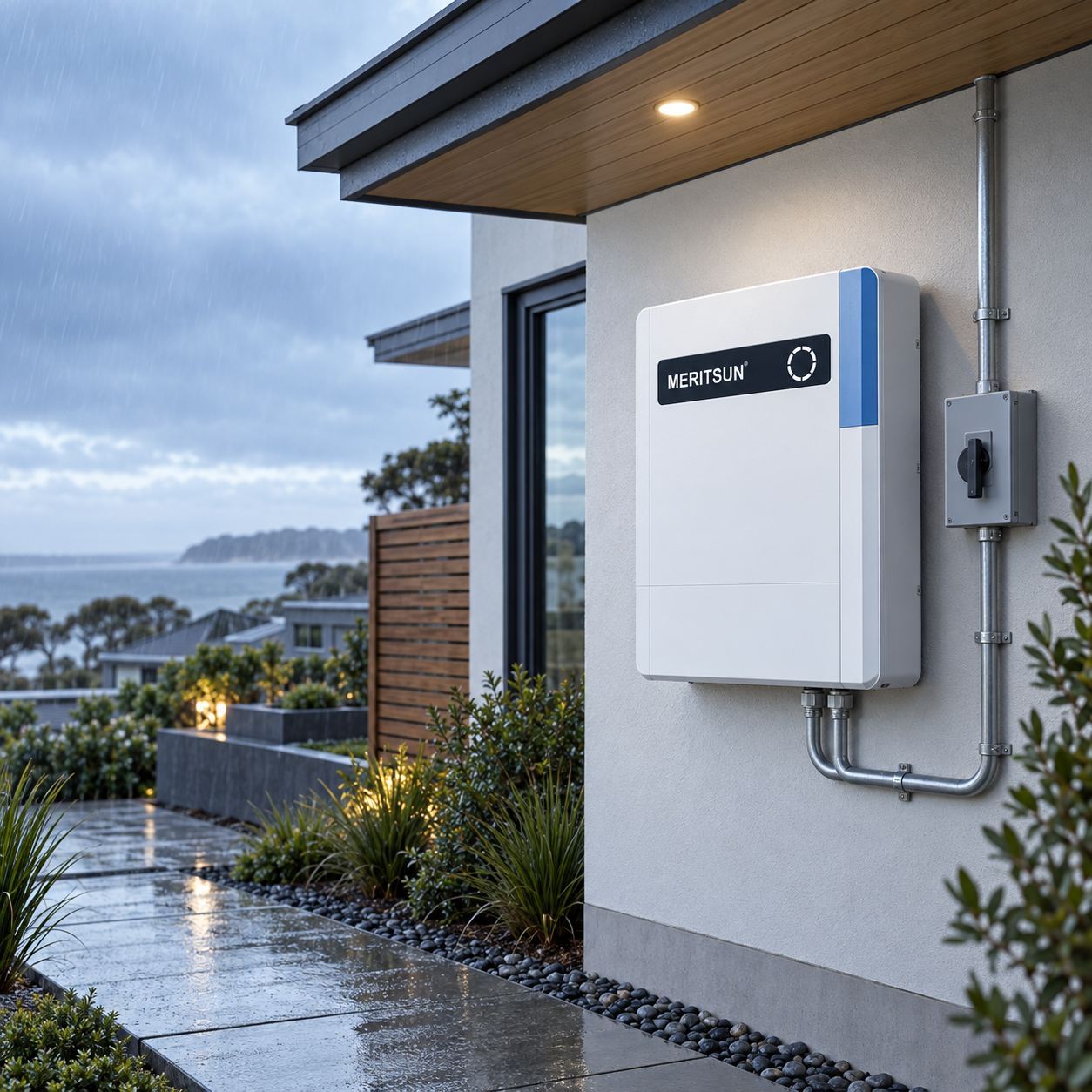
Direct answer
An IP65 rating describes an enclosure's tested protection against dust and water jets. It does not, by itself, approve a battery for flooding, immersion, salt spray, direct sun, extreme temperatures, every mounting surface or every local code environment.
For an outdoor home battery installation, the installer must verify the exact product manual, environmental limits, mounting method, cable-entry system, drainage, clearances, corrosion exposure, inverter compatibility and local approval requirements. IP65 is one input to the site decision—not the complete installation plan.
What does IP65 mean?
The IP code is defined by IEC 60529, which classifies the protection provided by an electrical enclosure against access to hazardous parts, solid foreign objects and harmful water ingress. In IP65, the first digit refers to solid-particle protection and the second digit refers to water protection.
In practical terms, the rating indicates a dust-tight enclosure and protection against water jets under defined test conditions. It does not mean the product is designed for temporary or continuous immersion. Those are separate protection levels.
Installers should use the rating stated for the exact model and configuration. A product-family article, sales image or similar-looking enclosure is not a substitute for the model label and installation manual.
What IP65 covers—and what it does not
| Question | Does IP65 answer it? | What the installer still needs |
|---|---|---|
| Is the enclosure tested for dust ingress? | Yes, within the applicable test definition | Confirm the rating applies to the complete supplied unit |
| Is it protected against water jets? | Yes, within the applicable test definition | Maintain specified covers, seals, glands and mounting orientation |
| Can it be submerged during flooding? | No | Flood elevation, drainage and a location outside known water paths |
| Is it resistant to coastal salt corrosion? | No | Corrosion rating, materials, coating and maintenance requirements |
| Can it operate in full afternoon sun? | No | Operating-temperature limits, derating and shading/ventilation guidance |
| Is the wall strong enough? | No | Structural assessment, anchors and required service clearances |
| Is it approved by the local AHJ? | No | Applicable listing, permits, fire/electrical rules and documentation |
| Will it work with the selected inverter? | No | Approved electrical and communication compatibility |
Why installation location still matters
1. Water paths and drainage
Do not place the battery in a low point, below a roof valley, beside a downspout or where irrigation, roof runoff or stormwater can collect. A wall under an eave may reduce direct weather exposure, but it cannot correct poor drainage.
The finished installation should prevent water from following cables or conduit into the enclosure. Cable glands, conduit fittings, unused openings and service covers must remain consistent with the manufacturer's instructions and the required enclosure protection.
2. Temperature and direct solar exposure
An enclosure rating is not a thermal rating. Direct sunlight can raise enclosure temperature above ambient conditions, while low temperatures can affect charging behavior. Confirm the battery's allowed charge, discharge and storage temperatures, plus any automatic derating or heating functions.
If the manual allows an external shade or canopy, it should preserve ventilation, access, clearances and fire-safety requirements. Do not improvise a sealed cabinet around the battery unless that configuration has been engineered and approved.
3. Coastal and industrial corrosion
IP65 does not establish resistance to salt mist, fertilizer, ammonia, cleaning chemicals or industrial contaminants. Coastal homes, farms and some industrial sites may require additional corrosion evidence, suitable fasteners, compatible conduit and a defined inspection schedule.
4. Mounting surface and access
Confirm wall material, anchor selection, unit weight, seismic requirements where applicable and access for isolation, inspection and replacement. The installer also needs safe working space around disconnects, protection devices and adjacent electrical equipment.
Outdoor, garage or utility room: a comparison
| Location | Potential advantage | Common design questions |
|---|---|---|
| Exterior wall | Preserves indoor space and may simplify some cable routes | Sun, rain path, flood level, vandalism, corrosion, temperature and local setbacks |
| Garage | Weather exposure may be lower | Vehicle impact, egress, fire separation, temperature and AHJ requirements |
| Utility room | Controlled access and shorter integration path in some homes | Ventilation, working space, fire/electrical rules, floor loading and service access |
There is no universally best location. The correct answer depends on the exact listed system, site conditions, building layout and jurisdiction.
Seven-step installer workflow
Step 1: Confirm the exact equipment
Record the battery model, inverter or power-conversion system, approved communication protocol, required protection devices and any permitted parallel configuration.
Step 2: Review manufacturer environmental limits
Check enclosure rating, operating and storage temperature, humidity, altitude, installation orientation, clearances and any indoor/outdoor restrictions.
Step 3: Survey the site
Document sun exposure, rainfall direction, drainage, flood risk, salt or chemical exposure, mounting construction, cable route and physical-security risks.
Step 4: Confirm compliance requirements
For U.S. projects, determine the applicable edition of the electrical, residential, fire and energy-storage requirements adopted by the local authority having jurisdiction. For other markets, identify the local approval path before equipment is ordered.
UL explains that UL 9540 addresses a complete energy storage system rather than treating the battery and inverter as automatically interchangeable components. Product certification and installation approval therefore need to be checked for the intended system configuration.
Step 5: Design the mechanical and electrical installation
Specify anchors, cable entries, disconnects, overcurrent protection, grounding/bonding, conduit, labels and any impact protection. Preserve the manufacturer's enclosure integrity.
Step 6: Commission the system
Verify polarity, torque values where specified, communication, firmware, battery limits, SOC readings, alarms, charging, discharging and transfer behavior. Test only within the approved commissioning procedure.
Step 7: Document handover
Provide the owner with shutdown instructions, monitoring access, alarm response, inspection requirements and the conditions that require a qualified service visit.
B2B procurement checklist
Before specifying an IP65 home battery, request:
exact model and current datasheet;
installation manual and mounting hardware requirements;
proof that the stated IP rating applies to the complete delivered enclosure;
charge, discharge and storage temperature limits;
derating and low-temperature charging behavior;
supported inverter models and communication protocols;
allowed series/parallel architecture;
required protection, disconnect and cable specifications;
applicable system-level certificates for the target market;
corrosion or salt-mist evidence when the project is coastal;
warranty exclusions related to location, weather or installation;
commissioning checklist and after-sales escalation process.
MERITSUN product context
MERITSUN has published an IP65-rated 100 Ah/200 Ah home-storage product and a stackable/wall-mounted IP65 product with Wi-Fi monitoring. Those public pages establish the existence of an IP65 residential product direction, but the exact model, energy, current limits, environmental limits, compatible inverter and certification package must still be verified before a project is quoted.
This article is not a claim that every MERITSUN battery can be installed outdoors.
Frequently asked questions
Is an IP65 battery waterproof?
“Waterproof” is too broad. IP65 indicates protection against water jets under defined test conditions; it does not indicate protection against immersion or flooding.
Can an IP65 battery be installed in direct rain?
Only if the exact manufacturer's instructions allow the proposed location and all other site conditions are satisfied. Good practice still includes avoiding concentrated runoff and known water paths.
Does IP65 cover direct sunlight and heat?
No. Check the product's operating-temperature limits, solar exposure guidance and derating behavior separately.
Is IP65 enough for a coastal installation?
Not necessarily. Salt corrosion is a separate issue. Request material, coating and salt-mist information for the exact model.
Can an installer drill a new cable entry into an IP65 enclosure?
Only when the manual permits it and the approved method maintains the required protection and certification conditions. Unapproved modifications may compromise safety and warranty coverage.
Does the battery rating approve the inverter combination?
No. Electrical ratings, communications and system-level approval must be confirmed for the battery-inverter combination.
Is an IP65 battery suitable for a flood-prone wall?
No enclosure rating should replace flood-risk planning. Locate equipment above expected water levels and outside drainage paths in accordance with project and local requirements.
What should an installer photograph at handover?
Capture the equipment label, mounting, clearances, cable entries, disconnects, protection devices, drainage context, final settings and commissioning results—subject to customer permission.
Key takeaways
IP65 is an enclosure test classification, not blanket outdoor approval.
Flooding, salt, heat, structure, cable entries and local rules require separate checks.
Verify the exact battery-inverter configuration and current documentation.
A defensible handover includes settings, tests, labels and owner instructions.
Use qualified designers and installers for the final site-specific system.
Project CTA
For a preliminary MERITSUN outdoor-installation review, send the project country, grid voltage/phase, site photographs, proposed mounting location, climate and coastal exposure, battery quantity, inverter model, cable distance, PV size, critical loads and required backup duration. MERITSUN can then identify the product information and engineering questions that must be resolved before quotation.