
Project Complete: 48 kWh Whole-Home Storage With Three MSP-6KW Units
Date: 2026-08-06 Categories: Blog Hits: 306
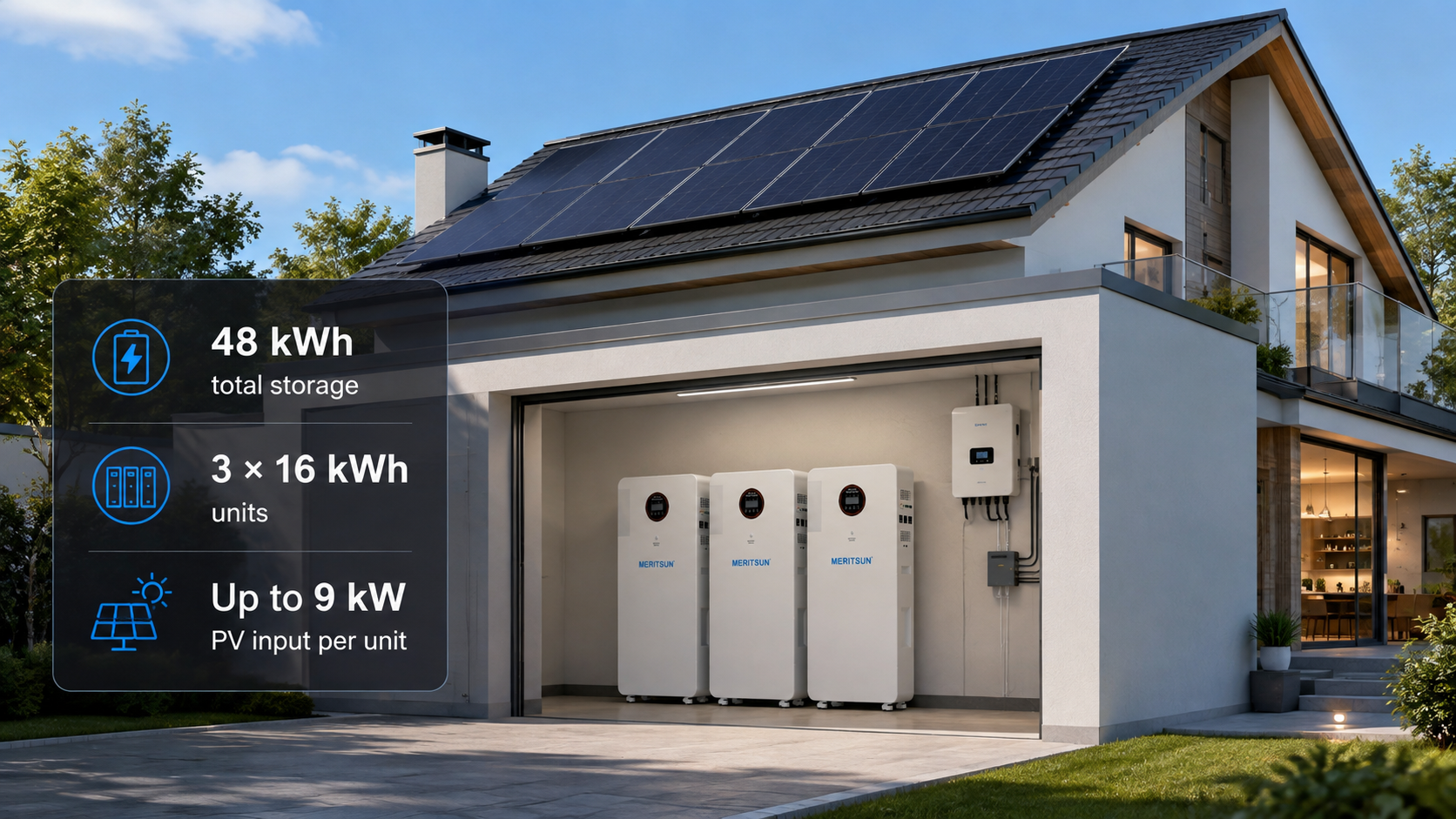
A 48 kWh MERITSUN residential storage system is now in service. The installation uses three MSP-6KW all-in-one units, each pairing a 6 kW inverter/charger with a 16 kWh battery.
The three units do not operate as one paralleled inverter. Instead, the home’s circuits are split across three managed load groups. That gives the household more stored energy and broader backup coverage without routing every circuit through a single 6 kW output.
Delivery, installation, and system handover are complete.
Project Snapshot
| Application | Whole-home residential storage |
| Equipment | 3 × MERITSUN MSP-6KW all-in-one ESS |
| Inverter rating | 6 kW per unit |
| Battery capacity | 16 kWh per unit |
| Total storage | 48 kWh nominal |
| Output architecture | Three independent 6 kW load groups |
| AC output | 220/240 VAC, 50/60 Hz, pure sine wave |
| PV input allowance | Up to 9 kW per unit |
| Status | Commissioned and in service |
The Design Brief
The home needed more than essential-load backup. The system had to cover a wider range of household circuits while keeping large appliances from overwhelming a single inverter.
That called for two things:
- enough battery capacity to carry the home through the target backup window; and
- enough inverter capacity, in the right places, to handle the loads that may run at the same time.
A single MSP-6KW would provide 16 kWh of storage, but every connected circuit would share one 6 kW inverter. Adding two more units raises total storage to 48 kWh and gives the installer three separate inverter outputs to work with.
The result is a zoned system: essential circuits, comfort loads, and higher-demand appliances can be managed independently instead of competing behind one power limit.
Three Units, Three Load Groups
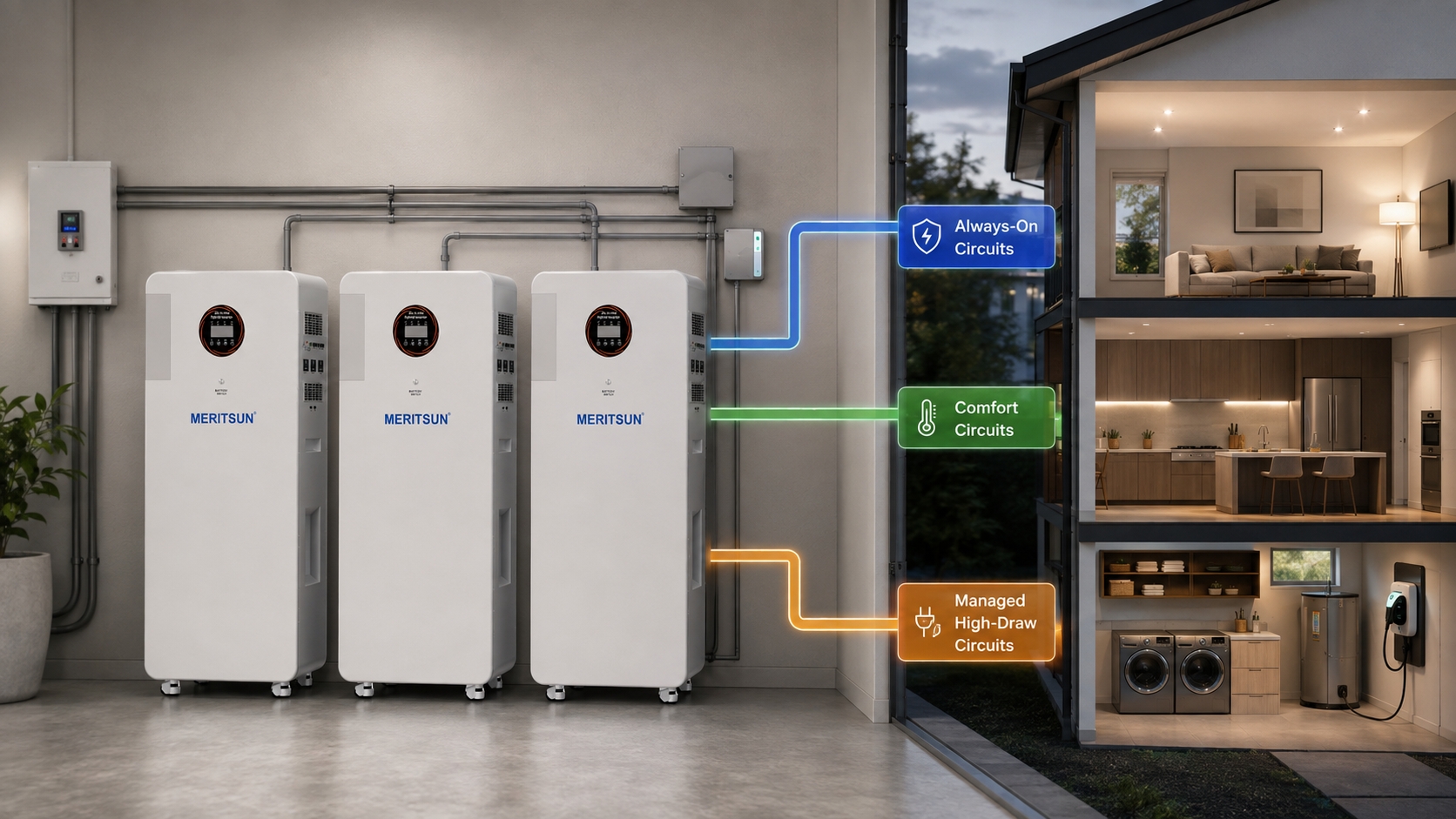
The MSP-6KW is not a parallel-capable inverter, so the installation does not combine the three AC outputs on a common bus. Each unit supplies its own protected load group.
Load Group 1: Always-On Circuits
The first group is reserved for the circuits the home needs most: refrigeration, lighting, internet equipment, communications, controls, and selected outlets.
These loads are generally predictable and relatively modest. Keeping them on a dedicated unit helps preserve backup time and isolates them from the starting current of larger appliances.
Load Group 2: Comfort Circuits
The second group supports selected comfort loads, including fans, living-area circuits, and approved air-conditioning equipment.
Air-conditioning needs to be assessed by more than its running wattage. Compressor startup can be several times higher than normal demand. During commissioning, the largest unit should be started under realistic conditions while the installer watches inverter output, battery current, voltage, and alarms.
Load Group 3: Managed High-Draw Circuits
The third group is used for approved kitchen, laundry, pump, or other higher-draw circuits.
These loads are managed rather than left to run without limits. Staggering a water pump, washing machine, cooking appliance, or other high-demand equipment keeps several peaks from landing on the same inverter at the same time. If battery reserve becomes more important than convenience, this group can be reduced first.
That is what whole-home coverage means in practice: the house remains usable, but the electrical loads still follow a plan.
Why “18 kW Combined” Needs Context
Across the three load groups, the system has 18 kW of combined nameplate inverter capacity. It is not the same as one 18 kW output.
Consider two operating scenarios:
- Group 1 draws 4 kW, Group 2 draws 5 kW, and Group 3 draws 5 kW. Total demand is 14 kW, and all three inverters remain within their 6 kW ratings.
- Group 1 draws 8 kW while the other two groups draw 3 kW each. Total demand is still 14 kW, but the first inverter is overloaded.
Unused capacity on one MSP-6KW does not automatically move to another load group. The installer therefore has to balance both continuous demand and appliance-starting demand across the three outputs.
Each MSP-6KW is rated for 6 kW of continuous output and lists 8,000 VA of instantaneous power. Before handover, the largest motor or compressor on each output should be tested on that output—not just checked against the home’s combined load total.
Turning 48 kWh Into Usable Backup Time
The installed battery capacity is straightforward:
3 × 16 kWh = 48 kWh nominal
Usable energy is lower than the nominal rating because the system retains an SOC reserve and loses some energy during DC-to-AC conversion.
For a planning estimate, applying a 75% operating window and the MSP-6KW’s stated 93% peak battery-to-inverter efficiency gives:
48 kWh × 0.75 × 0.93 = approximately 33.48 kWh at the AC loads
| Average demand across the home | Planning estimate |
|---|---|
| 1.5 kW | About 22.3 hours |
| 3 kW | About 11.2 hours |
| 4 kW | About 8.4 hours |
| 6 kW | About 5.6 hours |
| 9 kW | About 3.7 hours |
| 12 kW | About 2.8 hours |
A house rarely draws the same power continuously. Refrigerators cycle. Air conditioners turn on and off. Pumps may run for only a few minutes at a time. Solar production may also carry part of the daytime load.
The runtime table is therefore a planning tool, not a fixed operating promise. The more useful metric after handover is each unit’s actual energy throughput over a normal day and during a controlled backup test.
SOC Is Managed by Load Group
The installation has 48 kWh in total, but the three batteries are not one shared energy pool. Each unit supports its own circuits and reaches its reserve based on the demand of that group.
The operating strategy reflects that:
- The always-on group keeps the highest reserve.
- The comfort group can use a wider SOC window when energy is available.
- The high-draw group is the first to be curtailed when the system needs to extend backup time.
This arrangement prevents a discretionary appliance from using the energy intended for refrigeration, lighting, communications, or controls.
It also gives the installer a clear diagnostic signal. If one unit reaches low SOC much earlier than the others, the associated load group is consuming more energy than expected. The circuit schedule or operating rules can then be adjusted.
Solar Input for a Three-Unit System
Each MSP-6KW accepts up to 9 kW of PV input. The electrical limits for each unit are:
- 500 VDC maximum open-circuit voltage;
- 60–450 VDC MPPT operating range; and
- 27 A maximum PV input current.
Each inverter needs its own compliant string design. Module count cannot be selected from array wattage alone. String Voc at the lowest expected temperature must remain below 500 VDC, normal operating voltage must stay within the MPPT range, and total input current must remain within 27 A.
Solar production can change the backup picture significantly. During the day, PV can supply part of the live household demand and reduce the energy drawn from the batteries. If production exceeds the assigned load, it can also begin restoring battery SOC before the AC source returns.
The three PV inputs should still be treated as three engineered inputs. They should not be tied together or assumed to share one array unless the final wiring design and product documentation specifically support that arrangement.
Installation Details That Matter
Each cabinet weighs 122 kg, bringing the three-unit equipment total to 366 kg. The installation area has to accommodate the weight, delivery path, working space, and long-term service access.
The MSP-6KW enclosure is rated IP21, so the units belong in a dry, protected indoor space. Ventilation openings and connection panels must remain clear, and the displays, battery switches, communication ports, and isolation points must be accessible without moving another cabinet.
The wheels and handles help with final positioning, but they do not make the units portable household appliances. Once in place, the cabinets need a stable surface and the securing method specified for the site.
With three cabinets in one project, cable routing also deserves early attention. AC input, AC output, PV, grounding, and communication cabling should remain identifiable and serviceable rather than crossing between units without a clear route.
AC Distribution and Transfer
The MSP-6KW is used here as a non-export inverter/charger. Each unit has a defined AC input and a separate protected output feeding its assigned circuits.
The distribution design has to address:
- input and output isolation;
- breaker and conductor ratings;
- neutral switching and bonding;
- protective-earth continuity;
- transfer behavior when the AC source fails;
- load-shedding controls; and
- reconnection when the source returns.
Keeping the three output paths separate is essential. It prevents an overload or fault on one group from creating an unintended path through another inverter output.
Commissioning and Handover
Powering up the cabinets is only the first step. A three-unit system has to be commissioned at two levels.
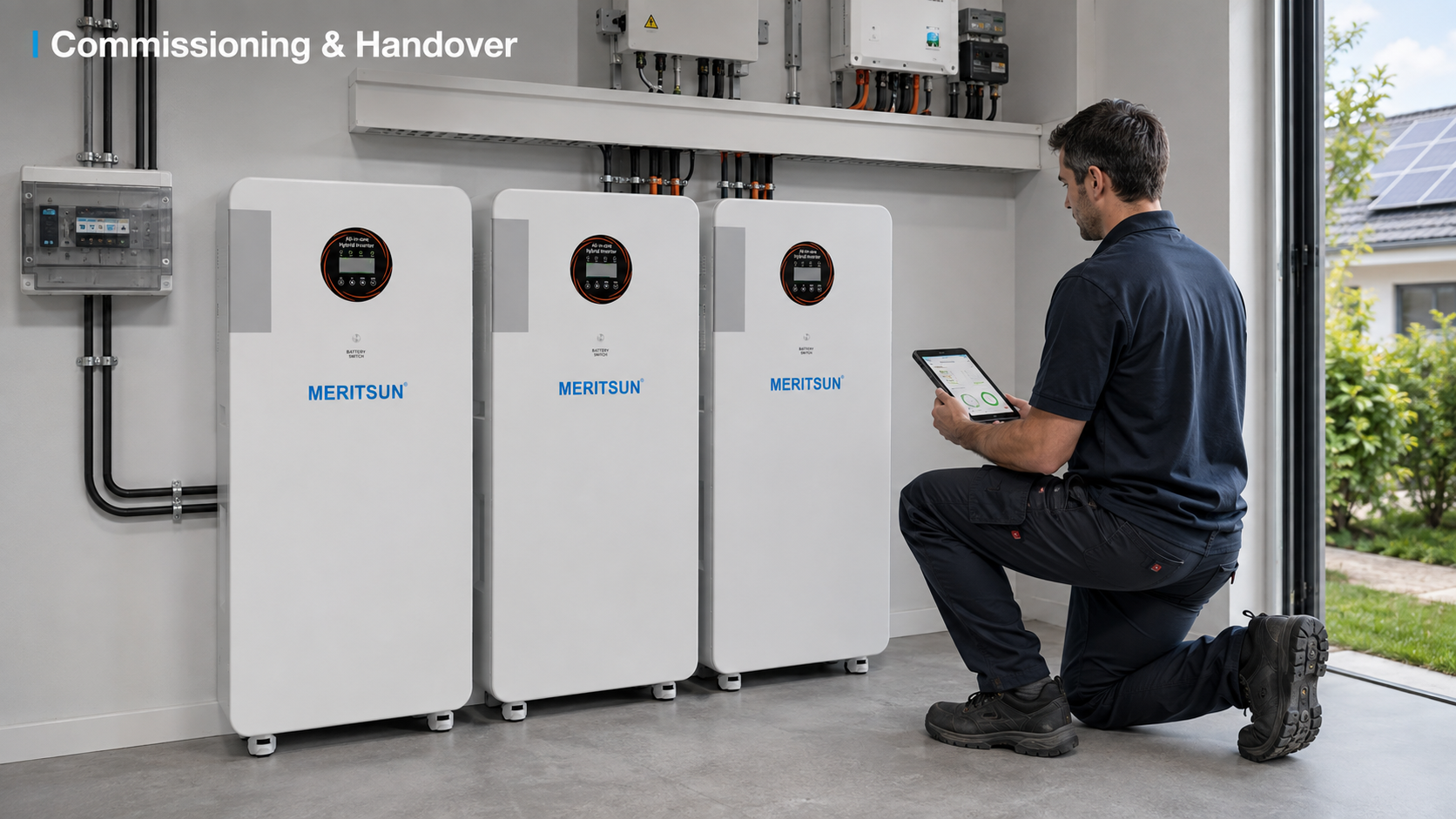
Unit-Level Checks
Each MSP-6KW is checked on its own for:
- AC and PV polarity;
- grounding and neutral arrangement;
- breaker, conductor, and terminal condition;
- PV open-circuit voltage before connection;
- charge-current and source-priority settings;
- low-SOC behavior;
- alarm, shutdown, and restart operation;
- transfer from AC input to inverter output; and
- startup of the largest assigned load.
Whole-Home Checks
Once the individual units are stable, the installer tests the house under realistic combinations of loads. That includes normal evening demand, air-conditioning startup, operation of high-draw appliances, loss of the AC source, low-SOC load shedding, and source recovery.
The three SOC readings are then compared over the same operating period. A noticeable imbalance shows where the load plan needs work.
The handover is complete when each group stays within its inverter limit, essential circuits retain the intended reserve, high-draw loads follow the operating plan, and the household recovers cleanly when the AC source returns.
The System Now in Service
The finished installation gives the home 48 kWh of nominal storage without forcing every circuit through one inverter.
Essential circuits have a dedicated power path and reserve. Comfort loads can be used when sufficient energy is available. Higher-draw appliances remain part of the whole-home plan, but they operate within a defined schedule instead of consuming battery capacity without priority.
The three-unit layout also makes the system easier to monitor. When one unit carries more power or loses SOC faster, the affected group is immediately identifiable. That gives the installer and homeowner a practical way to refine the system after handover.
The project is now complete and the system is in service.
Questions Installers Often Ask
Why use three 16 kWh systems instead of one?
The three-unit layout provides 48 kWh of storage and three independent 6 kW outputs. It covers more of the home without routing every circuit through a single 6 kW inverter.
Does the home have 18 kW of backup power?
It has 18 kW of combined nameplate capacity across three separate load groups. No single group has access to the full 18 kW.
Can every appliance run at once?
Only if each load group remains within its assigned inverter’s 6 kW continuous rating and approved starting capability. Large appliances may need to run in sequence.
How long will 48 kWh last?
Runtime follows the average load and SOC settings. Using the 33.48 kWh planning estimate, a 3 kW average load represents about 11.2 hours; a 6 kW average represents about 5.6 hours.
What happens when one battery reaches reserve first?
Lower-priority loads on that unit are reduced or switched off. If the same unit consistently reaches reserve early, its load group should be rebalanced.
Can all three units connect to solar?
Yes. Each unit has its own PV input, subject to its 9 kW power, 500 VDC open-circuit voltage, 60–450 VDC MPPT, and 27 A current limits.
Can the units feed power back to the grid?
This configuration is designed for non-export operation. A utility-interactive project requires approved grid-tied equipment and the applicable interconnection design.
Project Takeaways
- Three MSP-6KW units provide 48 kWh of nominal storage.
- The home’s circuits are divided across three independent 6 kW outputs.
- Load allocation matters more than the combined 18 kW headline.
- Essential, comfort, and high-draw circuits follow different SOC priorities.
- Each PV input requires its own string and protection design.
- Commissioning covers both the individual units and the home as a complete system.
- The project is complete and the 48 kWh system is now in service.
Planning a Similar Project?
Send MERITSUN the home’s panel schedule, largest motor or compressor, target backup time, AC service type, PV-module data, installation environment, and operating priorities.
With that information, the system can be sized around the way the home actually uses power—not just its daily kWh total.