
UN 38.3 vs. IEC 62619 vs. UL 1973: A Battery Document Checklist for Distributors and Installers
Date: 2026-09-29 Categories: Blog Hits: 194
Direct answer
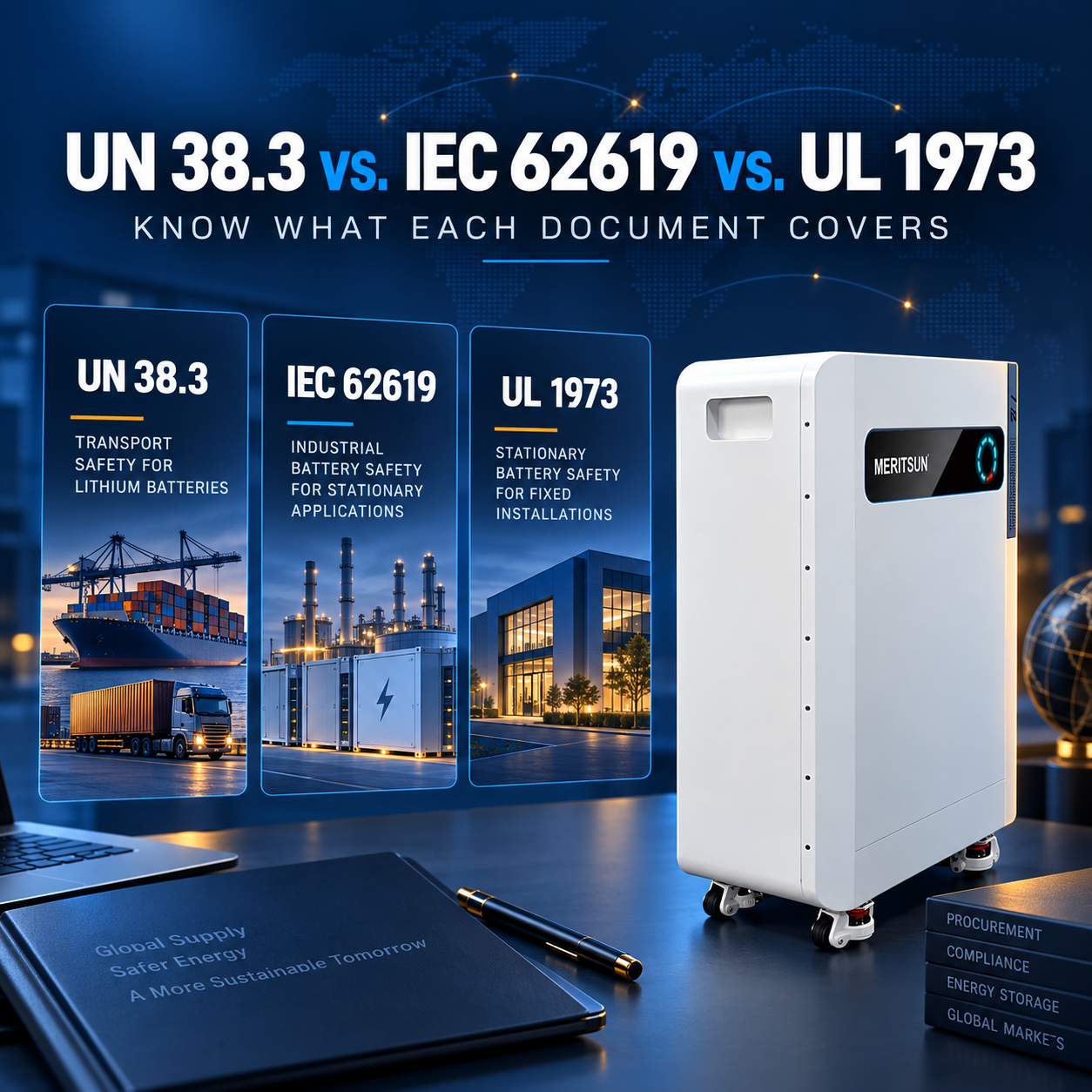
UN 38.3 addresses transport testing for lithium cells and batteries. IEC 62619 specifies safety requirements and tests for secondary lithium cells and batteries used in industrial applications, including stationary energy storage. UL 1973 covers batteries used in stationary and motive auxiliary power applications. These scopes are different, and none of the three alone proves that a complete field-installed ESS is approved for every jurisdiction.
Distributors and installers should verify the exact model, document scope, issuing or testing organization, revision, status and destination-market requirements before ordering or quoting.
Why These Documents Are Frequently Confused
Battery sales materials often place several abbreviations in one line. That makes them look interchangeable even though they answer different questions:
- Can the battery be prepared for transport under the applicable dangerous-goods framework?
- Has the cell or battery been evaluated to a relevant safety standard?
- Is the complete ESS acceptable for the intended installation and jurisdiction?
A transport test does not replace a stationary-product safety evaluation. A battery-level standard does not automatically approve a complete installed system. A certificate for one model does not automatically cover another model with a similar enclosure.
UN 38.3: Transport Testing Scope
Subsection 38.3 of the United Nations Manual of Tests and Criteria addresses lithium cells and batteries in the transport context. The UNECE page for Revision 8 and its 2025 amendment provides the current official publication access and notes changes to subsection 38.3.
UN 38.3 testing is commonly associated with a sequence that evaluates transport-related conditions. For procurement, the practical document is the test summary tied to the product being shipped.
The UN test-summary provisions identify information such as:
- manufacturer identity and contact information;
- testing laboratory information;
- test-report identification and date;
- cell or battery description;
- mass, watt-hour rating and model numbers;
- list of tests and results;
- manual revision used;
- signatory information.
See the official UNECE test-summary text in subsection 38.3.5.
What UN 38.3 Does Not Prove
UN 38.3 is not a universal approval for:
- residential installation;
- inverter compatibility;
- grid interconnection;
- fire-code acceptance;
- warranty performance;
- operation in every climate;
- complete ESS listing.
Treat it as a transport-related requirement, not as the entire safety or installation file.
IEC 62619: Industrial Lithium Battery Safety Scope
The official IEC 62619:2022 scope covers safety requirements and tests for secondary lithium cells and batteries used in industrial applications, including stationary applications such as telecom, UPS, electrical energy storage and emergency power.
For procurement, verify:
- exact standard edition;
- exact certified or tested product model;
- cell versus battery scope;
- certificate holder;
- issuing certification body or laboratory;
- certificate status and supporting report reference;
- whether national or project-specific requirements add other obligations.
What IEC 62619 Does Not Prove
IEC 62619 does not, by itself, prove:
- compliance with every national installation code;
- approval of a specific battery/inverter combination;
- compliance of the complete field-installed ESS;
- transport conformity;
- grid-code approval;
- performance or runtime for a particular load.
It is an important battery-safety scope, but it is not a universal project approval.
UL 1973: Stationary Battery Safety Scope
UL 1973 is titled Batteries for Use in Stationary and Motive Auxiliary Power Applications. The official UL scope includes stationary energy-storage uses such as PV storage, wind storage and UPS applications. UL also states that the standard evaluates the battery system's ability to withstand simulated abuse conditions within the manufacturer's specified charge and discharge parameters; it does not evaluate product performance or reliability in the same way a buyer might interpret those terms. See the UL 1973 official scope.
For a North American project, the procurement team should not stop at the words “UL 1973.” Verify:
- current active edition and certification status;
- product model and covered variants;
- certification organization and listing record;
- installation limitations or conditions;
- relationship to inverter, ESS and fire-test requirements;
- local authority having jurisdiction requirements.
What UL 1973 Does Not Prove
UL 1973 alone does not prove that:
- the battery and selected inverter form a listed complete ESS;
- the installation satisfies all local code and permitting requirements;
- the product passed every system-level fire test that may be requested;
- the product is approved for every indoor or outdoor location;
- the shipping file is complete.
UN 38.3 vs. IEC 62619 vs. UL 1973
| Document or Standard | Primary Question | Typical Procurement Use | Does Not Replace |
|---|---|---|---|
| UN 38.3 | Has the lithium cell/battery completed the applicable transport test sequence? | Transport test summary and shipping file | Product/system installation approval |
| IEC 62619 | Has the industrial secondary lithium cell/battery been evaluated to the applicable safety requirements and tests? | Battery safety evidence for markets/projects using IEC-based requirements | National code, grid approval or complete ESS approval |
| UL 1973 | Has the stationary or motive auxiliary battery been evaluated within the standard's scope? | Battery-level safety evidence for applicable North American projects | Complete ESS listing, site permit or transport file |
This table is a scope guide, not a jurisdictional approval matrix.
Product Certificate, Test Report and System Approval Are Different
The following terms should not be used as synonyms:
- test report: records testing performed and results under a stated method;
- certificate: indicates conformity within a defined scope and status;
- listing or certification record: public or controlled record identifying covered products and conditions;
- declaration: statement by a manufacturer or supplier;
- installation approval: decision by the relevant authority, utility or other project stakeholder;
- complete-system evaluation: applies to the defined ESS combination, not necessarily every component mix.
When a supplier provides only a logo or a one-page screenshot, request the complete evidence needed to identify the exact model and scope.
How to Match Documents to the Exact Battery
Use a model-to-document matrix:
| Field | Product Label | Datasheet | Test Summary | Certificate/Record | Manual |
|---|---|---|---|---|---|
| Manufacturer | |||||
| Model number | |||||
| Electrical rating | |||||
| Hardware revision | |||||
| BMS/firmware relevance | |||||
| Document date/revision | |||||
| Destination-market scope |
Resolve discrepancies before shipment or installation. Similar product names are not enough.
Distributor Pre-Order Document Checklist
- Exact product model and configuration.
- Current datasheet and installation manual.
- UN 38.3 test summary for the shipped battery.
- Applicable certificate and supporting scope.
- Safety data and packing documents where required.
- Inverter compatibility evidence for the exact models.
- Warranty for the destination market.
- Label and serial-number format.
- Packaging dimensions, mass and logistics classification.
- Local installation, permitting and grid requirements confirmed by the responsible project parties.
Frequently asked questions
Is UN 38.3 a residential battery safety certification?
No. It is associated with lithium-cell and battery testing in the transport framework. It does not replace installation or complete-system approval.
Does IEC 62619 replace UL 1973?
No. They are separate standards with different regional and project uses. The applicable requirement depends on the market, product scope and authority or customer specifications.
Is a battery certificate enough to approve a complete ESS?
Not necessarily. The inverter, controls, transfer equipment, enclosure, fire testing, installation method, grid connection and local code may require additional evidence.
How do I verify that a certificate covers my model?
Match the model number, product family definition, electrical rating, certificate holder, standard edition, issuing body, report reference and current status.
What happens if the BMS, cells or hardware revision changes?
The manufacturer and certification body must determine whether the change remains within the evaluated scope or requires review or retesting. Buyers should request current documents.
Which documents are needed for shipping?
Requirements depend on transport mode, battery configuration, packaging and jurisdiction. UN 38.3 documentation is part of the process, but the shipper or dangerous-goods specialist should confirm the complete file.
Who confirms local installation acceptance?
The relevant authority having jurisdiction, utility, electrical professional and other project stakeholders determine local acceptance. Supplier documentation supports that review but does not replace it.
Key takeaways
- UN 38.3, IEC 62619 and UL 1973 answer different questions.
- A transport test summary is not a complete-system approval.
- A certificate must match the exact model and current revision.
- Battery-level evidence does not automatically approve the inverter/battery combination or installation.
- Verify destination-market requirements before ordering, shipping or quoting.
Document Review CTA
Preparing a battery import, distribution or ESS project file? Send MERITSUN the destination country, exact product model, application, inverter, project stage and required standard or tender specification. Request the current documents available for that SKU. Final transport, certification and installation requirements must be confirmed by the responsible logistics provider, authority and project professionals.