
MERITSUN 40.96kWh Home Battery Installation in the United States: 8 x 51.2V 100Ah LiFePO4 Batteries
Date: 2026-07-17 Categories: Blog Hits: 318
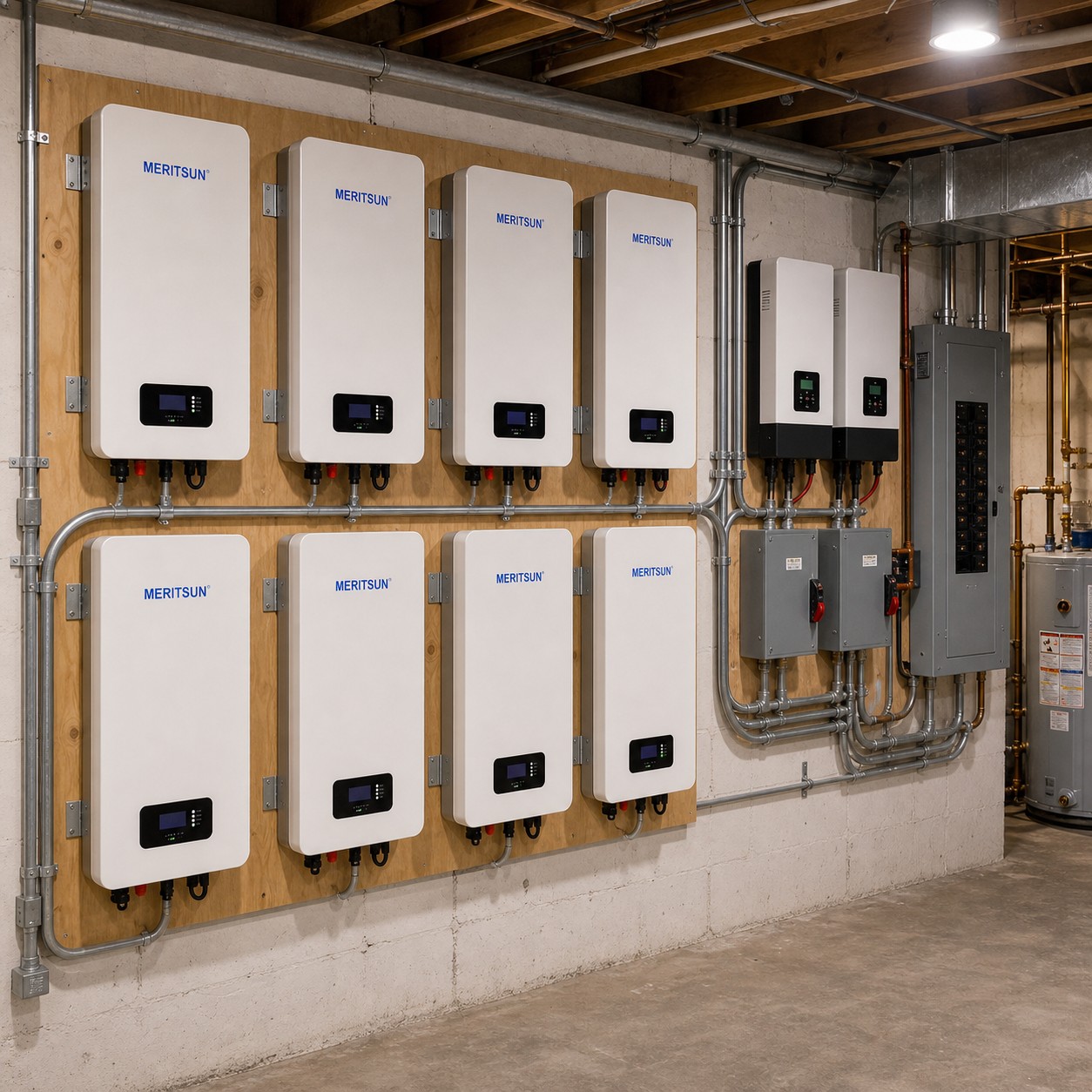
For homeowners who want more than short-duration backup, battery capacity must be planned around real household loads, available solar generation, inverter output and the desired backup window. This installation case shows how eight MERITSUN 51.2V 100Ah wall-mounted LiFePO4 batteries were arranged as a 40.96kWh residential storage bank in a U.S. home.
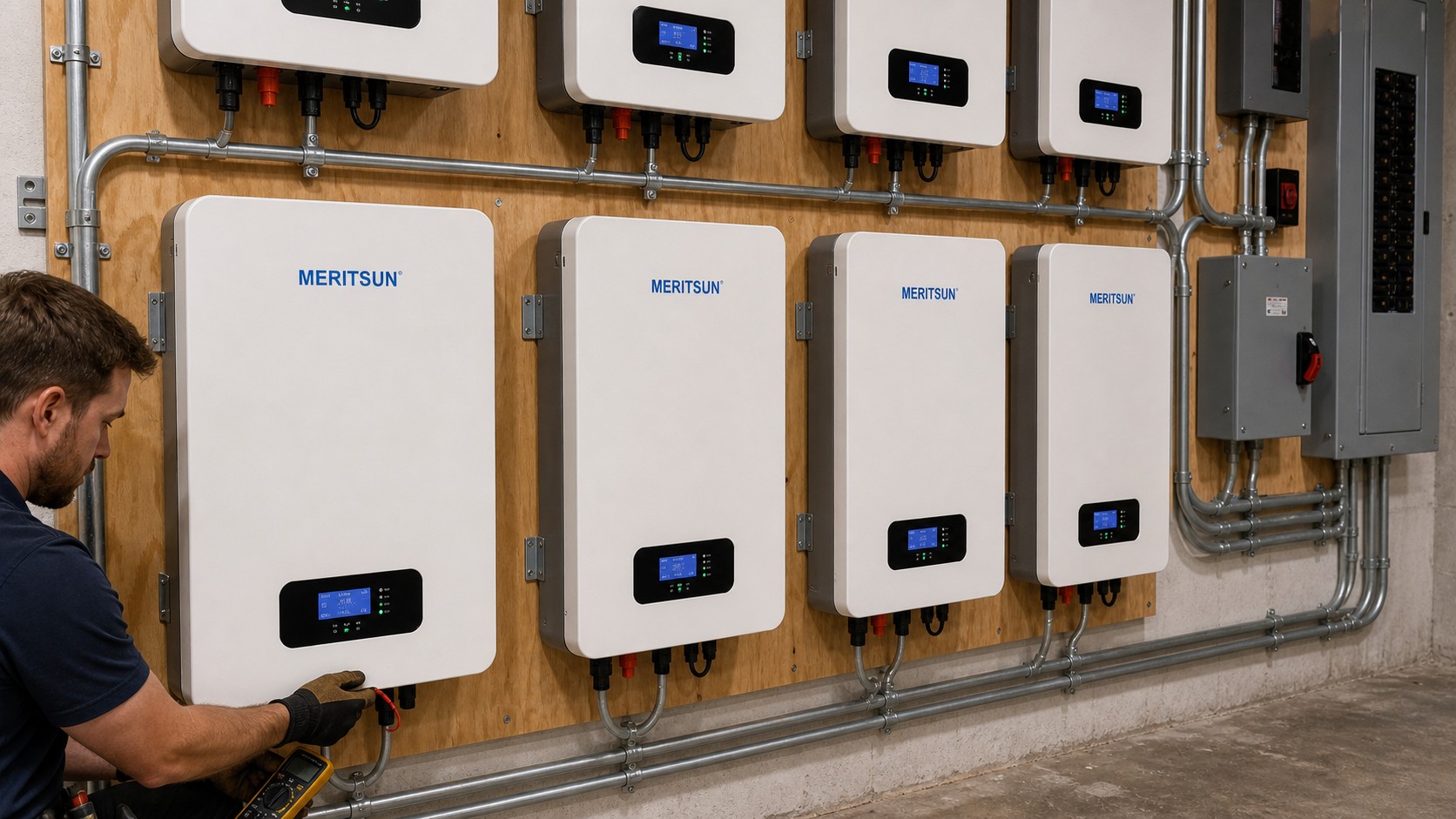
Installed in an unfinished basement mechanical room, the system uses a compact two-row wall layout that keeps the floor clear and leaves the protection equipment, hybrid inverters and service panel accessible. The project demonstrates how a modular battery design can turn an ordinary service space into an organized solar-plus-storage hub without requiring a dedicated outdoor enclosure.
Project Overview
| Location | United States |
| Application | Residential solar self-consumption and backup power |
| Battery | 8 x MERITSUN 51.2V 100Ah wall-mounted LiFePO4 batteries |
| Nominal energy | 5.12kWh per battery; 40.96kWh total |
| Installation area | Basement mechanical room |
| System architecture | Parallel low-voltage battery bank with hybrid inverter equipment |
| Monitoring | Battery LCD indicators and smart BMS communication |
The homeowner's objective was to create a larger reserve for essential circuits while retaining a modular system that could be inspected and serviced easily. Instead of relying on one oversized cabinet, the installer divided the capacity across eight identical 5.12kWh battery modules.
Why Eight 51.2V 100Ah Batteries?
Each 51.2V 100Ah module provides 5.12kWh of nominal energy. Eight modules produce a combined nominal capacity of 40.96kWh. The modular approach gives the project several practical advantages:
- capacity can be matched more closely to the home's load profile;
- individual modules are easier to handle and position during installation;
- the battery bank can be arranged around existing equipment and wall space;
- inspection and maintenance remain straightforward because every module is visible;
- future service work can be organized at module level rather than around one monolithic enclosure.
Actual usable capacity and backup duration depend on inverter settings, depth-of-discharge limits, temperature, battery condition and the loads selected for backup. Installers should size the system from measured consumption and a defined backup-load schedule rather than from total capacity alone.
A Practical Two-Row Basement Layout
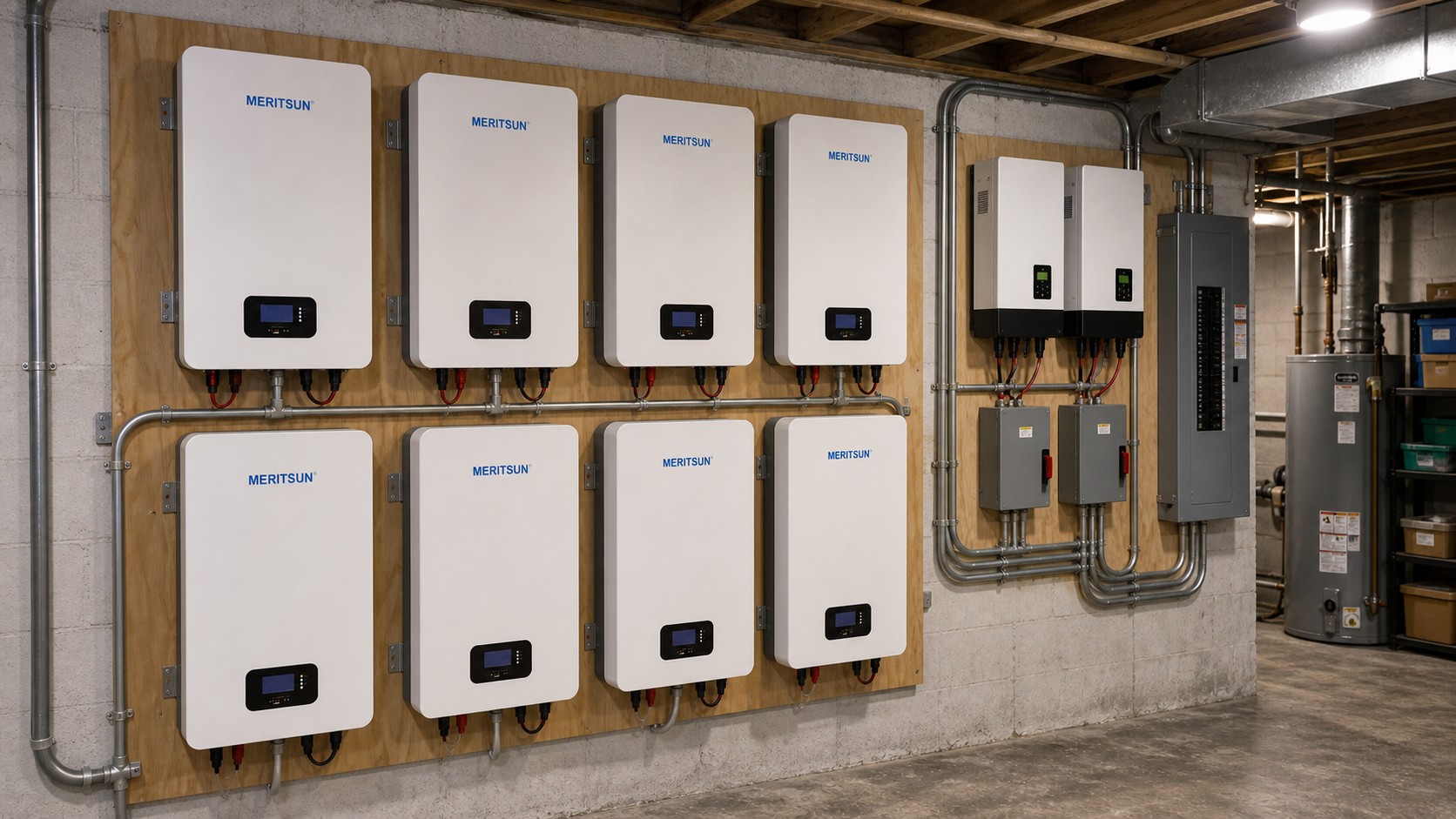
The installation wall was reinforced with plywood panels anchored to the masonry structure. Four batteries were mounted in the upper row and four in the lower row. This created a balanced, easy-to-read layout while keeping adequate space for cable routing and inspection.
The hybrid inverter equipment, disconnects and distribution panel were positioned to the right of the battery bank. Galvanized conduit and surface-mounted boxes suit the unfinished basement environment and protect the wiring from accidental contact. The water heater, HVAC ductwork and storage area remained accessible, so the energy system became part of the existing mechanical room rather than taking over the entire space.
Good residential storage design is not only about neat appearance. Clear equipment separation helps technicians identify the DC battery path, inverter connections, AC protection and communication wiring during commissioning or later service.
Product-Level Monitoring and Smart BMS Protection
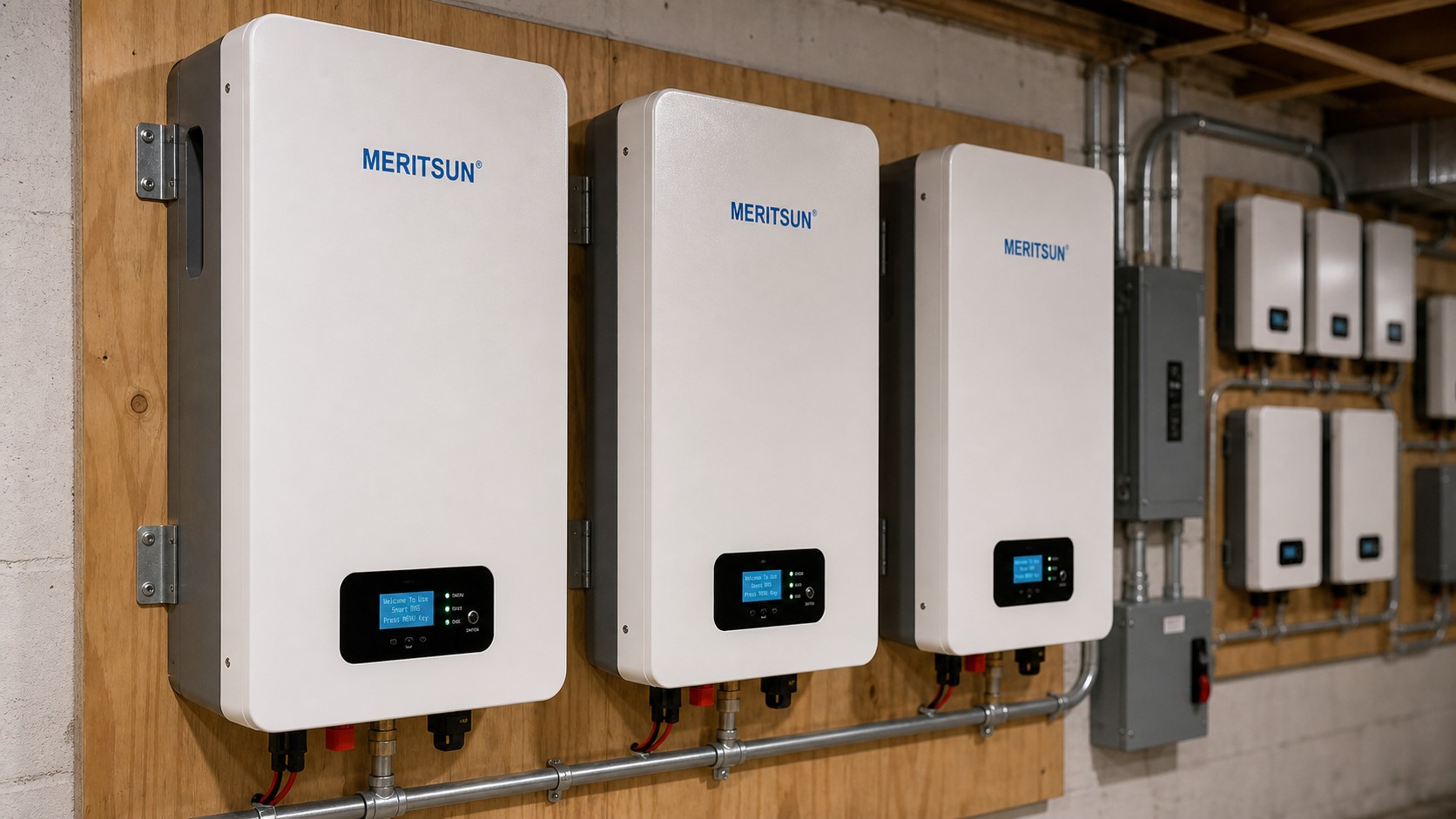
Each MERITSUN battery includes an integrated smart battery management system. The front LCD provides a local status reference, while the communication connection allows the battery bank and compatible inverter system to exchange operating information.
For a multi-battery installation, the commissioning process should verify:
- consistent battery voltage before parallel connection;
- correct polarity and secure terminal torque;
- balanced cable lengths and suitable conductor sizing;
- communication address and master/slave settings where required;
- inverter battery protocol and charging parameters;
- disconnect operation and protective-device coordination;
- normal charge and discharge behavior under a controlled test load.
The illuminated displays shown during commissioning give the installer an immediate visual check that the modules are powered and communicating as expected.
Designed Around Essential Home Loads
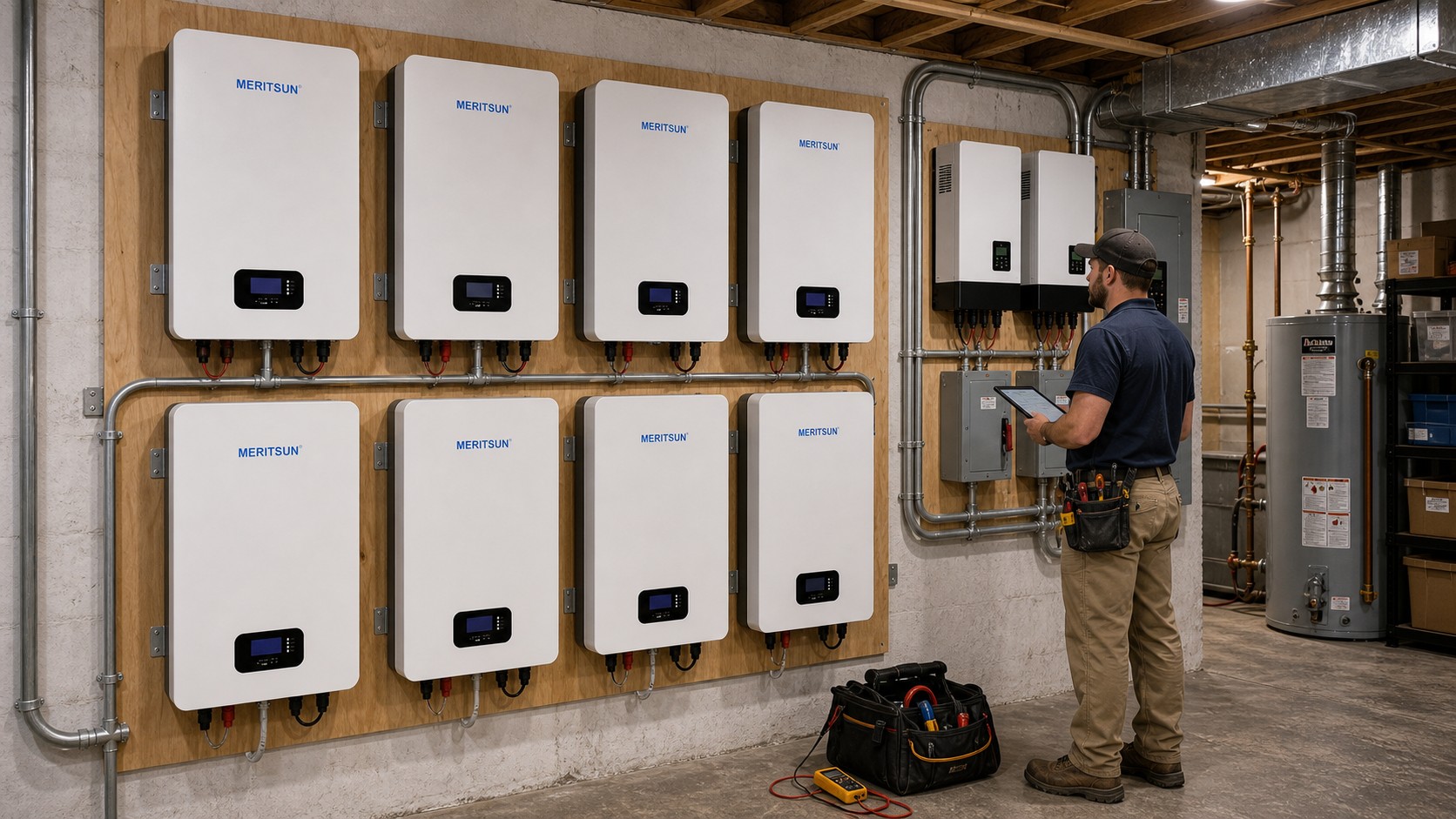
A 40.96kWh battery bank can support a wider backup plan than a small single-module system, but the quality of the load plan remains critical. In this project type, the priority circuits may include refrigeration, lighting, communications, selected receptacles, a well or sump pump, home-office equipment and other essential services.
High-demand loads such as electric resistance heating, large air-conditioning systems, EV charging or electric water heating must be evaluated against inverter output and the intended backup duration. Battery energy in kWh and inverter power in kW solve different parts of the design problem; both must be checked.
When paired with a suitably designed PV array, the system can store daytime solar energy for evening use and help maintain essential power during a grid interruption. The exact operating strategy should be configured for the customer's tariff, solar production and backup priorities.
Installer-Focused Design Details
- Modular capacity planning. Eight equal batteries create a clear, repeatable architecture.
- Serviceable wall layout. Every unit, screen and connection point remains visible.
- Protected cable routing. Conduit and enclosures reduce exposure in a shared mechanical room.
- Logical equipment grouping. Batteries, inverters, disconnects and distribution equipment are easy to identify.
- Commissioning access. A technician can test the system without moving unrelated household equipment.
Final spacing, overcurrent protection, conductor sizing, ventilation, mounting method and working clearances must follow the battery and inverter manuals as well as applicable local electrical and fire requirements. Installation and commissioning should be completed by qualified professionals.
The Result: Scalable Residential Energy Resilience
This U.S. installation shows how eight MERITSUN 51.2V 100Ah wall-mounted batteries can form a clean 40.96kWh residential storage system in a realistic basement environment. The finished project combines substantial battery capacity with a layout that remains understandable, accessible and ready for long-term service.
For solar installers, EPCs and distributors, the same modular approach can be adapted to different household load profiles and available installation spaces. MERITSUN supports residential storage projects with LiFePO4 battery options, smart BMS monitoring and scalable configurations for hybrid and off-grid applications.
Contact MERITSUN to discuss battery selection, inverter compatibility and project-specific storage sizing for your next residential solar installation.