
Home Battery Sizing Guide for Solar Installers: 10kWh, 20kWh and 30kWh Systems
Date: 2026-07-09 Categories: Blog Hits: 625
Choosing the right home battery capacity is not only a sales question. For solar installers, residential EPC teams, energy dealers, and battery distributors, it is a system-design decision that affects backup performance, customer expectations, inverter selection, installation layout, and future expansion.
Many residential solar storage projects are discussed around three common capacity ranges: 10kWh, 20kWh, and 30kWh. These numbers are useful starting points, but they should never replace a real sizing process. A 10kWh battery can be enough for selected essential loads in one home, while another home may need 20kWh or 30kWh because of higher evening demand, longer backup expectations, or a larger solar system.
This guide explains how solar professionals can compare 10kWh, 20kWh, and 30kWh home battery systems using load profile, backup duration, PV generation, inverter output, usable capacity, installation space, and future scalability.
Quick Answer: How Should Installers Choose Home Battery Capacity?
For residential solar storage, 10kWh is often suitable for essential-load backup or entry-level storage, 20kWh is a balanced option for stronger daily solar self-consumption and broader household coverage, and 30kWh is better suited to larger homes or customers with higher backup expectations.
The right capacity depends on the actual load profile, selected backup loads, inverter output, usable battery capacity, solar generation, installation conditions, local electrical code, and whether the system needs to expand later.
In short: choose battery capacity from the project requirements, not from a generic capacity label.
What Home Battery Capacity Really Means
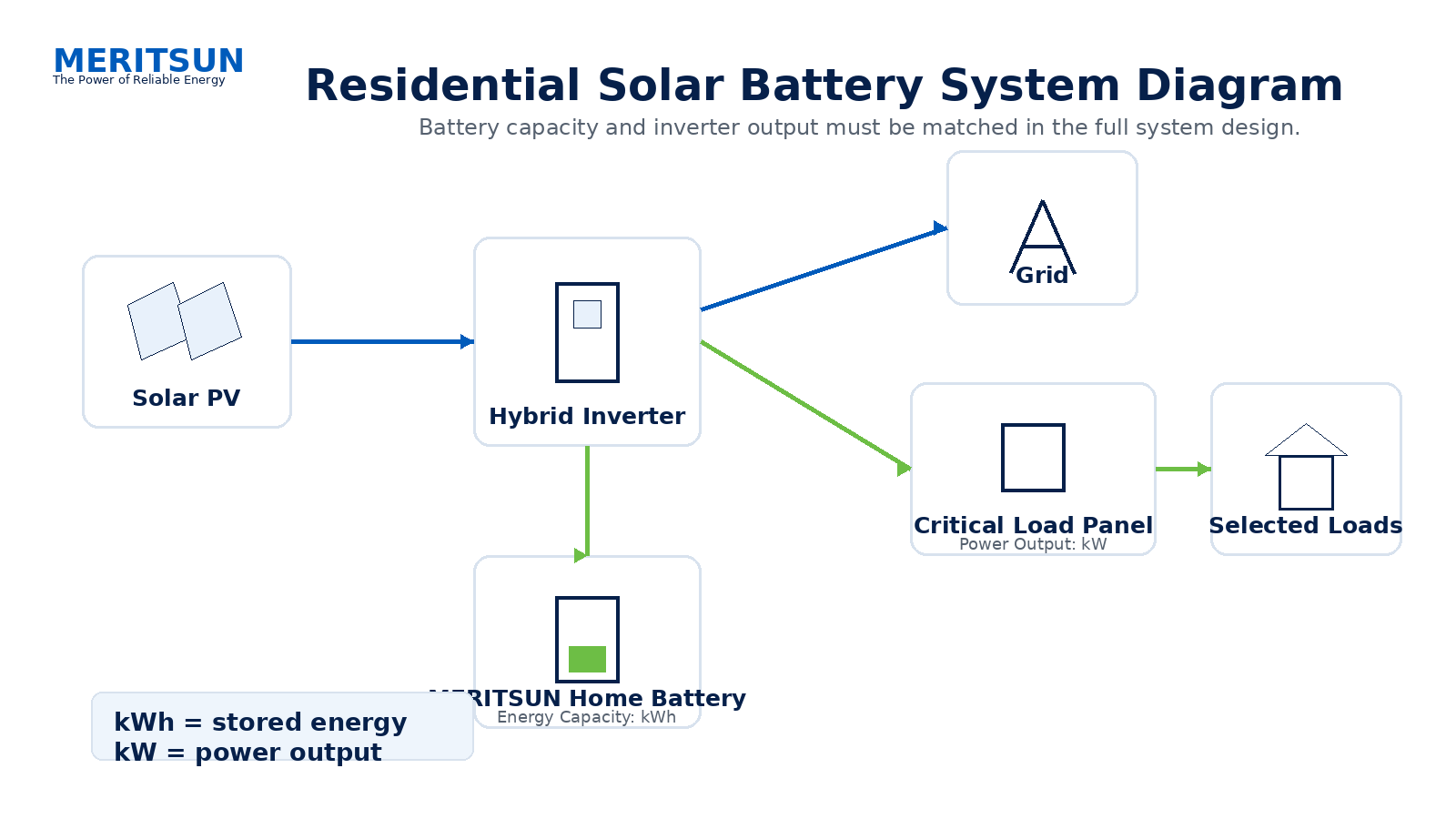
Battery capacity and inverter output must be matched in the full system design.
Home battery capacity is measured in kilowatt-hours, or kWh. It describes how much energy a battery can store. This is different from inverter output, which is measured in kilowatts, or kW, and describes how much power the system can deliver at one time.
This difference matters in real projects.
A battery may have enough stored energy for several hours of selected loads, but the inverter still needs enough output capacity to start and run those loads safely. High-power appliances such as air conditioning, water pumps, electric heating, ovens, and some motors may also create surge-load requirements that must be checked separately.
Installers should also distinguish between nominal battery capacity and usable capacity. Usable capacity depends on product specifications, depth of discharge, system settings, battery protection logic, and the state-of-charge reserve configured for backup operation.
10kWh vs 20kWh vs 30kWh Home Battery Systems
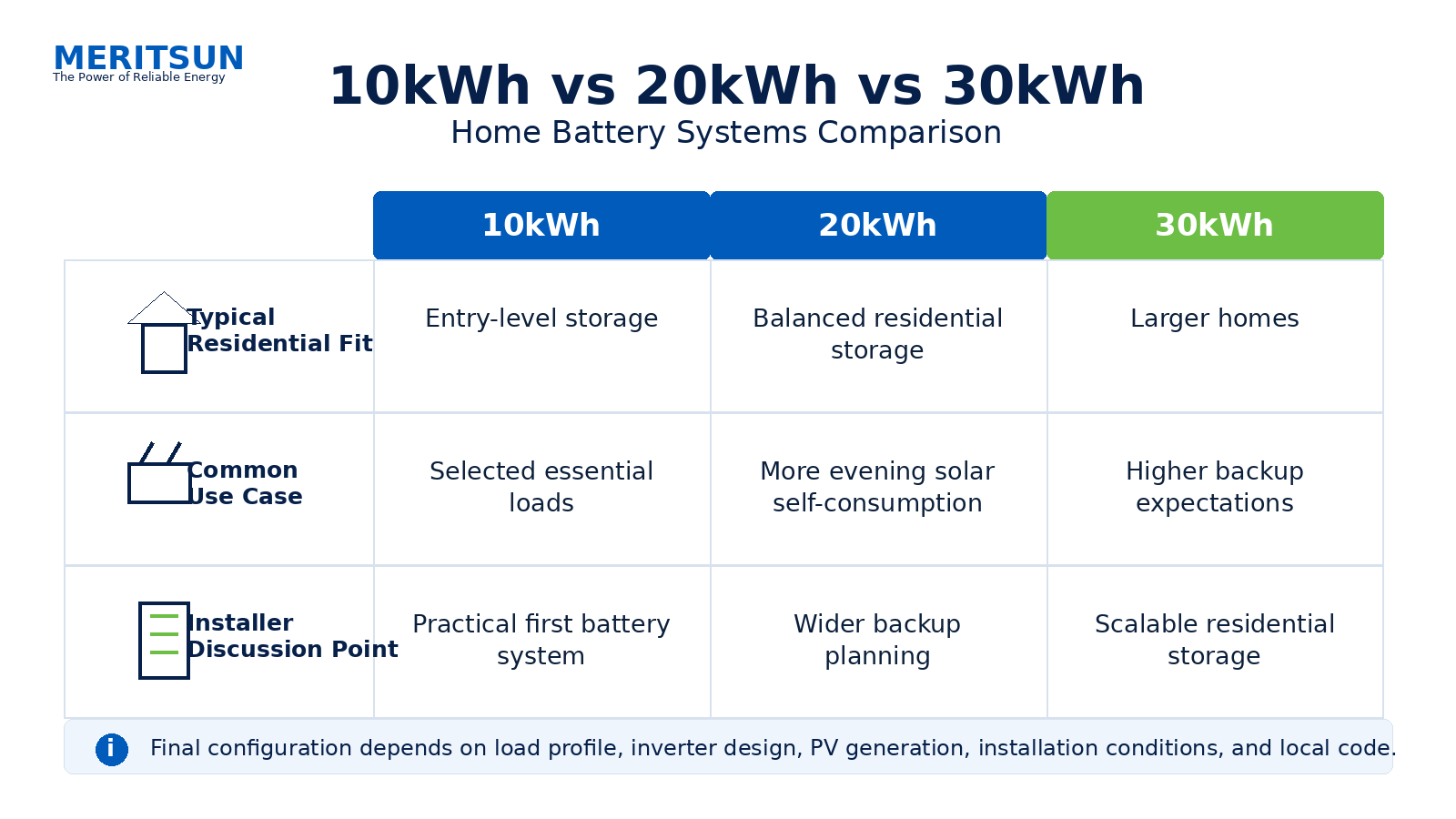
A practical comparison of common residential battery capacity ranges.
The table below gives a practical comparison for early customer discussions. It is not a final engineering calculation.
| Capacity Range | Typical Residential Fit | Common Use Case | Installer Discussion Point |
|---|---|---|---|
| 10kWh | Small to medium homes, entry-level battery storage, essential-load backup | Lighting, refrigerator, Wi-Fi, security system, selected outlets, basic evening use | Best for customers who want a practical first storage system and can define critical loads clearly. |
| 20kWh | Medium homes, higher evening usage, stronger solar self-consumption | More household circuits, longer backup planning, better daily storage use | Often a balanced capacity range for family homes with solar surplus and broader backup expectations. |
| 30kWh | Larger homes, higher backup expectations, scalable residential storage | Wider load coverage, longer reserve planning, future expansion | Suitable when the customer expects more than essential-load support and the PV/inverter design can justify it. |
The most important message for homeowners is simple: a larger battery is not automatically the better system. A correctly sized system is one that matches the load, backup goal, inverter design, PV generation, installation environment, and budget.
A Practical Capacity Sizing Workflow for Solar Installers
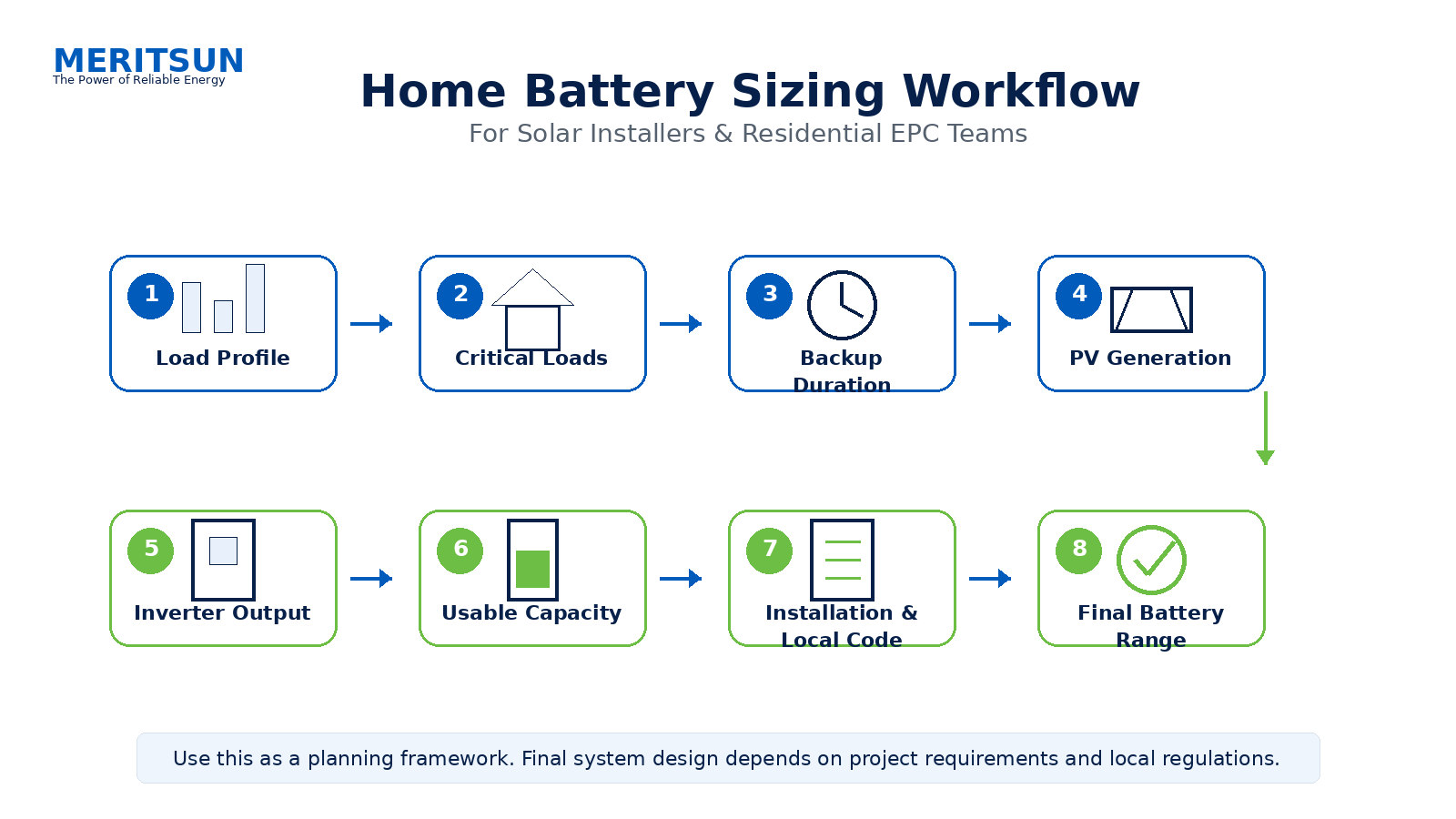
A structured sizing workflow helps installers avoid oversizing and undersizing.
Before recommending 10kWh, 20kWh, or 30kWh, installers should move through a structured sizing workflow.
| Step | What to Check | Why It Matters |
|---|---|---|
| 1. Build the load profile | Daily usage, evening usage, seasonal peaks, large appliances | Shows whether the battery is mainly for daily solar shifting, backup, or both. |
| 2. Separate critical and optional loads | Refrigerator, lights, Wi-Fi, security, pumps, air conditioning, home office loads | Helps customers understand what the battery is designed to support. |
| 3. Define backup duration | Short outage support, overnight backup, extended reserve planning | Backup hours directly affect the required usable capacity. |
| 4. Confirm PV generation | Solar array size, daytime surplus, weather and seasonal conditions | Batteries need enough solar energy to recharge in daily operation. |
| 5. Match inverter output | Continuous output, surge capacity, hybrid/off-grid mode, communication | Battery kWh alone does not determine what loads can run. |
| 6. Check usable capacity and reserve | DoD, SOC reserve, BMS settings, product specifications | Nominal capacity and usable operating capacity are not always the same. |
| 7. Review installation conditions | Wall space, utility room, ventilation, cable route, service access | Physical layout affects installation quality and future service. |
| 8. Plan expansion | Additional modules, inverter limits, communication, protection devices | Helps customers choose a system that can grow with future loads. |
| 9. Follow local code | Electrical protection, labeling, isolation, inspection, qualified installation | Final design must comply with local regulations and site requirements. |
Planning a residential solar storage project? Send MERITSUN the customer's load profile, inverter plan, target backup duration, and preferred capacity range to request technical specifications and configuration support.
When a 10kWh Home Battery Makes Sense
A 10kWh home battery is often a practical starting point for essential-load backup and entry-level residential solar storage.
This capacity range may be suitable when the customer wants to support selected loads such as lighting, refrigeration, internet equipment, security devices, small electronics, and basic household circuits. It can also work well when installation space is limited or the customer wants a first battery system before considering future expansion.
For installers, the key is to frame 10kWh correctly. It should be explained as a focused storage option for defined loads and realistic backup expectations, not as a universal whole-home solution.
Before recommending a 10kWh battery, review:
- Which loads must stay powered
- Whether the customer expects air conditioning, pumps, or heavy appliances
- How long backup support is expected
- Whether the inverter can support the selected loads
- Whether future battery expansion is required
When a 20kWh Home Battery Is a Better Fit
A 20kWh home battery system is often a stronger fit for homeowners who want more than basic backup. It can support a wider set of household loads and provide more flexibility for daily solar self-consumption.
This capacity range is useful when the home has higher evening demand, when the solar array produces meaningful daytime surplus, or when the customer wants a practical balance between system size and household coverage.
For installers and dealers, 20kWh is often easy to position as a balanced residential storage package. It helps customers understand that the system is designed not only for backup planning, but also for making better daily use of rooftop solar generation.
The 20kWh modern family home case uses 2 x MERITSUN 10kWh home battery units, providing 20kWh total nominal storage. This type of configuration is useful for explaining how two modular battery units can support a more flexible residential storage plan.
When to Recommend a 30kWh Home Battery System
A 30kWh home battery system is usually considered when customers expect broader backup planning, longer reserve time, higher evening usage, or future scalability.
This capacity range may be suitable for larger homes, homes with more critical circuits, households with home offices or higher comfort loads, and solar projects where the PV system can provide enough energy to support meaningful battery charging.
However, 30kWh should still be justified by the system design. Installers should review inverter output, surge loads, protection devices, installation space, communication compatibility, and local code requirements before presenting a 30kWh system as the right choice.
The MERITSUN 30kWh modern home case uses 3 x MERITSUN 10kWh wall-mounted battery modules, providing 30kWh total storage capacity. This is a clear example of modular residential storage for customers who need larger capacity planning.
Residential Case Matrix for Capacity Conversations
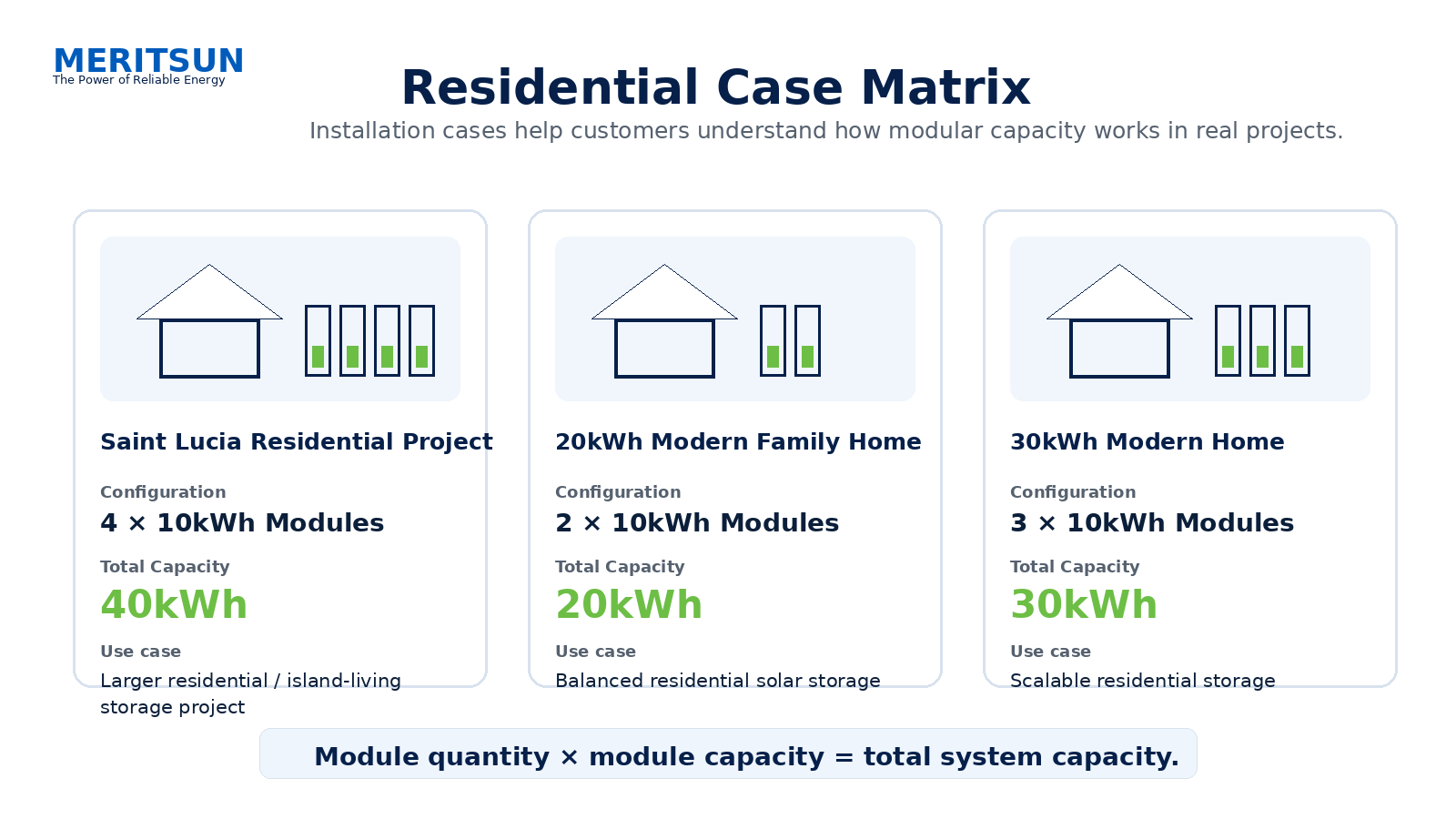
Installation cases help customers understand how modular capacity works in real projects.
Installation cases help customers understand how capacity, load expectations, and modular design work together. They also help installers move the conversation from product size to project fit.
| Reference Case | Configuration | Total Capacity | How It Helps the Customer Conversation |
|---|---|---|---|
| Saint Lucia residential project | 4 x MERITSUN 10kWh wall-mounted home battery systems | 40kWh | Larger residential/island-living storage project built from 10kWh modules. |
| 20kWh modern family home case | 2 x MERITSUN 10kWh home battery units | 20kWh total nominal storage | Balanced residential storage for daily solar self-consumption and backup planning. |
| 30kWh modern home case | 3 x MERITSUN 10kWh wall-mounted battery modules | 30kWh total storage capacity | Scalable residential storage for higher backup expectations and future expansion. |
This matrix also prevents a common mistake: confusing the capacity of one battery module with the total capacity of the installed system.
How MERITSUN Supports Residential Solar Storage Projects
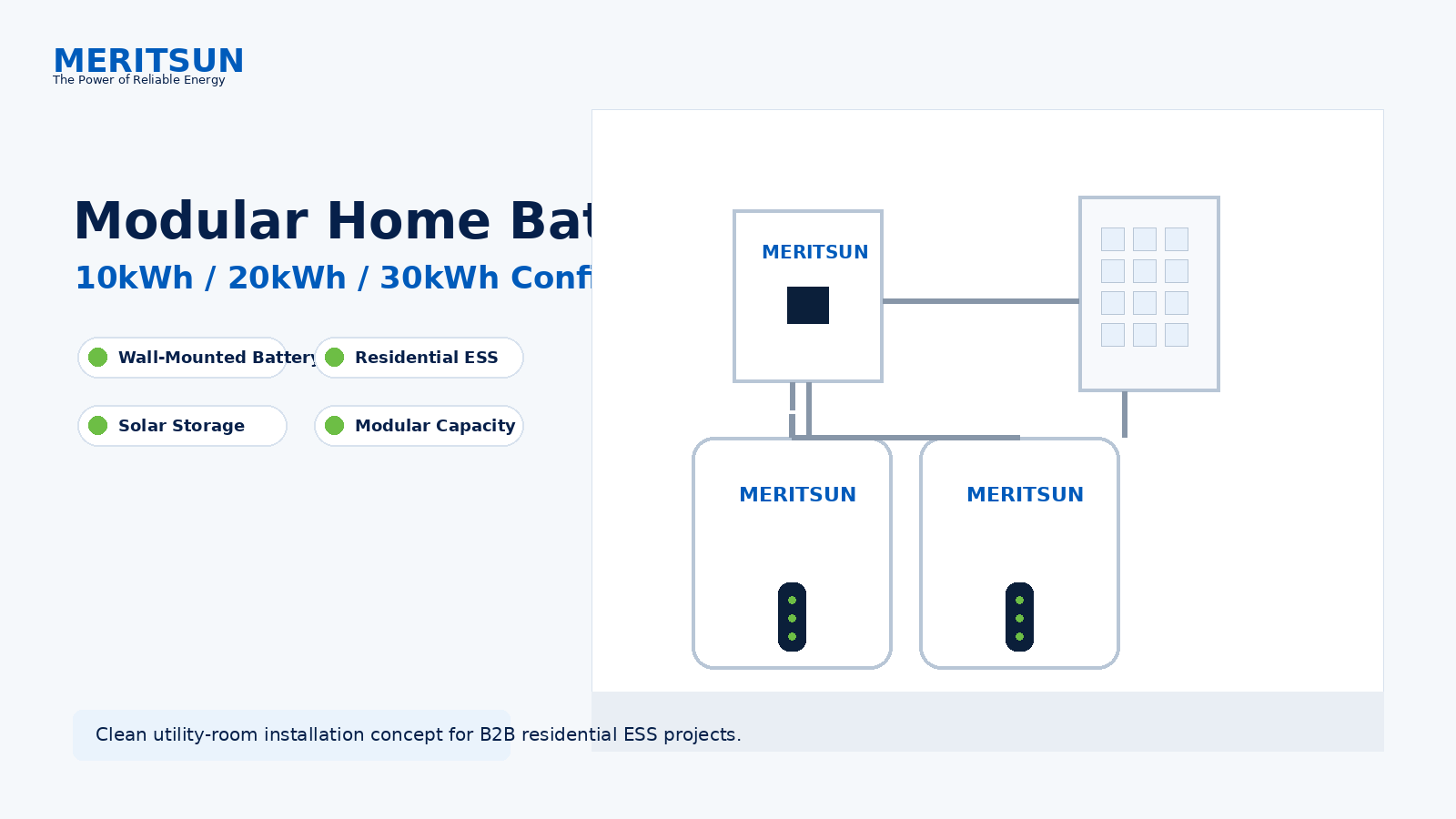
MERITSUN wall-mounted batteries can be configured for different residential storage capacities.
MERITSUN provides LiFePO4 home battery and residential energy storage solutions for solar installers, EPC teams, home energy dealers, and distributors.
For residential solar projects, MERITSUN wall-mounted LiFePO4 home batteries can be used as modular building blocks for different capacity ranges. Installers can use smaller configurations for selected essential loads, balanced configurations for daily solar self-consumption and household backup planning, and larger configurations when customers need broader reserve capacity and future scalability.
Relevant product and solution paths include:
- MERITSUN wall-mounted LiFePO4 home batteries for residential solar storage
- Residential ESS solutions for home solar-plus-storage applications
- Modular Powerpack ESS options for scalable system planning
- Installation case references for explaining real project layouts and capacity choices
Discuss your residential battery project with MERITSUN to request technical specifications, compare suitable configurations, or ask for distributor pricing.
Installer Procurement Checklist
Before choosing a home battery supplier or recommending a final capacity to a customer, solar professionals should check more than the kWh number.
| Procurement Item | What to Review |
|---|---|
| Battery chemistry | LiFePO4 chemistry and safety-related product documentation. |
| Rated and usable capacity | Nominal kWh, usable energy, DoD settings, reserve settings. |
| Inverter compatibility | Supported inverter brands, communication protocol, tested wiring guidance. |
| Scalability | Maximum parallel modules, communication limits, expansion method. |
| Protection design | Breakers, disconnects, BMS protection, labeling, and local code requirements. |
| Installation format | Wall-mounted, floor-mounted, cabinet, rack, indoor/outdoor conditions. |
| Serviceability | Access to cables, disconnects, communication ports, and future maintenance. |
| Documentation | Datasheet, installation manual, wiring diagram, certifications if available. |
| Channel support | Distributor pricing, sample policy, technical response, OEM/ODM options. |
This checklist helps installers reduce project risk and gives distributors a clearer way to evaluate whether a product line is suitable for their market.
FAQ
Is 10kWh enough for a residential solar battery system?
10kWh can be enough for selected essential loads, depending on the customer's load profile, backup duration, inverter output, usable capacity, and system settings. It is often suitable for entry-level storage or focused backup planning.
When should installers recommend 20kWh instead of 10kWh?
Installers should consider 20kWh when the customer has higher evening usage, wants more backup flexibility, has enough solar surplus to charge the battery, or expects the system to support more than basic essential loads.
Is a 30kWh home battery too large for residential projects?
Not always. A 30kWh system can be suitable for larger homes, stronger backup planning, and scalable residential solar storage. It should be recommended after reviewing load requirements, inverter output, surge loads, available space, and local electrical rules.
What is the difference between kWh and kW in home battery sizing?
kWh measures stored energy. kW measures power output. A battery's kWh capacity affects how much energy is available over time, while the inverter's kW output affects what loads can run at the same time. Installers need to evaluate both.
Can home battery capacity be expanded later?
Capacity can often be expanded when the system is designed for modular growth. Installers should review battery compatibility, inverter limits, communication settings, protection devices, available space, and local code before planning expansion.
What information should installers collect before sizing a home battery?
Installers should collect daily electricity usage, critical loads, desired backup duration, solar array size, inverter information, installation location, expansion plans, and local electrical requirements.
Should installers always recommend the largest battery?
No. The best battery capacity is the one that fits the customer's real load profile, backup expectations, PV generation, inverter design, installation conditions, and budget. Oversizing can increase cost and complexity without solving the real project requirement.
Conclusion: Capacity Choice Should Follow Project Logic
Send your project requirements to discuss suitable battery capacity and specifications.
Choosing between 10kWh, 20kWh, and 30kWh is not a one-size-fits-all decision. The right home battery capacity depends on how the customer uses energy, which loads need backup support, how much solar energy is available, what inverter configuration is used, and whether the system needs to expand in the future.
For solar installers, the best capacity recommendation starts with a clear project conversation. Define the loads, confirm the backup goal, check inverter output and surge requirements, review installation space, and then select the battery configuration that fits the project.
MERITSUN supports residential solar storage partners with LiFePO4 home battery solutions, modular capacity planning, product documentation, and B2B support for installers, EPC teams, distributors, and OEM/ODM partners.
Request MERITSUN home battery specifications, ask for distributor pricing, or send your residential solar storage project requirements for configuration review.